In Brief
This glossary defines the technical vocabulary used in TDLAS-based gas analysis, from the spectroscopy fundamentals through instrumentation, performance metrics, and system integration. The definitions are practical rather than academic: they focus on what each term means in the context of specifying, deploying, and interpreting data from an industrial laser gas analyzer.
Background
TDLAS sits at the intersection of laser physics, molecular spectroscopy, and industrial instrumentation. Engineers working with these analyzers come from diverse backgrounds: process control, mechanical engineering, electrical engineering, safety systems, or environmental compliance. Few have formal training in spectroscopy, and the terminology can be a barrier to writing clear specifications, interpreting datasheets, and troubleshooting performance issues.
The terms below are grouped by domain. Where a term has a textbook definition and a practical definition that diverge, the practical meaning in the context of industrial gas analysis takes priority.
Spectroscopy and physics
Absorbance (A): The natural-log ratio of incident to transmitted light intensity, A = ln(I₀/I). In TDLAS, absorbance is proportional to gas concentration, absorption line strength, and optical path length, as described by the Beer-Lambert law.
Absorption line: A discrete wavelength at which a specific molecular species absorbs infrared light. TDLAS targets an isolated absorption line for the gas of interest, chosen to avoid overlap with lines of other species present in the measurement environment.
Absorption spectrum: The complete set of absorption lines for a molecule across a wavelength range. Line positions, strengths, and widths vary with temperature and pressure, which is why TDLAS fitting algorithms must account for process conditions.
Beer-Lambert law: The quantitative relationship linking absorbance to gas concentration, absorption cross-section, and optical path length. This is the physical basis for converting a measured absorption signal into a concentration value.
Line strength: The intrinsic intensity of a molecular transition at a reference temperature (typically 296 K in the HITRAN database). Line strength scales with temperature, which means the analyzer must compensate for temperature variations along the measurement path to maintain accuracy.
Line shape (Voigt profile): The shape of an absorption line as a function of wavelength, resulting from the combined effects of Doppler broadening (thermal motion of molecules) and pressure broadening (collisions between molecules). The Voigt profile is the standard model used in TDLAS spectral fitting.
Pressure broadening: The widening of an absorption line caused by molecular collisions, which increase with pressure. At atmospheric pressure and above, pressure broadening dominates the line shape. The fitting algorithm must account for the actual pressure in the measurement path to retrieve concentration accurately.
Temperature dependence: The variation of both line strength and line width with temperature. In an in-situ measurement through a hot flue gas, the temperature along the beam path directly affects the absorption signal. TDLAS analyzers compensate for this either by using a temperature measurement as an input or by selecting absorption lines with low temperature sensitivity.
Optical depth: Synonymous with absorbance in most TDLAS contexts. The term appears more frequently in path-integrated measurements and atmospheric remote sensing.
Wavelength: The distance between successive peaks of the electromagnetic wave. In TDLAS, the laser wavelength is tuned across the target absorption line by modulating the laser drive current. Target wavelengths for common industrial gases fall in the near-infrared (0.7 to 2.5 µm) or mid-infrared (3 to 12 µm) regions.
Instrumentation and optics
Tunable diode laser: A semiconductor laser whose emission wavelength can be continuously varied over a narrow range by adjusting the drive current and operating temperature. The narrow linewidth (typically MHz to GHz) is much smaller than the width of molecular absorption lines, which enables high spectral resolution and selectivity.
Linewidth (laser): The spectral width of the laser emission. A narrower laser linewidth improves the ability to resolve closely spaced absorption features and reduces fitting uncertainty. In TDLAS, laser linewidths are typically orders of magnitude smaller than the target absorption line, so laser linewidth is rarely a limiting factor.
Photodetector: The optical sensor that converts transmitted laser light into an electrical signal. Detector bandwidth must be sufficient to capture the modulation frequency used in the spectroscopy scheme. Common detector types for near-infrared TDLAS include InGaAs photodiodes; mid-infrared applications may use MCT or InAsSb detectors.
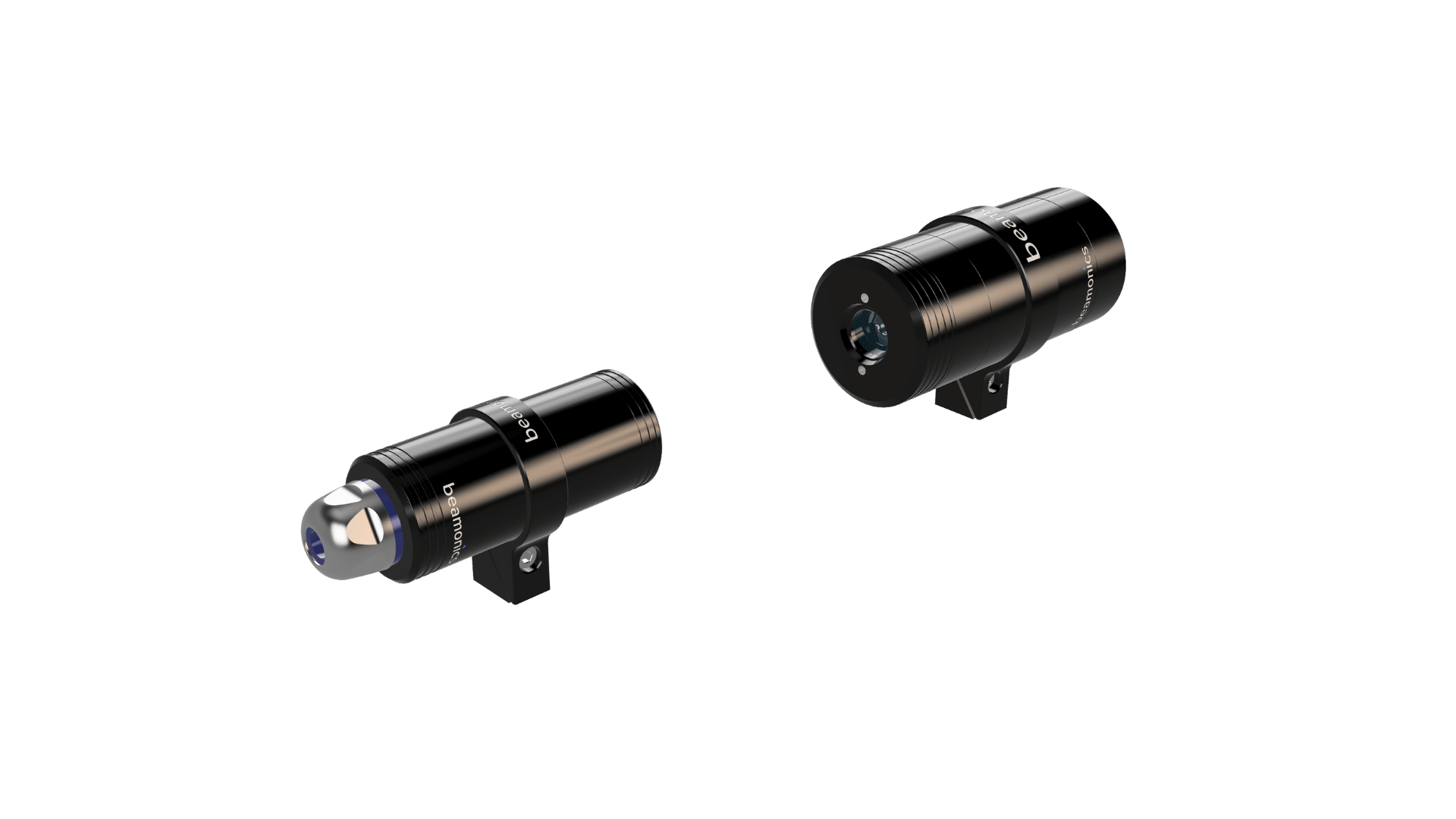
Cross-stack (in-situ) optics: A configuration in which the laser transmitter and optical receiver are mounted on opposite sides of a duct, pipe, or open space. The beam passes directly through the process gas, providing a path-averaged concentration measurement without extracting a sample. The Beamonics BeamStack (BM-H-3) uses this configuration.
Open-path optics: A variant of cross-stack measurement in which the beam traverses an open atmospheric path, typically tens of metres, for perimeter monitoring or area surveillance. The BeamStack supports open-path measurements up to 30 m.
Extractive flow cell: A compact optical chamber through which sampled gas is passed. The optical path length is fixed (0.2 m in the Beamonics BeamCell) and the gas conditions (temperature, pressure, particulate loading) are controlled, providing repeatable measurement conditions independent of the process environment.
Multipass cell: A mirror arrangement that folds the laser beam back and forth through the gas sample multiple times, increasing the effective optical path length within a compact physical volume. Used in some laboratory and field instruments to achieve long effective paths in small enclosures.
Optical path length (OPL): The total distance the laser beam travels through the gas. Longer paths increase the absorption signal for a given gas concentration, improving sensitivity. However, very long paths or very high concentrations can produce absorption so strong that the signal saturates, limiting the measurable range. The BeamStack operates at path lengths from short duct crossings to 30 m; the BeamCell at 0.2 m; the BeamSight at 0.2 to 100 m depending on configuration.
Window purge / heater: Mechanisms for keeping optical windows free of dust deposition and condensation. In cross-stack installations, a low-volume air purge directed across the window face prevents particulate accumulation. Heated windows prevent condensation in high-humidity or temperature-cycling environments. Both are standard practices in industrial TDLAS deployment.
Modulation and detection
Wavelength modulation spectroscopy (WMS): A technique in which the laser wavelength is modulated (dithered) at a frequency f while scanning across the absorption line. The detector signal is demodulated at harmonics of f, most commonly at 2f. The 2f signal is proportional to concentration and is inherently resistant to baseline drift and broadband noise, which is why WMS is the dominant detection scheme in industrial TDLAS analyzers.
Frequency modulation spectroscopy (FMS): A related technique operating at higher modulation frequencies (typically GHz), emphasising phase-sensitive detection for very low noise floors. FMS is used primarily in research instruments rather than in industrial field analyzers.
Lock-in detection: An electronic or firmware technique that extracts the signal component at the modulation frequency (or its harmonics) from the noisy raw detector output. Lock-in detection is the mechanism by which WMS achieves its noise rejection and drift resistance.
Reference cell: A small sealed cell containing a known concentration of the target gas, used to verify that the laser wavelength is correctly tuned to the absorption line. Some TDLAS instruments include an internal reference cell as a continuous wavelength calibration check.
Performance metrics
Detection limit (LDL): The lowest gas concentration (or concentration-path-length product, in ppm·m for open-path instruments) that the analyzer can distinguish from noise at a specified signal-to-noise ratio and averaging time. Detection limits in TDLAS datasheets should always state the associated path length, averaging time, pressure, and temperature to be meaningful. The Beamonics datasheets specify precision under standard test conditions (P = 1 atm, T = 300 K) at stated path lengths and averaging times.
Upper detection limit (UDL): The highest concentration at which the analyzer remains within its calibrated accuracy specification. At very high concentrations, the absorption line saturates (nearly all light at the line centre is absorbed), and the relationship between absorbance and concentration becomes nonlinear. The usable range depends on path length, line strength, and the spectral fitting algorithm.
Noise-equivalent absorption (NEA): The smallest absorbance change that equals the RMS noise level of the detection system, normalised to a 1 Hz detection bandwidth. NEA characterises the fundamental sensitivity of the optical and electronic system independent of gas species or path length. Lower NEA indicates a more sensitive instrument.
Signal-to-noise ratio (SNR): The ratio of the absorption signal amplitude to the noise floor. SNR improves with longer averaging (proportional to the square root of the averaging time), longer optical path, and cleaner optics.
Response time (T90): The time required for the analyzer output to reach 90% of its final value following a step change in gas concentration. In an in-situ TDLAS measurement, T90 is determined by the spectroscopy rate and any output filtering applied. In an extractive measurement, T90 also includes the sample transport time through the tubing. The distinction between instrument T90 and system T90 (including sample transport) is important when specifying performance.
Selectivity: The ability to measure the target gas without bias from other species present in the measurement path. In TDLAS, selectivity is achieved by choosing an absorption line that is spectrally isolated from the lines of expected interferent gases. This is a line-selection and spectral-fitting problem addressed during the analyzer design phase.
Zero drift: The change in analyzer reading over time when no target gas is present. TDLAS minimises zero drift through its self-referencing measurement principle: the concentration is derived from the shape and depth of the absorption feature relative to the local baseline, rather than from an absolute signal level that can shift with optical or electronic changes.
Sampling and deployment
Background gas (matrix): The non-target gases present in the measurement path. Common matrix species in industrial applications include N₂, H₂O, and CO₂. Matrix gases affect the measurement through pressure broadening of the target line and, in some cases, through spectral overlap if the target line is not well-isolated.
Cross-interference: A systematic bias in the reported concentration caused by another gas species absorbing at or near the target wavelength. TDLAS minimises cross-interference through careful line selection and multi-parameter spectral fitting, but it cannot be assumed to be zero for every gas pair in every condition. Datasheets or application notes should specify tested cross-interference levels for the expected matrix.
Condensation: Formation of liquid droplets on optical windows or inside sample tubing. On windows, condensation scatters and absorbs laser light, degrading the signal. In sample lines, it can block flow or alter the gas composition by dissolving soluble species. Prevention methods include window heaters, insulated or heated tubing, and condensation traps upstream of extractive measurement cells.
Purge gas: Clean, dry air or nitrogen directed across optical windows to prevent dust deposition and condensation. Purge flow rates are kept low enough to avoid diluting the gas in the measurement path (in cross-stack configurations) or pressurising the duct.
Hazardous area classification: Certification for operation in potentially explosive atmospheres, governed by ATEX (EU) or IECEx (international) standards. Hazardous area ratings are separate from IP ingress protection ratings. Not all TDLAS analyzers carry hazardous area certification; this must be verified against the classification of the installation zone.
IP rating: Ingress protection classification per IEC 60529, specifying resistance to solid particles and water. The BeamStack and BeamCell are rated IP67 (dust-tight, withstands temporary immersion). The BeamSight is rated IP44 (protected against objects larger than 1 mm and water splashing from any direction).
Units and notation
ppm / ppb: Parts per million or parts per billion by volume. Standard units for expressing gas concentration in a gas-phase mixture.
ppm·m: Parts per million multiplied by metres. The natural unit for path-integrated concentration measurements, reported by open-path and remote stand-off instruments (including the BeamSight). A reading of 100 ppm·m could represent 10 ppm over a 10 m path, 100 ppm over 1 m, or any other combination producing the same product. Converting to a point concentration requires knowledge of the gas distribution along the beam.
vol%: Volume percent. Used for gases present at percent-level concentrations, such as O₂ in air (approximately 20.9 vol%) or CH₄ in biogas (typically 55% to 70% vol%).
T90: Time to reach 90% of a step-change response, expressed in seconds or milliseconds.
Data and integration
Path-integrated concentration (PIC): The product of gas concentration and optical path length, typically expressed in ppm·m. Open-path and remote stand-off instruments report PIC because they measure the total absorption along the beam without knowledge of how the gas is distributed spatially.
Spectral fitting (retrieval): The mathematical process of estimating gas concentration by fitting the measured absorption spectrum to a modelled line shape, accounting for temperature, pressure, and baseline effects. The quality of the spectral fit is a diagnostic indicator: a poor fit may signal optical contamination, unexpected interferent gases, or instrument malfunction.
Validation / verification: A field check to confirm that the analyzer is performing within specification, for example by exposing it to a known reference gas concentration. Verification confirms that the existing calibration is still valid. It is distinct from recalibration, which adjusts the instrument’s response to match a reference. TDLAS analyzers are typically verified rather than recalibrated in the field.
CEMS (continuous emissions monitoring system): An integrated system for measuring and reporting regulated pollutant concentrations from industrial stacks, typically including gas analyzers, sample conditioning (if extractive), data acquisition, and quality assurance protocols. TDLAS may serve as the analyzer for one or more regulated species within a CEMS installation.
HITRAN: A spectroscopic database (High-Resolution Transmission molecular absorption database) maintained by the Smithsonian Astrophysical Observatory. HITRAN provides the line positions, strengths, and broadening parameters used to select target absorption lines and to build the spectral models that TDLAS analyzers use for concentration retrieval.
Closing remark
Consistent use of these terms in specifications, factory acceptance test protocols, site commissioning documents, and operating procedures reduces ambiguity between analyzer manufacturers, system integrators, and end users. Where a datasheet value is quoted without its associated conditions (path length, averaging time, pressure, temperature), the number is incomplete. Asking for the conditions behind the number is the starting point for any meaningful performance comparison.
Related links
- TDLAS platform overview: three configurations from a shared core
- What real-time gas analysis means in practice
- Where TDLAS fits among trace gas analysis methods
- BeamStack (BM-H-3) product page
- BeamCell (BM-H-3) product page
- BeamSight (BM-V-2) product page