In Brief
Tunable diode laser absorption spectroscopy (TDLAS) measures gas concentration by scanning a narrowband laser across a molecular absorption line and quantifying the attenuation of the beam through the gas. The measurement is tied to a physical property of the target molecule, which makes it inherently selective, stable, and free from long-term drift. This article explains the operating principle, the signal processing that extracts concentration from the raw optical signal, and the engineering decisions that determine how well a TDLAS analyzer performs in practice.
Background
Most industrial gas measurement technologies rely on a chemical or electrochemical interaction between the gas and a sensing element: an electrode that oxidises the gas, a catalytic surface that burns it, a reagent that reacts with it. These approaches work, but they share a fundamental limitation: the sensing element changes over time. Electrolytes dry out, catalytic surfaces poison, reactive coatings deplete. The result is drift, which must be corrected by periodic recalibration against a known reference gas.
TDLAS takes a different approach. The gas is not consumed, reacted, or altered. Instead, a laser beam passes through the gas, and the instrument measures how much light the gas absorbs at a specific wavelength. That wavelength corresponds to an energy transition in the target molecule, a property determined by quantum mechanics and recorded in spectroscopic databases. The transition does not change with time, exposure, or sensor age. As long as the laser is tuned to the correct wavelength and the detector can measure the transmitted light, the measurement holds its calibration indefinitely.
This is the core reason Beamonics TDLAS behaves differently from conventional gas sensors in long-term industrial deployment: the reference standard is built into the physics of the molecule rather than into a consumable element that degrades.
The absorption measurement
Beer-Lambert law
The quantitative foundation of TDLAS is the Beer-Lambert law, which relates the attenuation of light passing through a gas to three quantities: the concentration of the gas, the strength of the absorption at the chosen wavelength, and the distance the light travels through the gas (the optical path length).
In mathematical form: A = ln(I₀/I) = α(ν, P, T) × C × L, where A is the absorbance, I₀ is the incident laser intensity, I is the transmitted intensity after passing through the gas, α is the absorption coefficient at frequency ν under pressure P and temperature T, C is the gas concentration, and L is the optical path length.
The absorption coefficient α is not a constant. It depends on the gas species, the specific absorption line chosen, the temperature (which affects the population of molecular energy states), and the pressure (which broadens the absorption line through molecular collisions).
Absorption lines and selectivity
Every molecular species has a unique set of absorption lines, determined by its molecular structure and the quantum-mechanical energy levels of its vibrational and rotational states. The key to TDLAS selectivity is choosing an absorption line for the target gas that does not overlap with lines of other species expected in the measurement environment.
For example, O₂ absorbs in the A-band near 760 nm, a spectral region where common interferents like CO₂ and H₂O have negligible absorption. CH₄ has strong absorption features in the near-infrared around 1.65 µm that can be targeted without interference from water vapour if the line is chosen carefully. HF absorbs strongly at wavelengths where most other industrial gases are transparent, which is why TDLAS achieves exceptionally low detection limits for HF.
Careful line selection is an inherent part of the Beamonics design process, and the analyzers as such offer little to no cross-interference. The choice depends on the target gas, the expected matrix, the operating pressure and temperature, and the available laser technology at the required wavelength. A well-chosen line on an isolated spectral feature provides selectivity that is inherent to the physics rather than dependent on a filter or a chemical separation.
Line shape and spectral fitting
An absorption line is not infinitely narrow. At atmospheric pressure and typical industrial temperatures, the dominant broadening mechanism is pressure broadening: collisions between molecules spread the absorption feature over a range of wavelengths described by a Lorentzian profile. At lower pressures, Doppler broadening from thermal molecular motion becomes significant, producing a Gaussian profile. The combined effect is a Voigt profile, which is the standard model used in TDLAS spectral fitting.
The TDLAS analyzer scans the laser wavelength across the absorption feature and records the transmitted intensity as a function of wavelength. The firmware fits this measured profile to the expected Voigt line shape, using pressure, temperature, and concentration as fitting parameters. The quality of the fit serves as a built-in diagnostic: if the measured profile deviates from the expected shape due to an unexpected interferent, optical contamination, or instrument malfunction, the fit residual increases and the instrument can flag a fault.
This fitting approach is fundamentally different from the single-wavelength measurement used in NDIR instruments, where a broadband filter selects a spectral region and the total absorption within that band is attributed to the target gas. The spectral resolution of TDLAS, resolving individual absorption lines rather than broad bands, is the reason it achieves higher selectivity and lower cross-interference than NDIR.
Signal processing
Extracting the absorption signal from the raw detector output requires suppression of low-frequency noise sources: laser intensity fluctuations, detector baseline drift, and optical interference fringes from windows and other surfaces in the beam path. These noise sources dominate at low frequencies, precisely where the absorption signal would sit in a simple intensity-ratio measurement.
The Beamonics platform uses a proprietary signal processing approach that shifts the absorption signal to a frequency band well above these noise sources. The result is a large improvement in signal-to-noise ratio and a strong rejection of baseline drift. This is what allows Beamonics instruments to achieve ppb-level sensitivity through a metre of process gas using a milliwatt-class diode laser, and to maintain that sensitivity without recalibration over years of continuous operation.
Self-referencing and calibration
The phrase “calibration-free” appears frequently in TDLAS literature, and it requires clarification. A Beamonics TDLAS analyzer is factory-calibrated: the relationship between the fitted absorption signal and gas concentration is established during production using known reference gases and validated against spectroscopic database parameters (typically from the HITRAN database). This calibration is then fixed in the instrument firmware.
What Beamonics TDLAS avoids is routine field recalibration. Because the measurement references a molecular absorption line that does not change, and because the signal processing approach rejects the drift mechanisms that affect conventional sensors, the factory calibration remains valid indefinitely under normal operating conditions. Verification, confirming that the instrument reads correctly by exposing it to a known gas concentration, can be performed at any time but is not required on a schedule.
The instrument’s built-in diagnostics provide a continuous check on measurement integrity. Laser power, detector signal level, spectral fit quality, and optical path transmission are monitored in real time. If any of these degrade beyond threshold, the instrument reports an explicit fault rather than outputting a false concentration reading. This fail-safe behaviour is a direct consequence of the spectral fitting approach: a degraded optical signal changes the fit residual before it changes the reported concentration.
Engineering decisions that affect performance
Path length
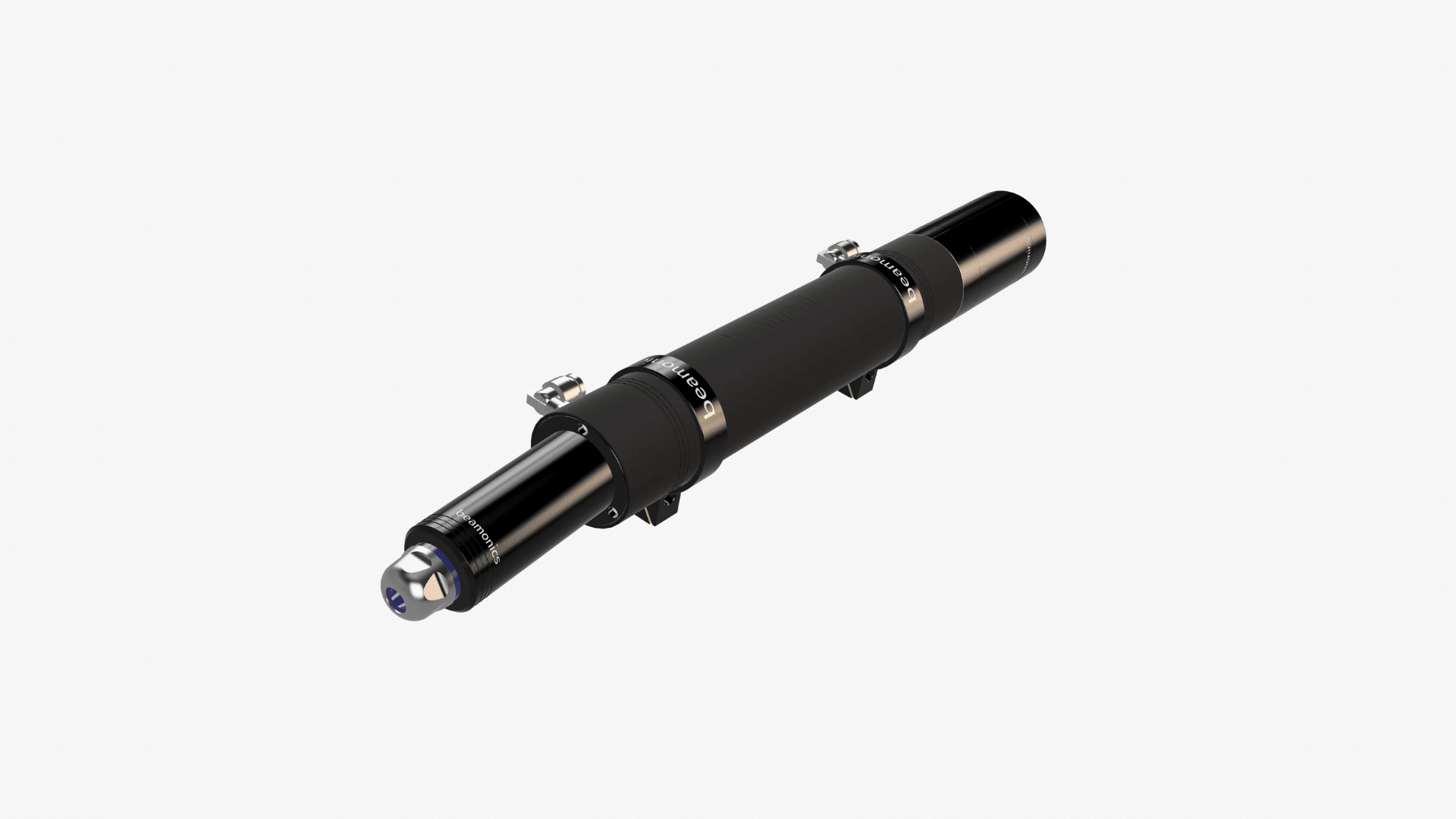
Longer optical paths produce more absorption signal for a given gas concentration, which improves sensitivity. BeamStack at 1 m path length achieves O₂ precision of 6 ppm; at longer paths across wider ducts, the precision improves proportionally. BeamCell’s 0.185 m extractive cell achieves O₂ precision of 30 ppm, consistent with its shorter path.
The trade-off is that very long paths or very high concentrations can produce absorption so strong that nearly all light at the line centre is absorbed (saturation). In this regime, the Beer-Lambert relationship becomes nonlinear and the measurement loses accuracy. Path length must be sized to keep the target concentration range within the linear portion of the absorption curve. At Beamonics, we are experts on picking the path length for your specific measurement case. Please get in touch below.
Optical cleanliness
Anything in the beam path that attenuates light without being the target gas, such as dust, condensed droplets, or window deposits, degrades the signal-to-noise ratio. The spectral fitting approach provides some inherent resistance: broadband attenuation reduces total signal but does not change the shape of the absorption feature, so the concentration retrieved from the fit is less affected than the raw absorption value. Beamonics instruments can handle transmission down to very low levels thanks to the proprietary platform, allowing processes to run uninterrupted without regular cleaning and re-calibration.
Beamonics platform specifications
| Parameter | BeamStack | BeamCell | BeamSight |
|---|---|---|---|
| Configuration | Cross-stack / open-path | Extractive flow-through | Remote stand-off |
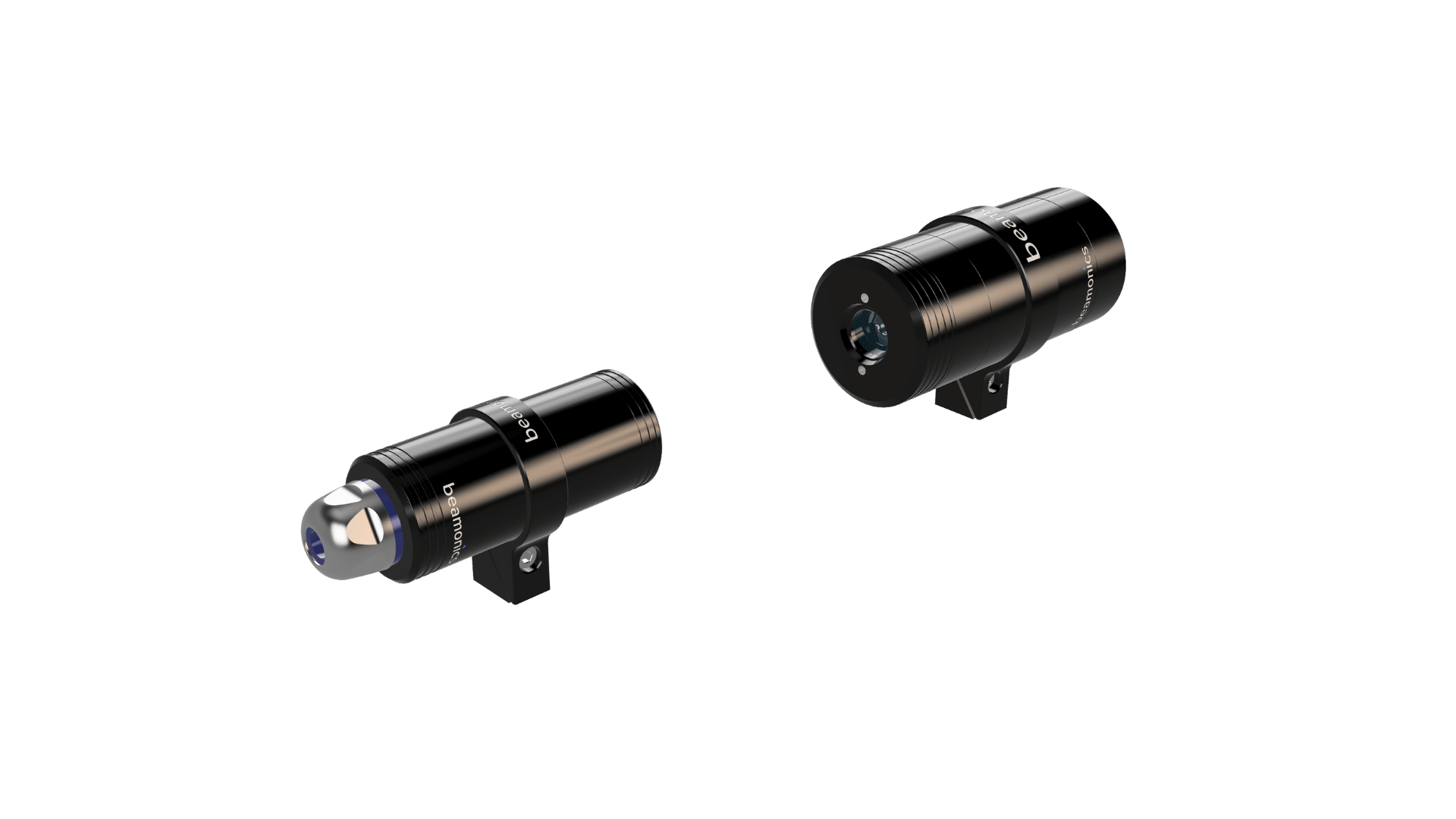
| Optical path | Up to 30 m | 0.185 m | 0.2 to 100 m |
| Analysis rate | 1 Hz to 10 kHz | 1 Hz to 10 kHz | Configurable |
| Spectroscopy cycle | 100 µs minimum | 100 µs minimum | — |
| Startup time | ~5 s | ~5 s | — |
| IP rating | IP67 | IP67 | IP44 |
| Supply voltage | 15–32 VDC | 15–32 VDC | 9–24 VDC |
| Power consumption | 5 W typical | 5 W typical | <5 W |
| Operating temperature | −10 °C to 55 °C | −10 °C to 55 °C | −10 °C to 50 °C |
| Weight | — | — | 0.7 kg (fixed), 1.0 kg (battery) |
Practical Considerations
Each laser module addresses one gas species or a narrow spectral window. Measuring multiple gases requires multiple laser channels or multiple instruments. This is a fundamental difference from broadband techniques like FTIR, which capture all species in one measurement.
The measurement reports a path-averaged or path-integrated value. In cross-stack and open-path configurations, the result is the average concentration along the beam. In remote stand-off (BeamSight), the result is the concentration-path-length product in ppm·m. Neither configuration provides spatial resolution along the beam; the reading represents the integral over the full optical path.
For multi-gas configurations covering the same duct or vessel, a single BeamStack installation can accommodate multiple laser channels targeting different absorption lines simultaneously. The gas species available on each Beamonics platform are defined at the time of system specification.
Closing Remark
The operating principle of TDLAS, measuring the attenuation of laser light at a molecular absorption line, is simple in concept. The engineering that makes it work reliably in an industrial environment, line selection for the target matrix, proprietary signal processing for noise rejection, spectral fitting for quantitative accuracy, and continuous self-diagnostics for fault detection, is where the value lies. Understanding these engineering layers helps the user specify the right configuration, interpret the data correctly, and get the most from the instrument over its operating life.