In Brief
TDLAS and gas chromatography (GC) both produce accurate gas concentration data, but they are built around fundamentally different operating principles. TDLAS delivers continuous, real-time readings of one or a small number of target gases with sub-second response, no consumables, and no routine recalibration. Gas chromatography separates and quantifies dozens of components from a single injection, but each analysis cycle takes minutes and the instrument requires laboratory-grade maintenance. The choice between them turns on whether the application needs speed and continuous monitoring or comprehensive compositional breakdown.
Two philosophies of gas measurement
Industrial gas analysis spans a wide range of requirements: detecting a trace contaminant at ppb levels in a process stream, verifying mixture composition before it enters a reactor, monitoring stack emissions for compliance, or characterizing the output of a separation column in full detail. No single instrument is optimally suited to all of these at once.
TDLAS and GC represent opposite ends of the measurement philosophy spectrum. TDLAS is a direct optical technique: fast, targeted, and designed for continuous in-process deployment. GC is a separation-based analytical technique: slower, but capable of resolving complex multi-component mixtures that no single optical measurement can distinguish. Understanding the physical basis of each method clarifies where its constraints lie, which makes the selection decision considerably more straightforward.
How TDLAS measures gas concentration
In tunable diode laser absorption spectroscopy, a laser diode is swept across a narrow wavelength range that coincides with a known molecular absorption line of the target gas in the infrared. As the beam passes through the sample, gas molecules absorb photons at that wavelength in proportion to their concentration, following the Beer-Lambert relationship.
The measurement is absolute: it references the physics of the molecule rather than an external calibration standard. This self-referencing property is what enables long-term stability without routine field recalibration. There is no sensor element that ages, no electrolyte that depletes, and no reactive surface that can be poisoned. Factory calibration is set during production, and field verification rather than routine span adjustment is the normal operating practice.
Detection sensitivity reaches ppb levels for many gases. Response time is governed by the laser scan rate and sampling configuration, not by chemical reaction kinetics. T90 values of one to two seconds are typical in industrial configurations. The Beamonics BM-H-3 platform supports analysis rates up to 10 kHz, with precision reaching 0.01 ppm for HF at a 1 m path length (BeamStack configuration) or 1 ppm for CO at 0.2 m (BeamCell extractive configuration). Because the laser targets a specific, narrow absorption line, selectivity against other gases is inherently high and cross-sensitivity effects are minimal in most industrial gas matrices.
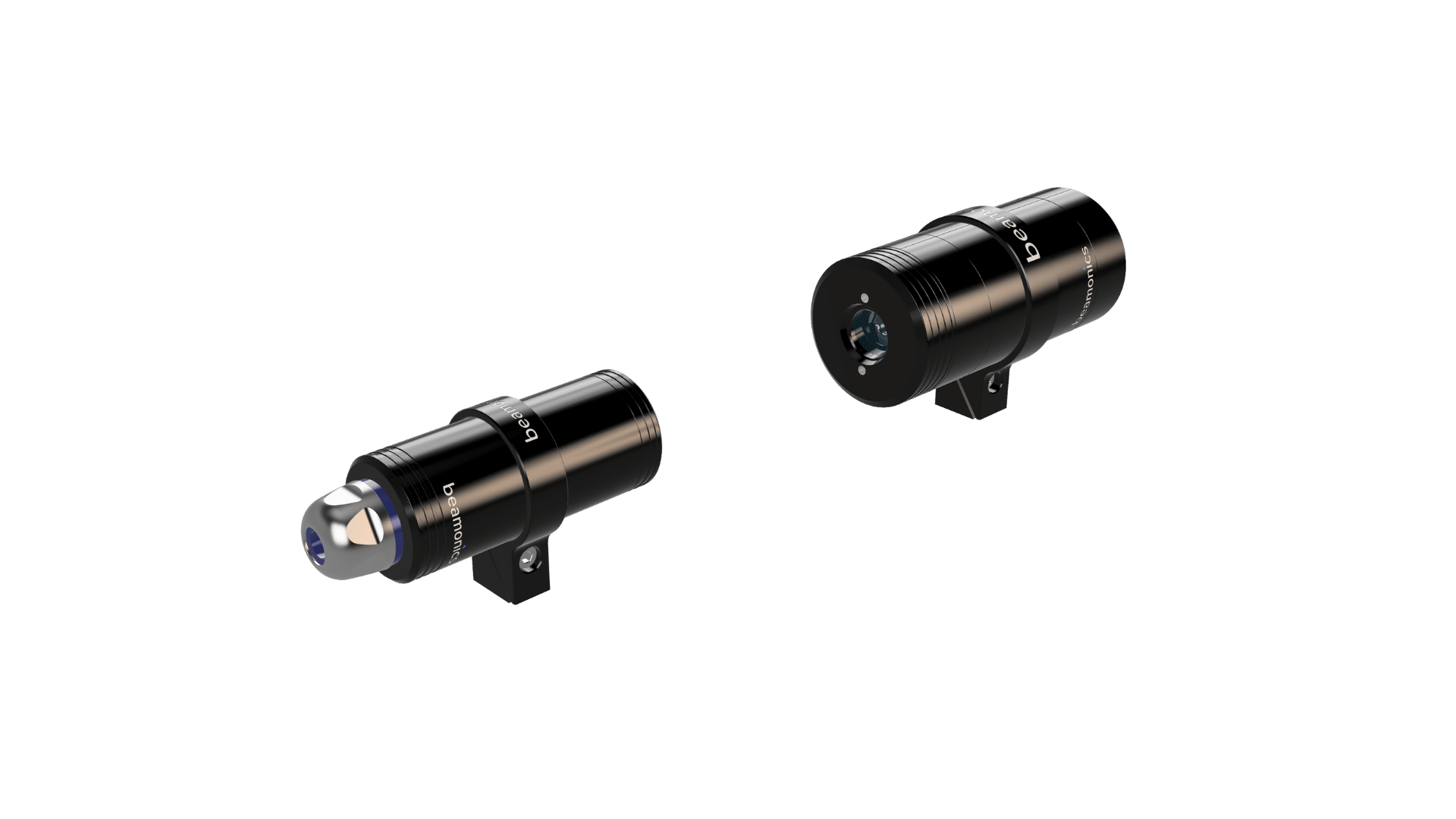
TDLAS analyzers are available in several physical configurations. A cross-stack or open-path setup places the transmitter and receiver on opposite sides of a duct or open space, measuring the path-averaged concentration directly through the process gas. An extractive flow-through configuration draws gas through an internal measurement cell, supporting multi-point sampling from a single instrument. A remote stand-off configuration detects gas at distances up to 30 m (100 m with a reflector) without physical contact. All three share the same core measurement principle.
The limitation is species count. Each laser channel measures one gas. Comprehensive compositional analysis of a mixture containing ten or more components would require a corresponding number of laser channels, which scales unfavorably in cost and complexity compared to a single analytical instrument designed for multi-component work.
How gas chromatography separates and quantifies mixtures
Gas chromatography takes a fundamentally different approach. Rather than measuring a specific physical property of a target molecule in real time, GC physically separates the components of a gas mixture before measuring them individually.
A small volume of sample gas is injected into a column, a long tube packed or coated with a stationary phase material. A carrier gas (typically helium or nitrogen) pushes the sample through the column. Different compounds travel at different speeds depending on how strongly they interact with the stationary phase: lighter, less interactive molecules elute first, while heavier or more polar molecules are retained longer. At the column exit, a detector measures each compound as it emerges. The most common detectors are the thermal conductivity detector (TCD), which responds to differences in thermal conductivity between the carrier gas and the analyte, and the flame ionization detector (FID), which is highly sensitive to hydrocarbons.
The output is a chromatogram: a time-resolved series of peaks, each corresponding to a different compound, with peak area proportional to concentration. A well-configured GC method can resolve and quantify dozens of components from a single injection. This makes GC the standard technique for natural gas composition analysis, refinery stream characterization, speciated hydrocarbon measurement, and many environmental and pharmaceutical quality control applications.
The trade-off is time. A single analysis cycle, from injection through separation to the elution of the last component of interest, typically takes 2 to 15 minutes depending on the method and the complexity of the mixture. During that cycle, the instrument cannot respond to changes in the sample. The result is a snapshot of composition at the moment the sample was injected, not a continuous measurement.
Where the two methods diverge in practice
The most consequential operational difference is temporal resolution. A TDLAS analyzer produces a valid concentration reading every one to two seconds, continuously. A GC produces one complete analysis every few minutes. For applications where concentration changes need to be detected and acted on in near-real time, including safety alarms, combustion control feedback, scrubber efficiency monitoring, and process trip logic, the GC cycle time is too slow. Transient events, short-duration excursions, and rapidly changing concentrations will not be captured reliably by a chromatograph.
Multi-component capability favors GC. Determining the full composition of a biogas stream (CH₄, CO₂, H₂S, N₂, O₂, siloxanes, and trace contaminants), characterizing a natural gas supply for calorific value calculation, or speciating the hydrocarbon content of a reactor off-gas are tasks that GC handles routinely. TDLAS cannot provide equivalent compositional breadth without deploying a separate laser channel for each species of interest.
Deployment environment differs substantially. TDLAS instruments are compact, IP67-rated industrial analyzers designed for continuous operation in process environments. The Beamonics BeamStack and BeamCell operate from -10 °C to 55 °C, consume approximately 5 W, and start measuring within 5 seconds of power-up. GC systems are laboratory instruments or shelter-mounted process analyzers requiring climate control, stable utilities (carrier gas supply, electrical power, sometimes hydrogen or air for FID), and trained operators for method development and troubleshooting. Portable TDLAS configurations exist, including the battery-powered BeamSight at 1.0 kg with 5 hours of operating life. Portable GC instruments are available but are operationally more complex and less suited to rapid field deployment.
Maintenance burden is where the difference compounds over the life of an installation. TDLAS optics are non-consumptive. There are no columns to condition or replace, no carrier gas cylinders to procure and manage, no detector elements to service on a scheduled basis. A typical inspection interval is 6 to 12 months, consisting of a visual check and optics cleaning. A process GC in continuous service requires column replacement (months to a year depending on the application), carrier gas supply management, detector maintenance, valve servicing, and periodic recalibration with certified reference gas mixtures. In remote installations or facilities with limited analytical support staff, this difference in maintenance demand can be a deciding factor.
Specification comparison
| Parameter | TDLAS | Gas chromatography |
|---|---|---|
| Measurement principle | Laser absorption at specific molecular line | Physical separation in column, then detection |
| Sensitivity | ppb to ppm (gas and path-length dependent) | ppm to ppb (detector-type dependent) |
| Response time | ~1–2 s continuous | 2–15 min per analysis cycle |
| Selectivity | High; targeted to specific absorption lines | High; separation before detection |
| Multi-component capability | One gas per laser channel; multiplexable | 10–30+ components per injection |
| Deployment | In-situ, extractive, or remote; industrial-rated, IP67 | Laboratory or climate-controlled shelter |
| Calibration | Factory-set, self-referencing; verification only | Periodic recalibration with certified reference mixtures |
| Maintenance | Minimal; no consumables; 6–12 month inspection interval | Regular: columns, carrier gas, detector servicing, valve maintenance |
| Startup time | ~5 seconds | Minutes to hours (column conditioning, thermal stabilization) |
| Portability | Fixed or battery-powered portable (BeamSight: 1.0 kg) | Laboratory-based; portable variants operationally complex |
| Consumables | None | Carrier gas, columns, detector supplies, calibration gas mixtures |
Where TDLAS is the stronger choice
TDLAS fits applications where the target gas is defined, the required detection limit is in the ppm-to-ppb range, and the process demands continuous data with fast response.
Emissions compliance monitoring for species such as NH₃, HF, HCl, or CO benefits from continuous, real-time reporting rather than periodic snapshots. Safety monitoring for toxic or flammable gases (H₂S, CH₄, CO) requires sub-second alarm response that a GC cannot provide. Combustion optimization through real-time CO and O₂ measurement needs the measurement to be fast enough to close a control loop, which means seconds, not minutes. Scrubber and abatement efficiency verification is more meaningful when measured continuously across the inlet and outlet than when sampled periodically.
The common thread is a well-defined measurement problem: a small number of species, low detection limits, and a process that cannot tolerate gaps in monitoring or delayed alarm response.
Where gas chromatography is the stronger choice
GC fits applications where the measurement requirement is compositional: what is in this gas mixture, and in what proportions?
Natural gas quality analysis, where the relative fractions of CH₄, C₂H₆, C₃H₈, CO₂, N₂, and heavier hydrocarbons determine calorific value, Wobbe index, and custody transfer pricing, is a GC application by design. Refinery process stream characterization, where dozens of hydrocarbon species must be individually quantified, requires the separation capability that only chromatography provides. Environmental sampling with speciated analysis (distinguishing between individual volatile organic compounds rather than reporting a total hydrocarbon number) relies on GC for regulatory acceptance. Laboratory quality control, where certified accuracy against reference standards is required for each identified component, is GC’s established domain.
The common thread is analytical breadth: many components resolved and quantified from a single sample, with the understanding that each measurement takes minutes rather than seconds and the instrument needs regular skilled attention.
Complementary rather than competing
TDLAS and GC occupy different roles in the same measurement landscape, and in many facilities both are deployed.
A typical pairing places TDLAS analyzers at continuous monitoring points: stack emissions, scrubber outlets, safety perimeters, and control-critical process taps where real-time data drives automated responses. A GC handles periodic compositional analysis of feedstock, product, or waste streams where understanding the full mixture is necessary for quality control, custody transfer, or detailed process characterization.
The instruments answer different questions. TDLAS answers: what is the concentration of this specific gas, right now, continuously? GC answers: what are all the components in this mixture, and what fraction does each represent? The measurement requirement determines which question matters, and therefore which instrument belongs at each point in the process.
Considerations when specifying either technology
TDLAS analyzers require optical line-of-sight for in-situ configurations. Particulate-laden or condensing streams may require window purging, heated optics, or extractive sampling. TDLAS is not suited to identifying unknown components: the instrument measures only the gas species it is configured for.
GC analysis cycle time must be compatible with the process dynamics being monitored. If concentrations change faster than the analysis cycle, a chromatograph will miss events. Carrier gas supply is a recurring consumable and a logistical consideration for remote or offshore installations where cylinder delivery is not routine.
Both technologies require attention to sample conditioning. For TDLAS extractive configurations and for all GC applications, sample temperature, moisture management, and particulate filtering affect measurement quality. Reactive gases such as NH₃, HF, and H₂S are particularly sensitive to sample handling: line losses, adsorption, and condensation can compromise results regardless of how accurate the analyzer itself may be.
Matching the instrument to the measurement
The comparison between TDLAS and gas chromatography is less about which technology is superior and more about which measurement task is being addressed. Continuous, real-time monitoring of defined target gases and detailed periodic characterization of complex mixtures are different problems, and the instrumentation suited to each reflects that difference. Selecting the right tool starts with a clear definition of what needs to be measured, how fast, how often, and to what level of compositional detail.
Related links:
- BeamStack (BM-H-3): Cross-stack and open-path TDLAS analyzer
- BeamCell (BM-H-3): Extractive flow-through TDLAS analyzer
- BeamSight (BM-V-2): Remote stand-off TDLAS analyzer
- TDLAS vs. electrochemical and catalytic bead gas detectors
- TDLAS and FTIR: selecting the right infrared method
- TDLAS and Raman spectroscopy: how two optical methods compare
- TDLAS and NDIR: how two infrared absorption methods compare