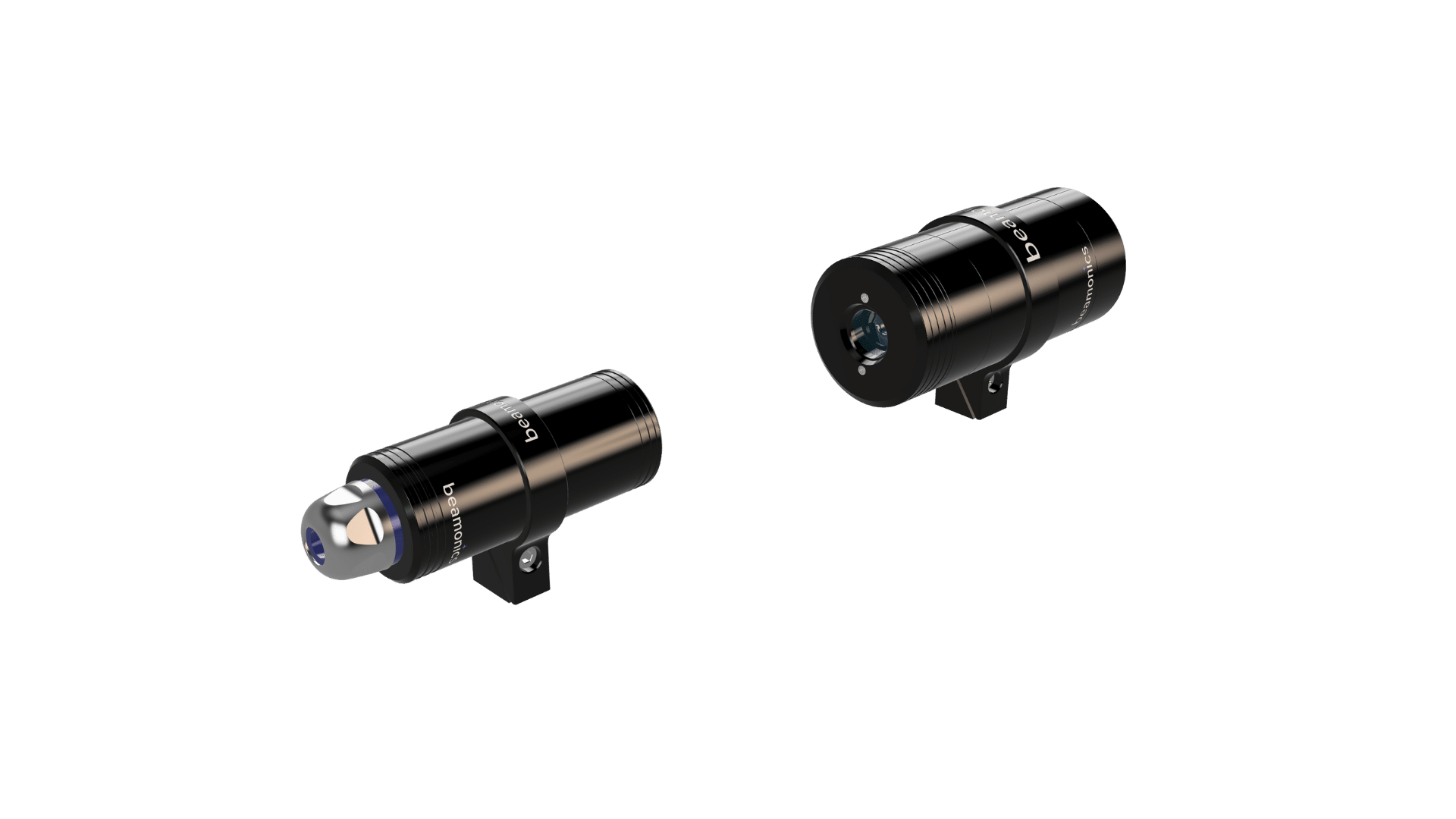
Nitrous Oxide (N₂O) Gas Analyzer
Continuous, real-time N₂O measurement using Tunable Diode Laser Absorption Spectroscopy (TDLAS). Designed for wastewater treatment and adipic acid processing plants to analyze and monitor the presence of nitrous oxide compounds.
Why Analyze Nitrous Oxide (N₂O)

Where the established methods run into trouble
Two measurement technologies are in common use and each has its own limits. NDIR analyzers work over a broad band of the infrared spectrum, which makes them cross-sensitive to water vapour and CO₂. Interference-compensation schemes exist, but changing gas temperature and pressure make that compensation difficult to get right and easy to get wrong. Drift and ageing optical components mean these units are typically recalibrated once or twice a year. Electrochemical and Clark-type cells are inexpensive and compact, and they pay for it in drift and in cross-talk with a long list of other molecules. Their lifetime is limited and the cells are commonly replaced every few months.

How the TDLAS measurement differs
Beamonics analyzers use narrowband spectroscopy. A tunable diode laser is scanned across a sharp absorption line belonging to the N₂O molecule itself, and the measurement reads the depth of that line. Water vapour and CO₂ in the same stream absorb at their own wavelengths and do not register as N₂O. Because the reading is referenced to a physical molecular property rather than to a stored calibration, baseline drift is negligible, there are no consumable cells to replace, and the instrument does not need routine recalibration. Solid-state lasers and detectors give service lifetimes in the ten-year range when operated within specification.

In-situ or extractive measurement
Two things decide which arrangement suits a given stream, and only one of them is about selectivity.
The first is optical transmission. Wet off-gas is the difficult case. Water has broad absorption features across much of the infrared, and in a saturated stream those features attenuate the beam across the whole band rather than at one wavelength. That is a transmission problem and not a cross-interference problem: the N₂O line stays selective, there is simply less light arriving at the detector to measure it with. Drying and conditioning the sample removes the water before the light path, which is what an extractive arrangement does.
The second is access. A cross-duct instrument measures the real gas in the real duct with nothing between the process and the reading, which suits a dry or moderately humid stream and a duct you can mount across. An extractive instrument accepts a sample line and the conditioning that goes with it, in exchange for control over the temperature, pressure and moisture of the gas at the point of measurement, and the option to sample several points in sequence.
Where N₂O is measured

Wastewater nitrogen removal
N₂O forms in the biological nitrogen-removal process and strips out of the aerated zones into the off-gas. Continuous measurement turns an emission factor into a real number for climate reporting, and over time it lets operators tune aeration and carbon dosing to lower N₂O without losing nitrogen-removal performance. Off-gas from a covered basin is close to saturated, so extractive sampling with conditioning is usually the right arrangement here; a drier ventilation duct downstream can be measured cross-duct instead.

Nitric & adipic acid production
Nitric acid feeds fertiliser production and adipic acid feeds nylon, and between them they are among the largest industrial sources of N₂O. Measurement at the abatement inlet and again at the stack shows what the DeN₂O catalyst is actually removing, documents emissions for compliance, and supports credit reporting. Inlet concentrations are high and the stack is comparatively clean, so the two points often call for different arrangements.

Combustion, SCR/SNCR & engine testing
N₂O is an unwanted byproduct of NOx reduction over SCR and SNCR systems, and it forms across after-treatment catalysts on engine test benches. A fast, selective measurement captures N₂O slip as it happens rather than after the fact, alongside the rest of the gas matrix.
Our products
Why our products are different
Adaptive Signal Control
Real-time compensation for fluctuating transmission.
Unmatched Precision
Flexible Integration
Adaptable outputs in your preferred format, fitting into existing PC/PLC.
True Real-Time Insights
>1000 analyses per second, notifying you when conditions change.
Ultra-Low Detection Limits
Compact Form Factor
Small, lightweight design makes installation and retrofitting simple.
Instant Startup
No warm-up or stabilizing time. Start measuring within seconds.
Reliable in Harsh Conditions
Accurate measurement even at low transmission levels, down to ~1%.
Made in Sweden
Built with robust, replaceable components for long service life.
Insights & articles

Nitrous Oxide Monitoring in Wastewater Treatment: TDLAS for Laughing Gas Measurement
In Brief Nitrous oxide (N₂O) is a potent greenhouse gas...

Ammonia monitoring in wastewater treatment: TDLAS for gas-phase ammonia analysis
In Brief Wastewater treatment facilities generate gas-phase...

Ammonia Monitoring in Agriculture: TDLAS for Barn, Scrubber, and Field Emissions
In Brief Ammonia emissions from livestock housing, manure...
How our technology works
1. Laser Emission
A tunable diode laser emits specific colors (wavelengths) of light that is directed through the gas sample.
2. Absorption Measurement
As the laser passes through the gas, molecules absorb some light, which is then measured and recorded.
3. Concentration Calculation
The absorption is analyzed to determine the gas concentration, providing precise, real-time measurements.
Frequently asked questions
What problems do your gas analyzers solve?
We help process and environmental teams measure critical gases in real time (e.g., CH₄, CO₂, H₂S, HF, HCl, H₂O, O₂) for safety, quality, and compliance across biogas, CCUS, battery, chemicals, and more.
How is TDLAS different from NDIR or electrochemical sensors?
TDLAS measures the unique absorption line of a gas with a laser. It’s fast, selective, stable, and needs less frequent calibration than NDIR/electrochemical cells in most tough processes.
Do you offer both in-situ and extractive measurement?
Yes. We provide line-of-sight in-situ probes for hot/wet ducts and extractive analyzers for conditioned sample lines. We help you choose based on dust load, pressure, temperature, and access.
What gases do you measure today?
Common: CH₄, CO₂, H₂S, NH₃, HF, HCl, H₂O, O₂, CO, and others on request. Please ask if your target gas isn’t listed.
How fast is the response time?
In practice, there is no T90, as our TDLAS analyzers operate in real time. For example, we deploy solutions in high-speed processes with several 100 Hz/ms. However, typical end-user requirements are often 1–2 seconds in situ and 2–5 seconds for extractive applications (application-dependent).
What accuracy and detection limits can we expect?
Process-ready accuracy (often ±1–2% of reading) and low ppm detection for many species. We’ll quote measurement range, repeatability, and LOD per application.
What does maintenance look like?
Maintenance is typically minimal. Mainly optics checks and purge air filter changes. No consumable cells. Annual verification is standard. No calibration is needed, since TDLAS is self-referencing.
Can you integrate with our DCS/PLC/PC?
Yes, please review the specific datasheet for the product you are interested in. Standard configurations are RS-485, RS-422, USB, 4-20 mA, and so on. Our solution comes complete with a servicing and commissioning software and integration-ready API. We are happy to help if you are unsure which integration method is best for you.
What certifications and ATEX/IECEx options are available?
We offer some enclosures and probes for industrial and explosive areas. Please reach out to us if you have questions regarding ATEX/IECEx, and we will do our best to assist you. We are committed to quality and are certified to ISO 9001:2015.
What are typical lead times and pricing models?
Most systems ship in 4–6 weeks, while some custom builds can take up to 12 weeks. Pricing depends on gas set, configuration, and explosive-area needs. We also offer pilot programs.
TALK TO OUR TDLAS EXPERTS
Interested in learning more?
Talk to an engineer or contact us to learn more about our products and technology, and explore how our next-generation TDLAS gas analyzers can solve your gas analysis applications.