In Brief
Nitrous oxide (N₂O) is a potent greenhouse gas produced during biological nitrogen removal in wastewater treatment. Emission factors vary widely between plants and over time, making continuous, real-time monitoring essential for accurate carbon footprint accounting and process control. Beamonics TDLAS provides the selectivity, speed, and long-term stability needed to track N₂O in the complex gas matrices found above aeration basins and in off-gas streams.
Background
Wastewater treatment plants that remove nitrogen biologically, through nitrification and denitrification, produce N₂O as an intermediate and by-product. The quantities involved are not trivial. N₂O has a global warming potential roughly 273 times that of CO₂ over a 100-year horizon and an atmospheric lifetime exceeding 100 years. An emission factor of just 1% of the incoming nitrogen load, expressed as a fraction of nitrogen converted to N₂O-N, can increase the total carbon footprint of a treatment plant by approximately 30%. Reported emission factors at full-scale plants range from near zero to above 8% of the influent nitrogen load, depending on plant design, operating conditions, and how the measurements were conducted. This variability is the central problem: without reliable, continuous measurement, operators cannot distinguish between a well-controlled process and one that intermittently releases large quantities of a gas they cannot see, smell, or detect with standard wastewater instrumentation.
How N₂O forms during biological treatment
N₂O production in activated sludge processes follows several microbial pathways. The two most significant are nitrifier denitrification by ammonia-oxidizing bacteria (AOB) and incomplete heterotrophic denitrification. A third route, involving the chemical breakdown of hydroxylamine oxidation intermediates, is also implicated but less well quantified.
In nitrifier denitrification, AOB reduce nitrite to N₂O under conditions of low dissolved oxygen or elevated nitrite concentration, both of which are common during the transition between aerated and non-aerated phases. In heterotrophic denitrification, N₂O is a normal intermediate in the stepwise reduction of nitrate to molecular nitrogen (N₂). If the final enzymatic step is inhibited, for example by insufficient carbon availability or by sudden changes in dissolved oxygen, N₂O accumulates rather than being reduced to N₂.
Aeration plays a dual role. It promotes the nitrification reactions that produce N₂O while simultaneously stripping dissolved N₂O from the liquid phase into the atmosphere. Gas-phase measurements at full-scale plants consistently show that emissions from aerated zones exceed those from non-aerated zones by two to three orders of magnitude, not because more N₂O is produced there, but because aeration physically drives the dissolved gas into the headspace.
The measurement challenge
Several features of N₂O emissions from wastewater make them difficult to quantify with conventional approaches.
Temporal variability is extreme. Emissions follow diurnal patterns driven by influent loading, and they respond within minutes to changes in dissolved oxygen, ammonia concentration, or carbon dosing. Short-term measurement campaigns, lasting days or a few weeks, frequently underestimate or overestimate the annual emission factor. Studies comparing campaign durations have found that monitoring periods shorter than one month tend to report emission factors below 0.3% of the nitrogen load, while campaigns lasting more than a year report median values closer to 1.7%.
Spatial variability is also significant. N₂O concentrations differ along the length of an aeration basin, between parallel treatment lines, and between different process stages. A single measurement point, whether a dissolved-phase sensor or a floating gas hood, captures only a local snapshot.
The gas matrix above an aeration basin contains H₂O, CO₂, residual CH₄ from influent degassing, and varying concentrations of N₂O, typically ranging from a few ppm to several hundred ppm in the off-gas. Any analyzer deployed in this environment must tolerate moisture, reject interference from CO₂ and CH₄, and respond quickly enough to capture the rapid fluctuations that characterize N₂O dynamics.
Conventional N₂O measurement methods
The established approach at most research-oriented plants involves floating gas hoods placed on the liquid surface, connected to an infrared gas analyzer or a gas chromatograph with an electron capture detector (GC-ECD). GC-ECD provides high sensitivity but operates in batch mode: grab samples are collected at intervals, transported, and analyzed offline. This approach cannot capture the minute-to-minute variability that governs cumulative emissions.
Dissolved-phase microsensors (Clark-type electrochemical N₂O sensors) are increasingly used for continuous liquid-phase monitoring. These provide good temporal resolution and can be installed directly in the mixed liquor. However, converting a dissolved N₂O concentration into an emission rate requires a mass transfer model, and the accuracy of that conversion depends on knowing the local oxygen transfer coefficient, which itself varies with aeration intensity and basin geometry. Sensor drift and the need for periodic recalibration also introduce uncertainty over long deployments.
Broadband infrared analyzers, including NDIR instruments, can measure N₂O in the gas phase but are susceptible to cross-interference from CO₂ and H₂O, both of which are present in high and variable concentrations in wastewater off-gas. This interference can introduce systematic errors that are difficult to correct without careful gas conditioning or multivariate compensation.
TDLAS for N₂O measurement in wastewater off-gas
Tunable diode laser absorption spectroscopy (TDLAS) addresses several of these limitations simultaneously. A narrowband diode laser is scanned across a specific molecular absorption line of N₂O. Because the laser probes only a narrow spectral window, matched to a well-characterized transition of the target molecule, interference from other gases in the sample is rejected at the physical level rather than through post-processing or compensation algorithms. Careful line selection is an inherent part of the Beamonics design process, and the analyzers as such offer little to no cross-interference.
The measurement is referenced to the known physics of the molecular absorption line: the line position, line strength, and pressure-broadening parameters described by the Beer-Lambert law are physical constants, not calibration coefficients that drift over time. This self-referencing property eliminates the need for routine span calibration and makes Beamonics TDLAS well suited to long-term, unattended monitoring, exactly the deployment profile that N₂O quantification in wastewater demands.
TDLAS is a real-time technique with practically no response delay. The optical measurement itself is instantaneous, which is fast enough to resolve the transient N₂O peaks associated with aeration cycling, load changes, and process upsets. This temporal resolution matters because short, high-concentration peaks contribute disproportionately to cumulative emissions. Studies at full-scale plants have found that roughly 12% of measurement days can account for 50% of total annual emissions. Missing those peaks, as a slow or intermittent measurement system would, leads directly to underestimation.
Measurement configurations for wastewater applications
N₂O monitoring in wastewater off-gas can be implemented in several configurations, each with different trade-offs.
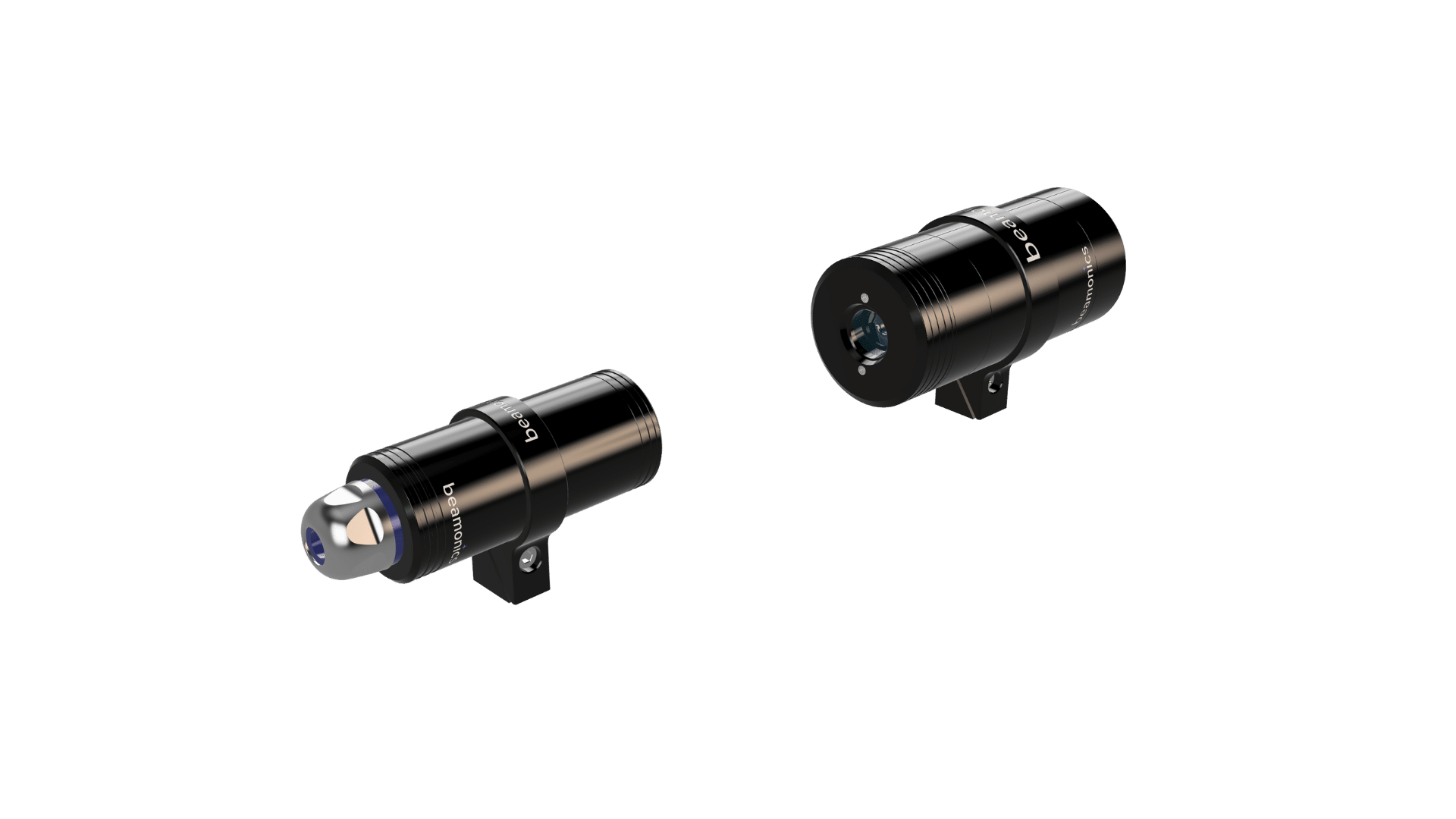
In an extractive arrangement, off-gas is drawn from beneath a floating hood or from a covered basin headspace and passed through a flow-through measurement cell. The Beamonics BeamCell is designed for this type of application: gas enters through push-in connectors adapted for 6 mm or 8 mm tubing, passes through the acid-resistant flow chamber (0.185 m optical path length), and exits without contacting consumable sensor elements. The IP67-rated enclosure tolerates the humid, sometimes corrosive conditions near aeration basins. Because the measurement cell volume is small and the analysis rate can reach up to 10 kHz, the system can cycle between multiple sampling points in sequence, covering several locations within a basin or across parallel treatment lines using a single analyzer and a multiport valve arrangement.
For open-path or cross-duct measurements, the Beamonics BeamStack transmitter and receiver are mounted on opposite sides of a duct or headspace channel. This configuration measures the path-integrated N₂O concentration across the full width of the gas stream, providing a spatially averaged value rather than a point sample. In covered basins with ducted exhaust, this approach can directly quantify the N₂O mass flow when combined with a flow velocity measurement. N₂O is supported on the BeamStack platform alongside gases such as CO (0.2 ppm precision at 1 m), CO₂ (0.5 ppm), and CH₄ (0.2 ppm) under standard test conditions (P = 1 atm, T = 300 K, t = 1 s).
For survey and screening applications, the Beamonics BeamSight provides remote stand-off detection at distances up to 30 m without a reflector, or up to 100 m with a reflecting surface. In a portable battery-powered configuration weighing 1.0 kg with approximately 5 hours of operating battery life, BeamSight can be used to map N₂O emissions across the surface of open aeration basins, identify emission hotspots, and guide the placement of permanent monitoring equipment. The measurement output is in ppm·m units, representing the path-integrated concentration, which is well suited to screening but requires additional information to convert to a mass emission rate.
Why selectivity matters in wastewater off-gas
The gas composition above an activated sludge basin is not a clean laboratory sample. CO₂ concentrations in the off-gas can reach several percent, and H₂O is near saturation. CH₄ may be present if the influent carries dissolved methane from sewer networks or if anaerobic zones exist upstream.
Beamonics instruments targeting N₂O use laser wavelengths selected to coincide with absorption features that are spectrally isolated from the nearby transitions of CO₂, H₂O, and CH₄. The narrow tuning range of the diode laser, typically spanning only a fraction of a nanometre, means that the instrument physically cannot respond to molecules that do not absorb at the probed wavelength. This is a qualitatively different approach to selectivity than the mathematical compensation used in broadband infrared analyzers, where overlapping absorption bands must be deconvolved in software. In wastewater off-gas, where the background composition shifts with aeration rate, temperature, and loading, the hardware-level selectivity of Beamonics TDLAS provides measurement stability that software-compensated instruments struggle to match over extended periods.
Practical considerations
Extractive sampling systems require attention to condensation management. Wastewater off-gas is warm and humid, and cooling in the sample line can produce liquid water that blocks tubing, corrupts readings, or damages optics. Heated sample lines, coalescing filters, or Nafion dryers are commonly used, and the sample conditioning system should be designed for the specific conditions at the plant.
Dust and aerosol loading above aeration basins is generally low compared to combustion stacks. Beamonics instruments can handle transmission down to very low levels thanks to the proprietary platform, allowing processes to run uninterrupted without regular cleaning and re-calibration.
The spatial variability of N₂O emissions within a single basin means that a measurement at one location may not represent the entire process. Multi-point sampling with a single extractive analyzer, or the use of multiple cross-path measurements, can improve spatial coverage. Preliminary screening with a portable instrument such as BeamSight can help identify where permanent monitoring should be installed.
Converting gas-phase N₂O concentration data into an emission rate (mass of N₂O per unit time) requires knowledge of the gas flow rate through the measurement point. In covered basins with ducted exhaust, this can be measured directly. In open basins with floating hoods, the emission flux is calculated from the hood area, the gas flow through the hood, and the measured concentration. The accuracy of the final emission factor depends as much on the flow measurement and hood design as on the gas analyzer itself.
Plant operators intending to use N₂O data for process control, for example adjusting dissolved oxygen setpoints or carbon dosing rates to minimize emissions, need response times that match the process dynamics. The real-time optical measurement of Beamonics TDLAS is more than adequate; the practical bottleneck is usually the sample transport time in extractive configurations, which can be minimized by keeping sample lines short and flow rates high.
Closing Remark
Regulatory and reporting frameworks around wastewater greenhouse gas emissions are tightening, and the IPCC emission factor for N₂O from treatment plants has been revised upward significantly in recent years. Generic emission factors applied across entire national inventories are increasingly recognized as inadequate, because the actual emissions from individual plants depend on design and operational choices that vary enormously. Plant-specific, continuous monitoring is the path toward both accurate reporting and targeted mitigation, and the measurement requirements, selectivity, stability, speed, and tolerance for difficult sample matrices, align closely with the operating characteristics of Beamonics TDLAS.