In Brief
Ammonia emissions from livestock housing, manure storage, and fertilizer application contribute to eutrophication, secondary particulate matter formation, and occupational health risks. Monitoring NH₃ across the barn-to-field chain requires analyzers that handle wide concentration ranges, high humidity, dust, and corrosive gas mixtures without drifting or losing selectivity. Beamonics TDLAS analyzers provide continuous, calibration-free NH₃ measurement in open-path, cross-stack, extractive, and remote stand-off configurations, covering the full range of agricultural monitoring needs from area screening to scrubber control to multi-point verification.
Background
Agriculture is the dominant source of atmospheric ammonia in most industrialized countries, with livestock operations and fertilizer use accounting for the large majority of emissions. NH₃ released from animal housing, manure storage, slurry spreading, and urea application enters the atmosphere and contributes to several environmental and health problems. Deposited ammonia drives eutrophication in soils, rivers, lakes, and coastal waters by adding reactive nitrogen where it disrupts natural nutrient balances. In the atmosphere, NH₃ reacts with sulfuric and nitric acids to form ammonium salts, a significant component of fine particulate matter (PM2.5). At higher concentrations near sources, ammonia is directly irritating to the respiratory system of both humans and animals, and it contributes to odor complaints that affect the relationship between farming operations and surrounding communities.
Concentrations vary enormously depending on proximity to the source and ventilation conditions. Background outdoor levels may sit at tens of ppb. Inside a poultry house or pig barn, concentrations commonly reach tens to hundreds of ppm. Near manure agitation events, short-lived spikes can be higher still. A monitoring system must resolve low-ppb outdoor signals for inventory work while tolerating high-ppm indoor concentrations without saturating.
Conventional monitoring approaches rely on networks of electrochemical (EC) point sensors distributed across a site. These sensors are compact and relatively inexpensive per unit, but they carry well-documented operational limitations. EC sensors for NH₃ are susceptible to cross-interference from H₂S, amines, and other co-emitted species common in livestock environments. Electrolyte aging causes baseline drift, requiring recalibration on a monthly to quarterly schedule. Sensor poisoning from silicones, acids, and volatile organic compounds shortens usable life, often to 6 to 18 months. In humid, dusty barn environments where sensor access may be limited by animal welfare and biosecurity protocols, maintaining a network of EC sensors becomes a significant recurring burden.
How TDLAS addresses agricultural NH₃ monitoring
TDLAS measures ammonia by scanning a narrowband laser across a specific NH₃ absorption line in the near-infrared. The laser wavelength is scanned rapidly through a narrow spectral window that includes both the absorption feature and adjacent non-absorbing regions. Comparing the transmitted light intensity at the absorption peak to the baseline on either side yields an absolute concentration measurement, following the Beer-Lambert law, that is inherently self-referencing. The instrument does not rely on an external calibration gas or a chemical reaction to produce its reading.
This self-referencing property is what eliminates drift. The position and shape of the NH₃ absorption line are determined by molecular quantum mechanics and do not change over time, with temperature, or with sensor age. As long as the laser scans across the correct spectral feature and the detector measures the transmitted light, the concentration reading is tied to a physical constant. There is no electrolyte to deplete, no catalyst to poison, and no reference cell to maintain.
Selectivity follows from the same principle. Careful line selection is an inherent part of the Beamonics design process, and the analyzers as such offer little to no cross-interference. Other gases present in the measurement path, including H₂O, CO₂, CH₄, and H₂S, absorb at different wavelengths and do not affect the NH₃ reading. This is particularly important in agricultural settings where humidity is high and variable, and where multiple gas species are emitted simultaneously from the same source.
Measurement configurations for agricultural applications
Agricultural NH₃ monitoring spans a wide range of physical settings, from open barnyards to enclosed ductwork to soil surfaces after slurry application. Different measurement geometries suit different situations.
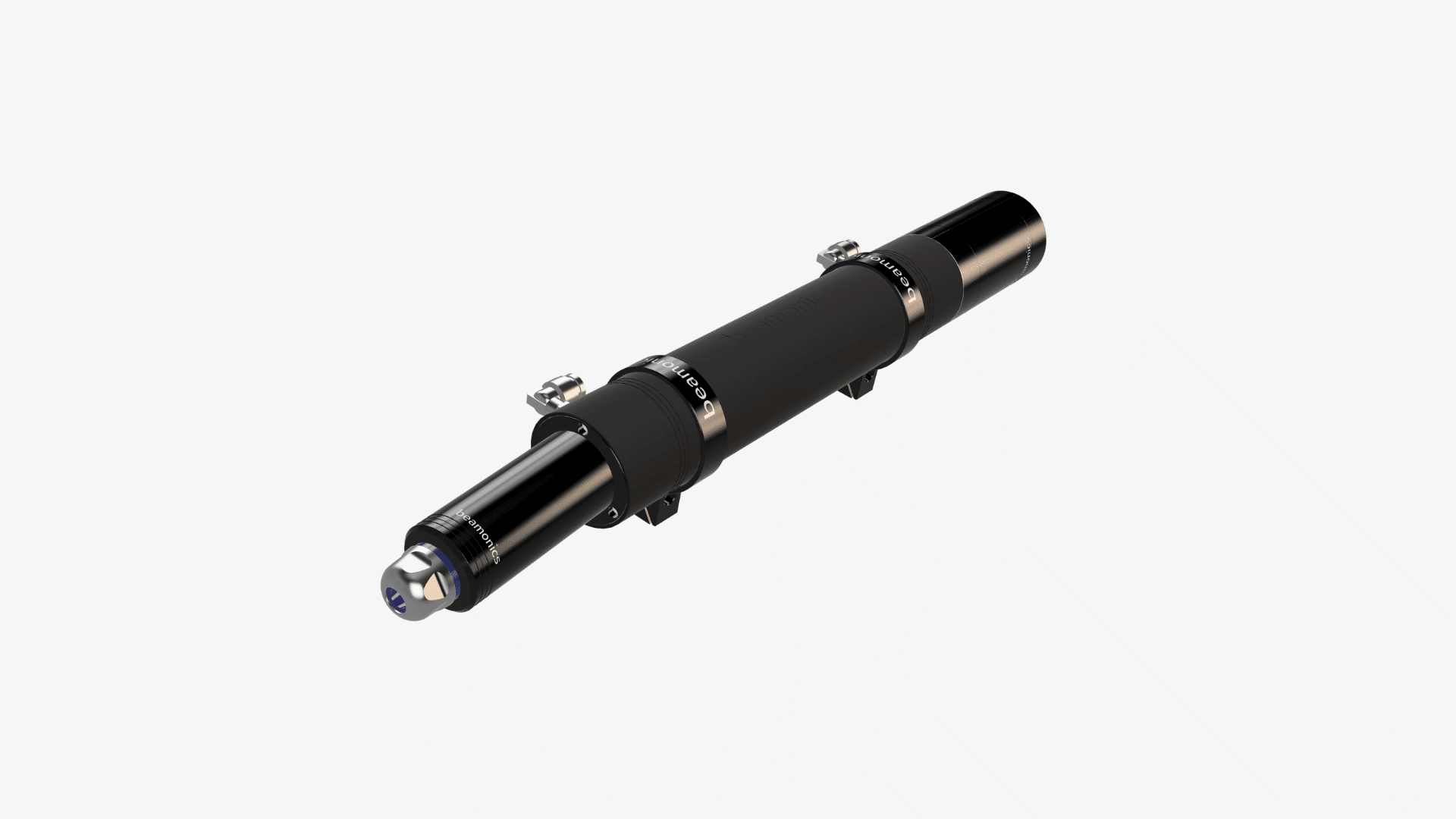
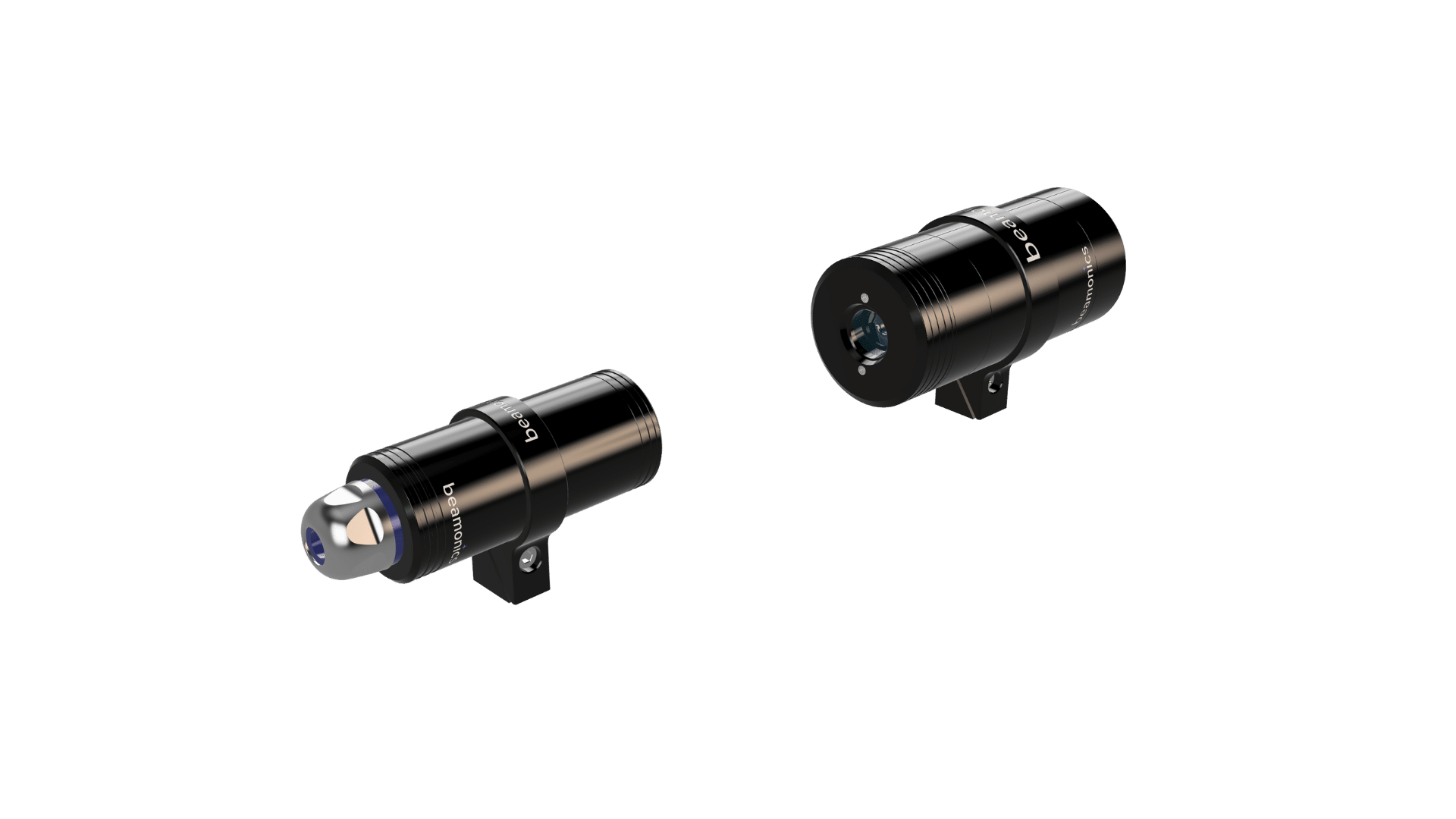
Cross-stack and open-path monitoring. A transmitter and receiver mounted on opposite sides of a ventilation duct, barn opening, or corridor measure the path-averaged NH₃ concentration in real time. This configuration is well suited to controlling acid scrubbers on livestock ventilation exhaust, where the NH₃ concentration entering and leaving the scrubber determines dosing rates and removal efficiency. Continuous, fast feedback prevents under-dosing (which wastes emission permits) and over-dosing (which wastes acid and increases operating cost).
Beamonics BeamStack operates in this configuration with NH₃ analysis precision of 0.2 ppm at a 1 m path length under standard test conditions (t = 1 s, P = 1 atm, T = 300 K). Analysis rates reach up to 10 kHz, capturing transient concentration peaks during events such as manure agitation or ventilation rate changes. The instrument is rated IP67 and operates from −10 °C to 55 °C, which covers the full range of conditions in livestock buildings and exhaust systems. Standard interfaces including RS-485, 4–20 mA, and relay outputs connect directly to PLC systems for automated scrubber control and alarm generation.
Open-path configurations using the same instrument architecture can span across a barn section, a feed alley, or a fence line to provide spatially averaged concentration data for emission inventory work. Pairing concentration readings with measured airflow rates yields mass emission rates, which is the metric required for regulatory reporting and inventory submissions.
Extractive multi-point sampling. Inside a large barn or across a complex of buildings, concentration gradients can be steep. Animal zones, manure pits, ventilation inlets, and exhaust outlets may have substantially different NH₃ levels. An extractive analyzer connected to a valve manifold can cycle through multiple sample points in rapid succession, building a spatial concentration profile from a single instrument.
Beamonics BeamCell is designed for this role. Its flow chamber (0.185 m optical path length) uses acid-resistant materials that tolerate the corrosive gas mixtures found in agricultural exhaust, including NH₃ combined with H₂S, organic acids, and high humidity. Push-in G1/8 connectors accept 6 mm or 8 mm gas tubing for straightforward installation. NH₃ precision reaches 1 ppm under standard test conditions (L = 0.185 m, t = 1 s, P = 1 atm, T = 300 K). Multi-point sequencing allows cycling through sample locations within seconds, which is fast enough to track concentration changes across a barn during ventilation adjustments or feeding events.
For validation studies or research campaigns where high spatial resolution is needed, the extractive approach provides point concentrations at defined locations. This complements open-path measurements, which give spatial averages but cannot resolve localized hot spots.
Remote stand-off monitoring. Some agricultural sources are difficult to instrument directly. Open manure lagoons, field surfaces after slurry spreading, and compost windrows present measurement challenges related to access, area coverage, and the transient nature of emissions. A stand-off analyzer pointed at the ground or a nearby surface measures the path-integrated NH₃ concentration through the air column between the instrument and the reflection point, covering a broad area without deploying sensors across it.
Beamonics BeamSight achieves NH₃ detection precision of 15 ppm·m under standard test conditions (Range = 8 m, t = 0.5 s, P = 1 atm, T = 300 K), with a detection range of 30 m or up to 100 m with a reflective surface. The battery-powered portable version weighs 1.0 kg and operates for approximately 5 hours, enabling handheld surveys across a farmyard, drone-mounted screening of field emissions after fertilizer application, or rover-based monitoring along a fence line. No alignment with a remote receiver is required, which simplifies deployment and allows rapid repositioning during a survey.
Stand-off monitoring is particularly useful for screening: identifying which sources on a farm are the largest contributors before committing to permanent instrumentation.
Specification overview
| Parameter | BeamStack (cross-stack) | BeamCell (extractive) | BeamSight (stand-off) |
|---|---|---|---|
| NH₃ precision | 0.2 ppm | 1 ppm | 15 ppm·m |
| Path length (test conditions) | 1 m | 0.185 m | 8 m |
| Measurement unit | ppm | ppm | ppm·m |
| Analysis rate | 1 Hz to 10 kHz | 1 Hz to 10 kHz | — |
| Multi-point capability | No | Yes, via valve manifold | No (but scannable by repositioning) |
| Operating temperature | −10 °C to 55 °C | −10 °C to 55 °C | −10 °C to 50 °C |
| IP classification | IP67 | IP67 | IP44 |
| Weight | — | — | 0.7 kg (fixed) / 1.0 kg (battery) |
| Battery operation | No | No | ~5 h |
| Calibration | Factory-calibrated, self-referencing | Factory-calibrated, self-referencing | Factory-calibrated, self-referencing |
All precision values under standard test conditions: P = 1 atm, T = 300 K. BeamStack and BeamCell at t = 1 s; BeamSight at t = 0.5 s. Largest of 1% relative and specified precision applies.
Practical considerations
Agricultural environments combine high humidity with airborne dust from feed, bedding, and dried manure. Beamonics instruments can handle transmission down to very low levels thanks to the proprietary platform, allowing processes to run uninterrupted without regular cleaning and re-calibration. The analyzers continuously monitor optical signal levels and flag diagnostics when attenuation exceeds normal thresholds. In extractive configurations, upstream filtration removes particulate before gas enters the flow cell.
NH₃ is a sticky gas. Ammonia adsorbs readily onto metal and polymer surfaces, particularly in cool or humid conditions. For extractive installations, keeping sample lines short, heated if necessary, and constructed from materials with low NH₃ affinity (such as PTFE or treated stainless steel) minimizes response lag and sample loss. In-situ and stand-off configurations avoid this issue entirely since no sample transport is involved.
ppm·m is not the same as ppm. Stand-off and open-path readings report path-integrated concentration. A reading of 150 ppm·m across a 10 m path could represent a uniform 15 ppm, or a localized plume at higher concentration crossing a fraction of the beam. For regulatory reporting that requires point concentration, use extractive sampling or divide the path-integrated value by a known, well-mixed path length.
Emission inventories require mass flow, not just concentration. NH₃ concentration alone does not quantify emissions. Combining concentration data from a cross-stack BeamStack with measured ventilation flow rates yields a mass emission rate in kg/h or tonnes/year, which is the metric used for national inventories and permit compliance.
Biosecurity and animal welfare constrain installation. Equipment installed inside livestock housing must be positioned away from animal contact and resistant to high-pressure wash-down cleaning. IP67-rated enclosures on BeamStack and BeamCell tolerate these conditions. Placement should also account for the cleaning protocols that most livestock operations follow between production cycles.
Zero verification at commissioning is good practice. Although TDLAS does not require routine span calibration, confirming the zero reading with clean, NH₃-free air during initial installation provides a documented baseline. Routine span checks with reference gases are not required for ongoing operation.
Closing Remark
Agricultural ammonia emissions are large in aggregate, spatially distributed, and difficult to characterize with point sensors alone. Beamonics TDLAS provides the selectivity, stability, and speed needed to monitor NH₃ across the range of agricultural sources, from enclosed barn ventilation to open-field volatilization, without the calibration burden and sensor replacement cycle that make conventional approaches expensive to maintain over time. Combining cross-stack, extractive, and stand-off configurations within a single technology platform allows a monitoring program to scale from initial screening through to continuous process control and regulatory reporting.