In Brief
TDLAS (tunable diode laser absorption spectroscopy) can measure gas temperature across industrial process streams without physical contact with the gas. Because the technique reads molecular absorption features that shift with temperature, it provides path-averaged temperature data in real time, with no sensor degradation from heat, dust, or corrosive species. This makes it particularly useful in furnaces, boilers, gasification reactors, and metal processing, where conventional thermocouples struggle with durability and spatial coverage.
Background
Temperature is one of the most consequential variables in combustion and thermal processing. Errors of even a few degrees in a furnace zone can shift air-fuel ratios, increase pollutant formation, accelerate refractory wear, or degrade product quality. Traditional temperature sensors, primarily thermocouples, measure temperature at a single point and must be in physical contact with the gas. In high-temperature or chemically aggressive environments, this creates two problems: the sensor degrades over time, and a single point measurement may not represent conditions across the full cross-section of a duct or furnace chamber.
Laser-based gas analyzers offer an alternative. A TDLAS instrument can simultaneously determine gas concentration and temperature from the shape and intensity of molecular absorption lines, providing a line-of-sight average that better represents bulk process conditions.
How TDLAS measures temperature
Tunable diode laser absorption spectroscopy works by scanning a narrowband laser across a specific molecular absorption line, typically in the near-infrared. As the laser wavelength is scanned across the line, gas molecules in the optical path absorb a fraction of the light. The depth and shape of the resulting absorption feature depend on the gas concentration, the optical path length, and the temperature, as described by the Beer-Lambert law.
Temperature affects molecular absorption in two ways. It changes the population distribution of energy states in the gas molecules, which alters the relative strengths of different absorption lines. It also broadens the absorption features through increased molecular motion (Doppler broadening). By measuring two or more absorption lines with different temperature dependencies, a TDLAS system can extract both concentration and temperature from the same measurement.
Because the absorption line positions are determined by fundamental molecular physics, the measurement is inherently self-referencing. There is no baseline to drift and no chemical reaction to degrade over time.
Instrument configuration for temperature measurement
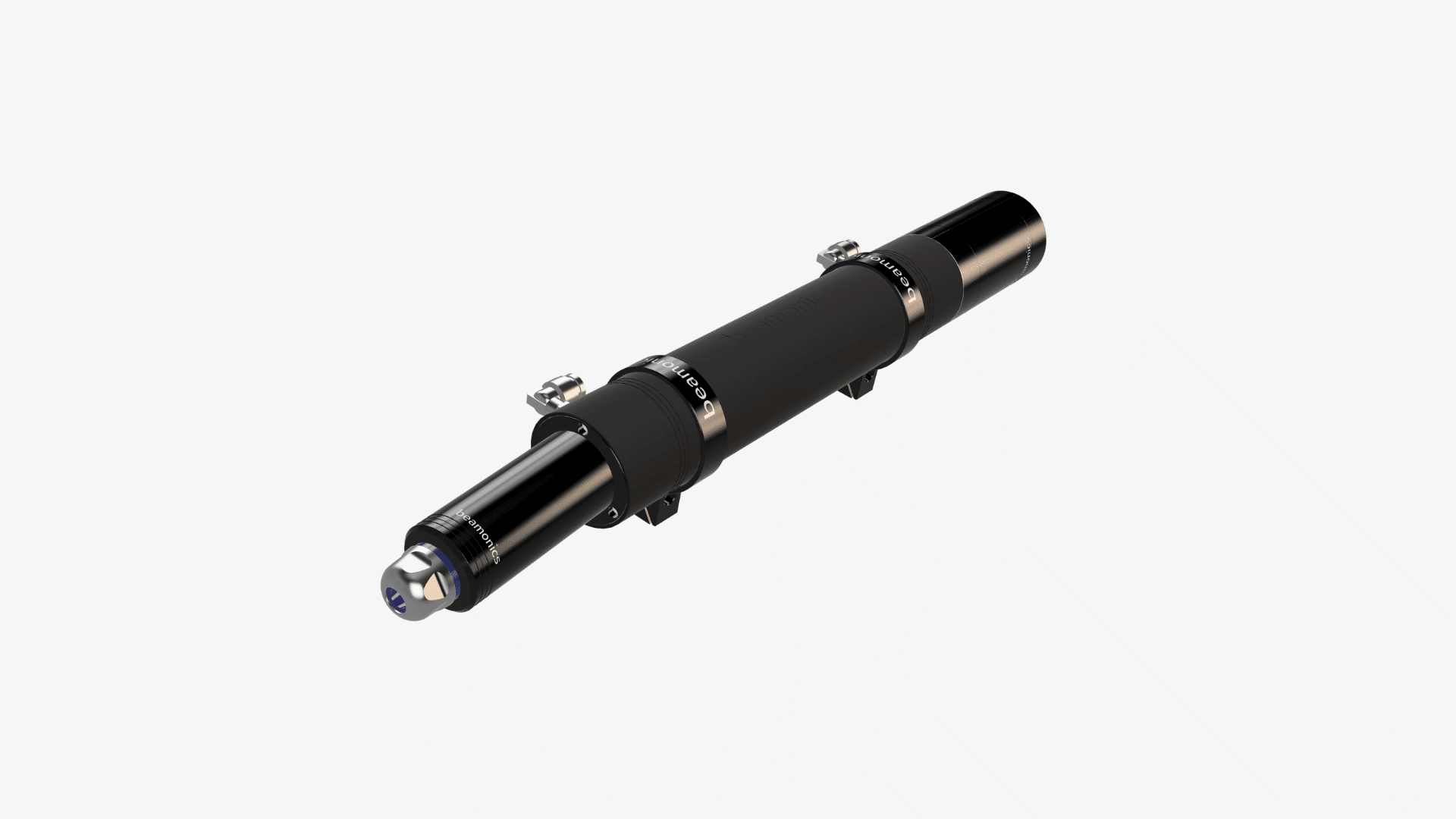
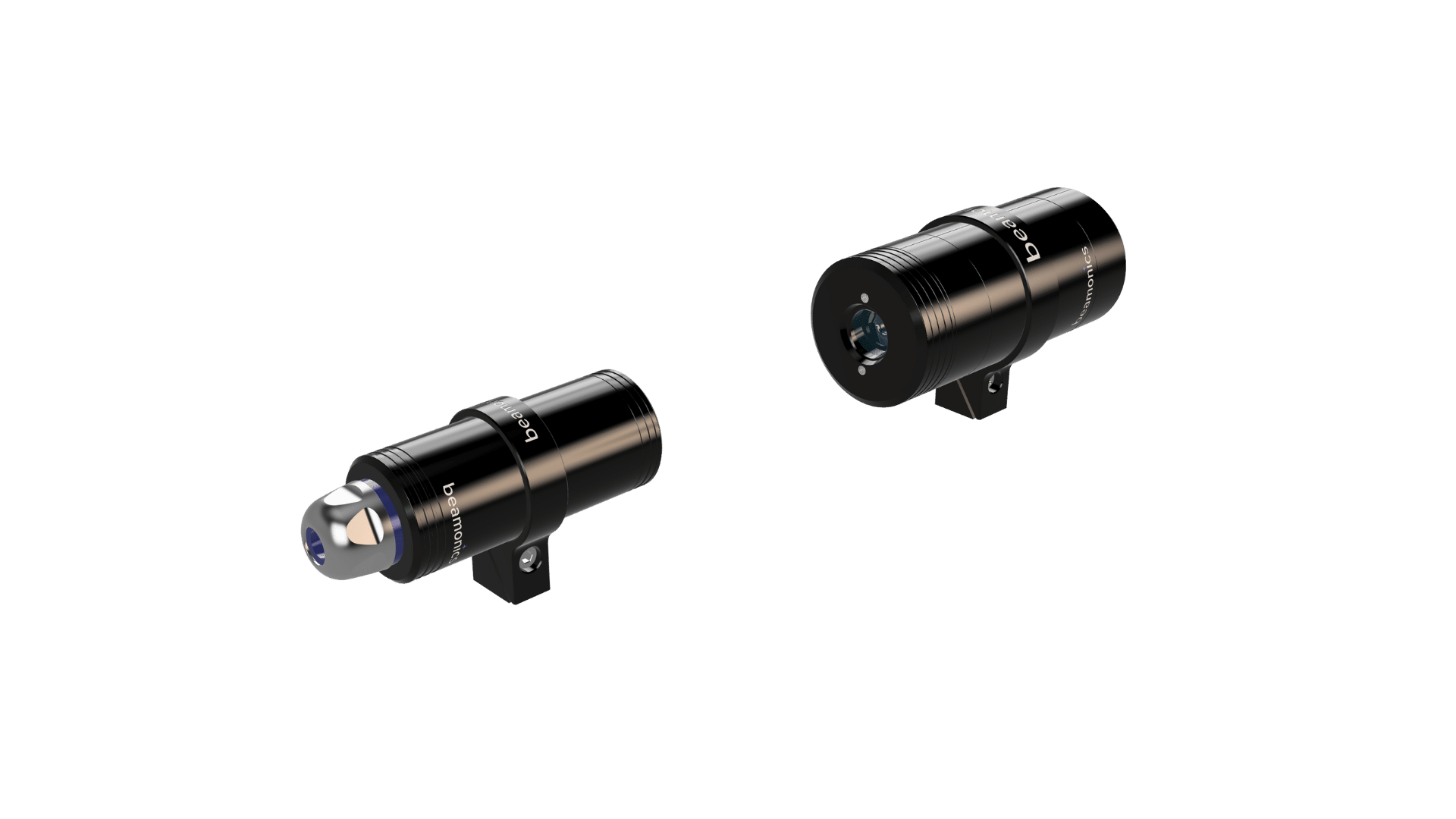
Beamonics BeamStack is a cross-stack, open-path analyzer that mounts a transmitter and receiver on opposite sides of a duct or process vessel. The laser beam passes directly through the gas, making the measurement in situ and non-extractive.
| Parameter | Value |
|---|---|
| Measurement type | In-situ, cross-stack / open-path |
| Analysis rate | 1 Hz to 10 kHz |
| Analysis precision, CO | 0.2 ppm |
| Analysis precision, H₂O | 0.2 ppm |
| Analysis precision, O₂ | 6 ppm |
| IP classification | IP67 |
| Operating temperature | −10 °C to 55 °C |
| Power consumption | 5 W |
| Startup time | 5 s (ambient) |
| Calibration | Factory-calibrated, no routine field calibration |
All precision values reported under standard test conditions: L = 1 m, t = 1 s, P = 1 atm, T = 300 K. Largest of 1% relative and specified precision.
Applications in heavy industry
Smelters and metal processing
Furnaces in aluminum, steel, and non-ferrous metal production operate at temperatures where thermocouples degrade rapidly. Replacing or recalibrating sensors in these environments is costly and often requires process shutdowns. A Beamonics TDLAS system installed across the furnace exhaust or combustion zone avoids direct contact with the process gas, eliminating sensor degradation. The real-time temperature data enables tighter control of burner settings, which reduces fuel consumption and can improve melt quality.
Gasification and syngas production
Gasification reactors convert biomass, coal, or waste feedstocks into syngas at temperatures typically above 700 °C, often in the presence of tar, particulates, and corrosive species such as H₂S. Thermocouple life in these conditions is measured in weeks or months. Beamonics TDLAS systems measuring CO and H₂O absorption can derive temperature alongside gas composition, giving operators a more complete picture of reactor performance without consumable sensor costs.
Boilers and combustion systems
Combustion optimization in industrial boilers depends on maintaining the correct air-fuel ratio. Temperature measurement downstream of the flame zone is one input to this control loop. Published field data from petroleum distillation furnaces has shown that reducing excess oxygen by 0.5 percentage points, enabled by better process monitoring, can save on the order of 240,000 litres of fuel per year at a single installation, with a corresponding reduction of roughly 720 tonnes of CO₂. While these figures are site-specific, they illustrate the scale of efficiency gains available when combustion control is improved through accurate, real-time gas analysis.
Reheating furnaces in steel rolling
Steel slabs must be heated uniformly before rolling. Temperature variations across the slab lead to uneven mechanical properties and increased scale formation. Conventional thermocouples placed at discrete points in the furnace cannot detect spatial gradients across the full width of the heating zone. A cross-stack TDLAS measurement provides a path-averaged temperature that reflects conditions across the entire optical path, giving operators better visibility into temperature uniformity.
Practical considerations
TDLAS temperature measurement requires optical line-of-sight between the transmitter and receiver. Installations where the beam path is frequently blocked by solid obstructions (not gas or dust, which can often be managed) may not be suitable.
The measurement is path-averaged. In processes with strong temperature gradients perpendicular to the beam, the reported value represents the mean along the optical path, not a spatially resolved profile. For applications requiring point-specific temperature data, supplementary sensors may be needed.
Beamonics instruments can handle transmission down to very low levels thanks to the proprietary platform, allowing processes to run uninterrupted without regular cleaning and re-calibration. In installations where the analyzer housing is exposed to radiant heat from the process, thermal shielding or standoff mounting may be required to stay within the −10 °C to 55 °C operating range.
TDLAS temperature measurement relies on well-characterized absorption lines of a gas species present in the process stream (commonly H₂O or CO₂). In processes with very low or unpredictable concentrations of these species, temperature extraction may not be practical. At Beamonics, we are experts on picking the path length for your specific measurement case. Please get in touch below.
Closing Remark
Non-contact temperature measurement using TDLAS is not a new concept in research, but its adoption in routine industrial monitoring has been limited by instrument cost, complexity, and a lack of compact, field-ready systems. As analyzer hardware becomes more robust and easier to integrate, the technique is likely to see broader use in applications where thermocouples have long been accepted as adequate despite their known limitations.