In Brief
Remote TDLAS analyzers measure gas concentration along an optical path without physical contact with the gas or installation of hardware at the measurement point. The instrument stays outside the hazard zone while delivering real-time, quantitative data. Stand-off analysis is suited to fence-line monitoring, leak localization across tank farms and well pads, stack-exit screening, and any scenario where extractive sampling is impractical due to access constraints, safety risk, or the scale of the area to be covered. Detection precision for key gases reaches 15 ppm·m for CH₄ and NH₃, 40 ppm·m for CO₂, and 0.05 ppm·m for HF under standard test conditions (Range = 8 m, t = 0.5 s, P = 1 atm, T = 300 K).
Background
Many industrial and environmental monitoring situations present a common problem: the gas that needs to be measured is in a place where conventional analyzers cannot easily go. Hot stacks, corrosive plume zones, confined spaces, open-air storage yards, elevated piping, and areas classified as hazardous for personnel entry all create barriers to installing sample probes or mounting transmitter-receiver pairs directly on the source.
Extractive sampling can address some of these situations, but it requires running tubing from the sample point to the analyzer, which introduces transport delay, potential sample losses for reactive gases, and a physical connection to the process that must be maintained. Cross-stack in-situ measurement requires mounting hardware on both sides of the duct, which is impractical when the source is an open area, a moving plume, or an elevated structure without suitable mounting points.
Remote gas analysis solves these problems by measuring from a distance. The analyzer is positioned at a safe, accessible location and directs a laser beam toward the gas of interest. No tubing, no mounting on the source, no entry into the hazardous zone. The measurement happens in real time, continuously, and the operator or control system receives quantitative concentration data without anyone or anything needing to be at the point where the gas exists.
How remote TDLAS measurement works
A remote TDLAS analyzer emits a narrowband laser beam toward the target area. The beam passes through whatever gas is present along its path and either reflects off a surface (a wall, the ground, a pipe, a retroreflector) or, in cross-stack configurations, reaches a dedicated receiver on the opposite side. As the laser is scanned across a specific molecular absorption line, gas molecules along the path absorb a fraction of the light. The instrument fits the measured absorption profile to a physical model based on the Beer-Lambert law and computes the concentration.
In stand-off mode, the instrument reports path-integrated concentration in ppm·m: the product of average gas concentration and the distance the beam traveled through the gas. A reading of 300 ppm·m could represent 30 ppm of gas distributed uniformly over 10 m, or a 150 ppm plume crossing 2 m of the beam path. If the geometry is known and the gas distribution is reasonably uniform, dividing ppm·m by the path length gives an average concentration in ppm.
The measurement is self-referencing. Each laser scan covers both the absorption feature and adjacent non-absorbing wavelength regions, which establishes the baseline within every measurement cycle. This eliminates drift, removes the need for routine span calibration, and makes the reading insensitive to slow changes in optical throughput from window contamination or atmospheric scattering.
Beamonics BeamSight
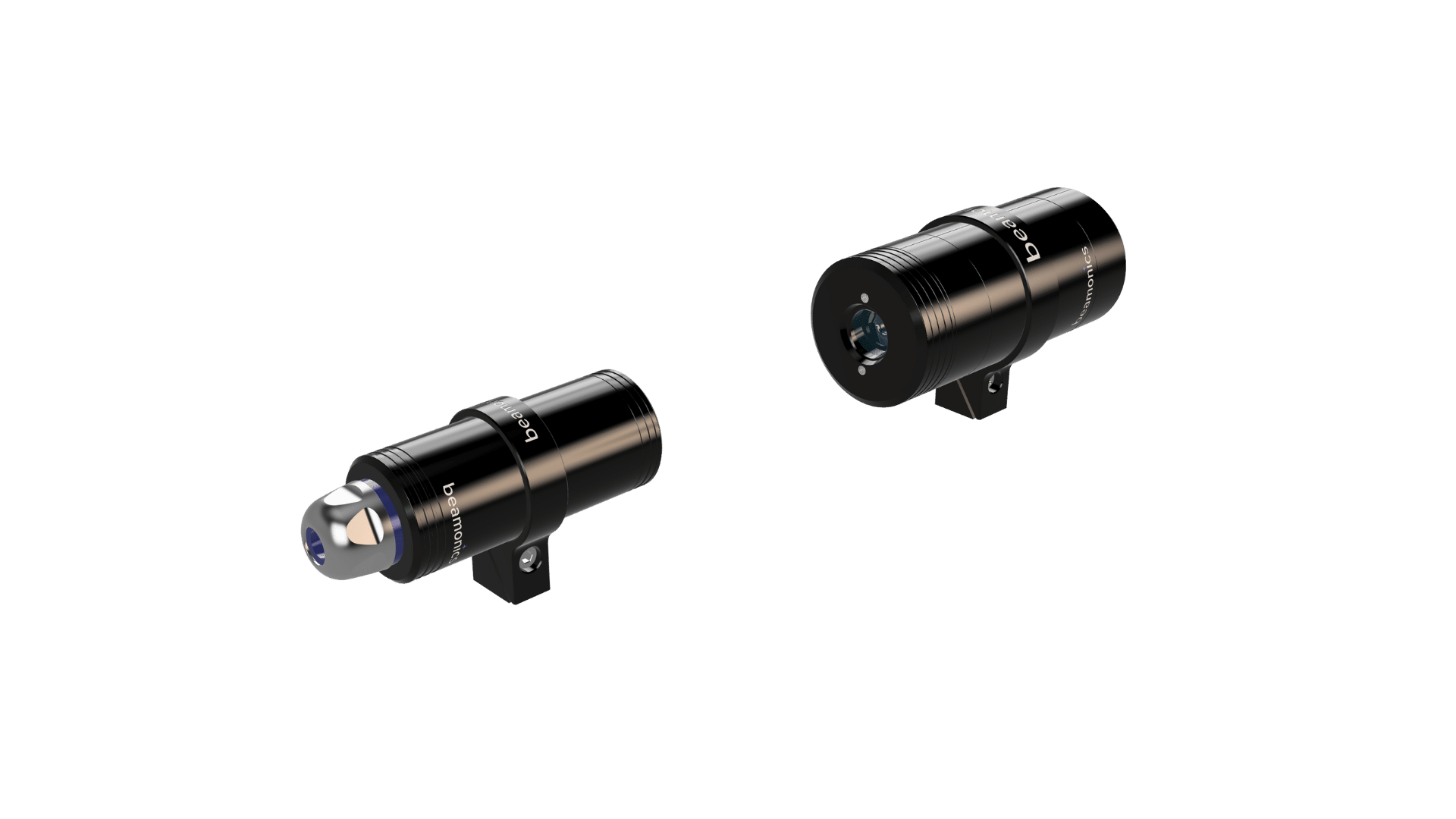
BeamSight is a compact remote TDLAS analyzer designed for stand-off gas detection. It operates as a true stand-off instrument: the laser and detector are in the same housing, and no aligned receiver or retroreflector is required at the far end (though a reflective surface extends the usable range). This eliminates the alignment procedures and cabling associated with transmitter-receiver pairs and allows rapid repositioning during surveys.
Detection range extends to 30 m in free space and up to 100 m when a reflective surface or retroreflector is available. The instrument is available in two configurations: a fixed-installation version weighing 0.7 kg and a battery-powered portable version at 1.0 kg with approximately 5 hours of operating life. Both configurations measure 147 mm × 111 mm × 84 mm (fixed) or 147 mm × 111 mm × 184 mm (portable) and accept 9 to 24 VDC external supply. Power consumption is 4.0 to 5.0 W.
Target gases include CH₄, CO₂, CO, HF, H₂S, and NH₃. Detection precision under standard test conditions (Range = 8 m, t = 0.5 s, P = 1 atm, T = 300 K) is as follows:
| Gas | Detection precision (ppm·m) |
|---|---|
| HF | 0.05 |
| CO | 15 |
| CO₂ | 40 |
| CH₄ | 15 |
| H₂S | 25 |
| NH₃ | 15 |
The analysis laser operates at Class 1 (eye-safe). A visible Class 3R aim laser assists with setup and targeting, requiring standard laser safety precautions during alignment. Interfaces include USB (Mini USB), I²C, UART, and GPIO via the expansion connector, plus a resistive touch display for field operation.
Applications for remote TDLAS
Fence-line and perimeter monitoring. A fixed BeamSight unit mounted on a mast, pole, or building wall monitors a fence line or facility boundary continuously. The beam traverses the air column along the perimeter, and any gas plume that crosses the path produces a measurable ppm·m signal. For differential monitoring, two instruments or two beam paths can be arranged as an upwind-downwind pair. The difference between the two readings isolates facility emissions from background variability. When the differential exceeds a defined threshold, the system triggers an alarm through the available digital interfaces.
Leak localization across large areas. Portable BeamSight, carried by hand or mounted on a tripod, scans across a tank farm, compressor station, well pad, or process unit from 10 to 30 m away. The operator moves the beam across the area and observes real-time concentration on the display. Elevated readings indicate the presence and approximate location of a leak. Because the instrument requires no setup at the far end, repositioning between vantage points takes seconds.
Stand-off triangulation. Two BeamSight units viewing the same area from different angles produce intersecting lines of sight. The point where both instruments detect elevated concentration locates the source. After triangulation, a handheld unit can approach for confirmation without entering the hazard zone. This technique is particularly useful in refineries, chemical plants, and offshore platforms where direct access to suspect components requires permits, scaffolding, or process shutdown.
Drone and rover-mounted surveys. At 1.0 kg in battery-powered configuration, BeamSight can be integrated onto drones or ground rovers for systematic area surveys. Aerial surveys cover elevated piping, flare headers, tank roofs, and remote wellheads that would otherwise require manned inspection. Ground rovers can patrol fence lines or landfill perimeters on a scheduled or continuous basis. The 5-hour battery life supports extended survey missions without interruption.
Stack-exit and exhaust screening. Pointing the instrument across a stack exit or ventilation outlet from a safe distance provides a rapid indication of emission levels without installing cross-stack hardware. This is useful for initial site assessments, temporary monitoring during turnarounds, or screening multiple emission points to prioritize which ones require permanent instrumentation.
Hazardous and confined-space adjacent monitoring. Environments where toxic gases such as HF or H₂S may be present at dangerous concentrations can be monitored from outside the hazard boundary. The 0.05 ppm·m detection precision for HF allows detection of very low-level releases at meaningful distances, supporting early warning before concentrations approach occupational exposure limits. No sensor element is exposed to the gas, which means there is no risk of sensor poisoning, and the measurement range extends from background atmospheric levels to full saturation without reconfiguration.
Pairing remote with extractive measurement
Remote stand-off measurement excels at area coverage, rapid screening, and access to difficult locations. It reports path-integrated concentration, which is powerful for detection and trending but does not directly provide point concentration at a specific component. For applications requiring absolute ppm at a defined location, regulatory compliance reporting against point-concentration thresholds, or process control loops that need a single-point input, an extractive TDLAS analyzer complements the remote instrument.
Beamonics BeamCell provides this complementary role. With NH₃ precision of 1 ppm, CO precision of 1 ppm, CH₄ precision of 1 ppm, H₂S precision of 1.5 ppm, and HF precision of 0.05 ppm under standard conditions (L = 0.185 m, t = 1 s, P = 1 atm, T = 300 K), BeamCell delivers the point-concentration data needed for verification and control. Its acid-resistant flow chamber and IP67 enclosure handle the same harsh gases that the remote instrument detects from a distance.
A practical workflow uses BeamSight for initial screening and leak localization, then BeamCell for quantification at the source and verification after repair. Both instruments share the same Beamonics TDLAS measurement principle and calibration-free operation, so results are directly comparable without cross-calibration concerns.
Practical considerations
Line of sight is mandatory. The laser beam must have an unobstructed path between the instrument and the reflection point or target surface. Structural obstructions, equipment, and vegetation that partially block the beam reduce the effective measurement path and can create dead zones. Survey the optical path before committing to a fixed installation.
Reflective surfaces extend range. Any hard surface, such as a wall, pipe, ground, or building, provides some diffuse reflection that the instrument can use. A dedicated retroreflector significantly increases return signal strength and extends usable range toward 100 m. For permanent installations at longer distances, a retroreflector is recommended.
Beamonics instruments can handle transmission down to very low levels thanks to the proprietary platform, allowing processes to run uninterrupted without regular cleaning and re-calibration. The instrument monitors optical signal levels and reports when attenuation exceeds normal operating thresholds. During conditions where optical transmission is severely reduced, extractive sampling via BeamCell is unaffected since the measurement occurs inside a sealed flow cell.
Narrow plumes dilute over long paths. A concentrated jet that crosses only a short segment of a long beam will produce a lower ppm·m reading than the same jet measured at close range with a short beam. For small, localized leaks, positioning the instrument closer and shortening the path improves sensitivity to the plume. Alternatively, angling the beam to maximize intersection with the expected plume geometry captures more of the signal.
Power and connectivity. The fixed-installation version operates from 9 to 24 VDC external supply at 4.0 to 5.0 W, which is compatible with solar-powered remote sites. The battery-powered version provides approximately 5 hours of continuous use. Data interfaces (USB, UART, I²C) support both real-time alarming and logged data retrieval for audit and analysis.
Closing Remark
Remote TDLAS measurement removes the requirement to place hardware at the point where the gas exists. For sites where access is restricted, where the source is distributed over a large area, or where safety constraints prevent direct instrumentation, stand-off analysis provides quantitative, real-time gas data from a safe distance. Combining remote screening with extractive point measurement creates a monitoring workflow that covers both broad area surveillance and precise source-level quantification using a consistent Beamonics TDLAS platform.