In Brief
Beamonics manufactures TDLAS-based gas analyzers in Lund, Sweden, built on a shared spectroscopy platform. The product line covers three distinct optical configurations: cross-stack (BeamStack), extractive (BeamCell), and remote stand-off (BeamSight). All three share the same core analysis engine, data interfaces, and calibration-free operating principle, while addressing different physical access and installation constraints.
Background
Gas analysis in industrial settings is rarely a single problem. A combustion process may need in-situ monitoring across a duct. A multi-point sampling system may need extractive analysis through a controlled flow cell. A leak survey may need remote detection at distance, without physical contact with the gas. Traditionally, these requirements have been served by separate instrument families, often from different vendors, each with its own interface conventions, calibration procedures, and maintenance schedules.
The Beamonics approach consolidates these three measurement geometries onto a single TDLAS platform. The spectroscopy engine, signal processing, data output protocols, and API are identical across all products. For facilities that operate more than one configuration, this reduces integration effort and simplifies spare parts and training requirements.
How the platform works
Tunable diode laser absorption spectroscopy (TDLAS) operates by scanning a narrowband laser across a specific molecular absorption line in the infrared spectrum. Each target gas absorbs light at wavelengths determined by its molecular structure, and the depth of that absorption is directly proportional to the gas concentration along the optical path, as described by the Beer-Lambert law. Because the measurement is referenced to a physical absorption line rather than to a chemical reaction or an external calibration standard, it is inherently selective and stable over time.
All Beamonics analyzers share this core principle. A tunable diode laser emits infrared light at a precisely controlled wavelength. As the laser current is modulated, the emission wavelength is scanned across the target gas absorption feature. A detector measures the transmitted light intensity, and the onboard spectroscopy engine calculates concentration from the absorption profile. The entire cycle completes in as little as 100 microseconds, enabling analysis rates up to 10 kHz depending on the product and application.
The self-referencing nature of the measurement eliminates the need for routine field calibration. Factory calibration is performed against known gas-line parameters and reference standards, and the analyzer’s output remains tied to molecular physics rather than to a sensor element that ages or drifts. Verification can be performed with a reference gas or through the instrument’s built-in diagnostics, but scheduled recalibration is not required.
Careful line selection is an inherent part of the Beamonics design process, and the analyzers as such offer little to no cross-interference.
Three configurations from a shared core
BeamStack: cross-stack and open-path
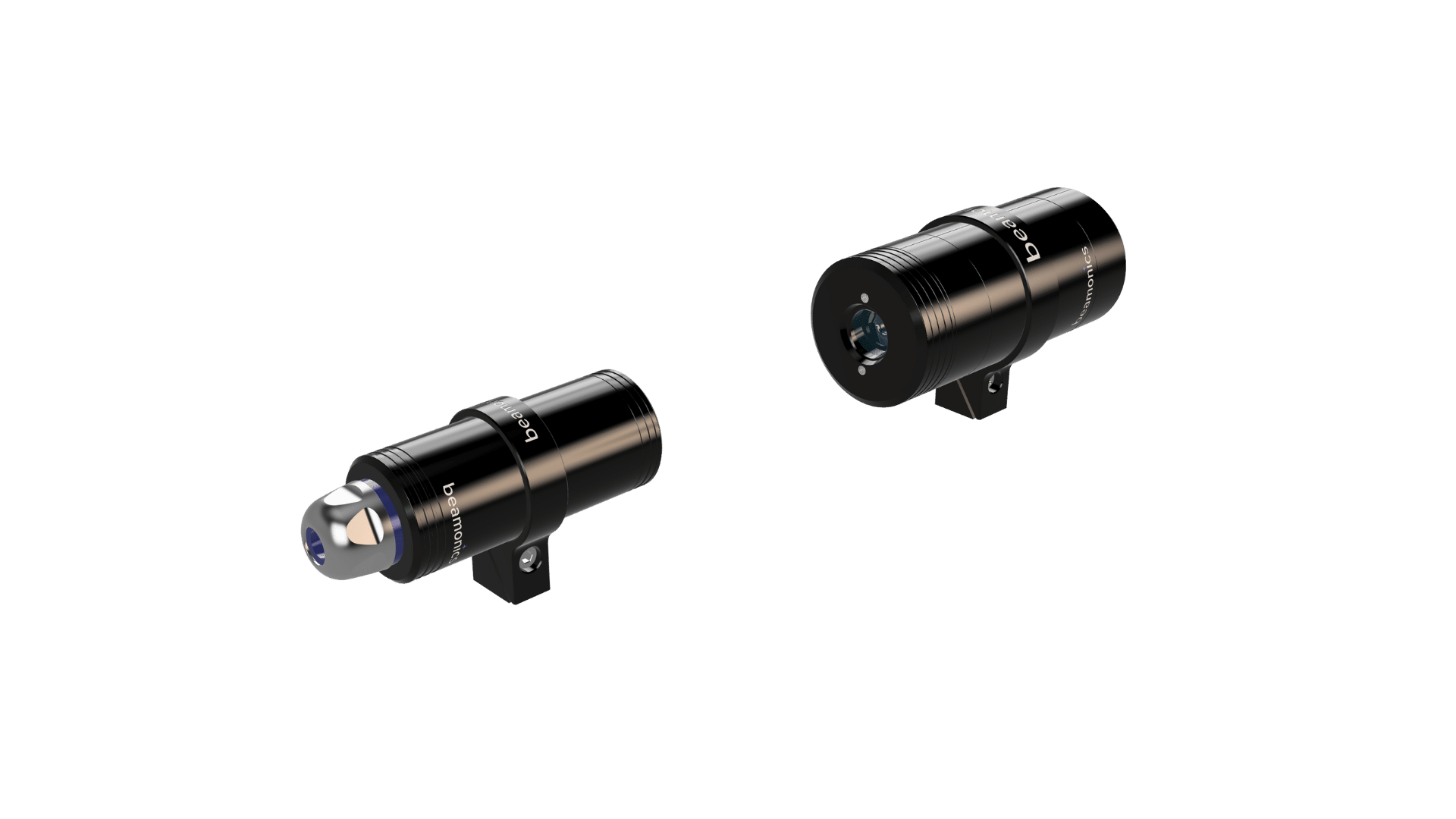
BeamStack places a transmitter and receiver on opposite sides of a duct, stack, or open space. The laser beam passes through the process gas in situ, providing a path-integrated concentration measurement without extracting a sample. This non-contact approach avoids sample conditioning, transport delays, and the failure modes associated with heated sample lines.
The instrument supports optical path lengths from short duct crossings to open-path measurements up to 30 metres. Analysis rates reach 10 kHz, which is relevant in turbulent or rapidly changing processes where slower instruments would average out short-duration events. BeamStack achieves O₂ precision of 6 ppm and CO precision of 0.2 ppm at a 1 m path length under standard test conditions (t = 1 s, P = 1 atm, T = 300 K).
Both transmitter and receiver are IP67-rated and designed for direct field mounting. Power consumption is 5 W typical, supply voltage ranges from 15 to 32 VDC, and the instrument reaches measurement state within approximately 5 seconds of power-up. Data interfaces include RS-485/422, USB, relay outputs, trigger inputs, and an expansion connector carrying I²C, SPI, UART, 4–20 mA, and 0–10 V signals.
BeamCell: extractive flow-through
BeamCell applies the same spectroscopy platform to extracted gas samples. Gas is drawn through a compact flow chamber (0.185 m optical path) fitted with push-in connectors (G1/8) adapted for 6 mm or 8 mm tubing. The controlled sample environment eliminates the optical path variability of in-situ measurements and provides repeatable conditions for trace-level work.
The extractive configuration suits applications where direct optical access across a duct is impractical, where multiple sampling points must be served by a single analyzer, or where sample conditioning is needed upstream. BeamCell’s real-time measurement allows sequential sampling from multiple valves: even 16 sampling points can be cycled within a few seconds.
The flow chamber is constructed from corrosion-resistant materials capable of withstanding aggressive gases including sulfuric acid. The instrument shares BeamStack’s IP67 enclosure, interface set, and electrical characteristics. O₂ precision is 30 ppm, CO precision is 1 ppm, and HF precision is 0.05 ppm at the 0.185 m internal path length under standard test conditions (t = 1 s, P = 1 atm, T = 300 K).
BeamSight: remote stand-off
BeamSight detects gas concentrations at a distance, without any physical contact with the target gas and without requiring a retroreflector on the far side. The instrument emits a laser beam and analyses the light scattered back from whatever surface lies beyond the gas volume. This single-ended configuration eliminates the need for alignment between a transmitter and a receiver, and allows rapid repointing to different areas.
Detection range extends to 30 m using natural diffuse back-reflections, or up to 100 m when a reflecting surface is available. The measurement is reported in ppm·m (concentration-path-length product), which is the natural unit for an integrated-path remote measurement. Detection precision for CH₄ is 15 ppm·m, for CO₂ 40 ppm·m, and for HF 0.05 ppm·m under standard test conditions (Range = 8 m, t = 0.5 s, P = 1 atm, T = 300 K).
BeamSight is available in two form factors. The fixed-installation version weighs 0.7 kg and measures 147 × 111 × 84 mm. The battery-powered portable version weighs 1.0 kg, includes an integrated battery providing approximately 5 hours of operation, and is sized at 147 × 111 × 184 mm. Both versions draw under 5 W and accept 9 to 24 VDC external supply. Interfaces include Mini USB, I²C, UART, and GPIO via an expansion connector, plus a resistive touch display.
The low weight and power consumption make BeamSight suitable for mounting on drones or ground-based rovers for autonomous survey work, as well as for handheld leak-searching sessions.
Target gases
The platform supports a range of infrared-active gases depending on the laser module installed. Commonly analysed species include O₂, CO, CO₂, CH₄, NH₃, HF, H₂S, H₂O, HCl, and N₂O. Not all gases are available on all product variants; BeamSight, for example, does not currently list O₂, H₂O, HCl, or N₂O in its datasheet specifications.
| Gas | BeamStack (ppm, 1 m) | BeamCell (ppm, 0.185 m) | BeamSight (ppm·m, 8 m) |
|---|---|---|---|
| O₂ | 6 | 30 | — |
| HF | 0.01 | 0.05 | 0.05 |
| CO | 0.2 | 1 | 15 |
| CO₂ | 0.5 | 2.5 | 40 |
| CH₄ | 0.2 | 1 | 15 |
| H₂S | 0.3 | 1.5 | 25 |
| NH₃ | 0.2 | 1 | 15 |
| H₂O | 0.2 | 1 | — |
Standard test conditions: t = 1 s (BeamStack, BeamCell) or t = 0.5 s (BeamSight), P = 1 atm, T = 300 K. Precision is the largest of 1% relative and the specified value.
Practical considerations
Beamonics instruments can handle transmission down to very low levels thanks to the proprietary platform, allowing processes to run uninterrupted without regular cleaning and re-calibration. In extractive configurations, the measurement occurs inside a sealed flow cell and is unaffected by external atmospheric conditions.
BeamSight reports concentration as a path-integrated value (ppm·m), not as a volumetric concentration (ppm). Converting to a point concentration requires knowledge of or assumptions about the gas distribution along the measurement path, which may not always be available.
All three instruments require optical line-of-sight between the laser source and the detection element (or the back-scattering surface, in the case of BeamSight). Obstructions, severe misalignment, or optical fouling will degrade or interrupt the measurement. The instruments’ built-in diagnostics monitor optical signal levels and flag fault conditions explicitly, rather than reporting degraded signals as false concentration readings.
Operating temperature range is −10 °C to 55 °C for BeamStack and BeamCell, and −10 °C to 50 °C (or −5 °C to 45 °C depending on configuration) for BeamSight. All instruments are rated for non-condensing humidity.
Closing Remark
Consolidating multiple measurement geometries onto a shared spectroscopy platform simplifies the instrumentation layer for facilities that need more than one type of gas measurement. As regulatory and process control requirements expand the number of measurement points across a site, the ability to deploy cross-stack, extractive, and remote analyzers with a common interface and data format becomes a practical advantage in system design and long-term maintenance planning.