In Brief
Carbon monoxide in combustion exhaust is a direct indicator of incomplete combustion. Elevated CO signals problems ranging from poor air-fuel mixing to flame instability, and if left undetected, it leads to equipment trips, downstream component damage, and hazardous gas accumulation. Beamonics TDLAS analyzers provide real-time CO measurement without the drift, cross-interference, and maintenance burden of electrochemical or NDIR sensors, making continuous monitoring practical in the high-temperature, high-dust environments where CO measurement matters most.
Background
Every combustion process produces carbon monoxide when fuel does not oxidize completely to CO₂. The causes are varied: insufficient oxygen supply, poor fuel-air mixing, low flame temperature, short residence time, uneven fuel loading across burner arrays, or mechanical faults such as damaged burner tips and leaking air registers. In a well-tuned system, CO concentrations in the exhaust are low, typically in the single-digit to tens-of-ppm range. When combustion degrades, CO rises, sometimes sharply, and often before other indicators such as temperature changes or visible flame behavior signal a problem.
This makes CO a leading indicator. A rising CO trend tells the operator that something has changed in the combustion process before that change manifests as equipment damage, a safety event, or a regulatory exceedance. The practical value of CO monitoring depends entirely on whether the data arrives fast enough and accurately enough to act on.
In facilities such as cement kilns, waste incineration plants, steel furnaces, power boilers, and refinery heaters, the consequences of missed CO events are concrete. A sustained CO excursion can trigger an automatic trip that shuts down the furnace or boiler, halting production and requiring a restart sequence that may take hours. CO that reaches downstream equipment, including particulate filters, heat exchangers, and emissions scrubbers, can cause thermal damage or, in the case of bag filters, fire. In enclosed ductwork, CO accumulation above the lower explosive limit creates an explosion hazard. In occupied spaces near combustion equipment, CO is an acute inhalation toxin with an 8-hour occupational exposure limit of 20 to 35 ppm depending on jurisdiction.
The common thread across these scenarios is that the problem is preventable if the CO concentration is known in real time and with sufficient accuracy to distinguish a developing fault from normal process variation.
Limitations of conventional CO sensors in combustion environments
Electrochemical (EC) CO sensors and non-dispersive infrared (NDIR) analyzers are widely installed in industrial combustion systems. Both have known performance limitations that become more consequential as combustion processes become more dynamic.
EC sensors measure CO through an electrochemical reaction at an electrode. The output current is proportional to CO concentration after linearization. The technology is compact and inexpensive per sensor, but the electrolyte ages over time, causing baseline drift that accumulates between calibration intervals. Typical drift rates require monthly to quarterly bump tests and periodic span calibration with reference gas to maintain accuracy. Cross-interference from H₂, H₂S, and other reducing gases common in combustion exhaust can produce false CO readings or suppress the true signal. Sensor poisoning from silicones, solvents, and acid gases shortens usable life, often to 6 to 24 months. Response times (T90) are typically 30 to 90 seconds, which means a brief CO spike lasting a few seconds may not register at all, or may appear as a small, attenuated bump in the data rather than the sharp peak it actually was.
NDIR analyzers measure CO by passing broadband infrared light through a gas cell and detecting absorption at CO-specific wavelengths using optical filters. NDIR provides better stability than EC sensors, but it is susceptible to interference from H₂O and CO₂, both of which absorb in overlapping infrared regions. In combustion exhaust where H₂O and CO₂ concentrations are high and variable, this cross-sensitivity can introduce measurement errors that are difficult to separate from real CO changes. NDIR instruments also require periodic zero and span calibration, and extractive versions depend on sample conditioning systems that add complexity, transport delay, and maintenance.
In processes with rapid load changes, cycling fuel blends, or variable waste feed (as in waste-to-energy facilities), the combination of slow response, drift between calibrations, and cross-interference means that conventional sensors may report a stable, reassuring CO reading while the actual concentration is fluctuating through peaks that would trigger corrective action if they were visible.
How TDLAS addresses CO measurement in combustion
TDLAS measures CO by scanning a narrowband laser across a specific CO absorption line in the near-infrared. Each wavelength scan, which takes microseconds, covers both the absorption peak and adjacent non-absorbing regions. The instrument fits the observed absorption profile to a model based on the Beer-Lambert law and known molecular parameters, and computes the CO concentration. Because the baseline and the absorption signal are measured in the same scan, the result is self-referencing: it does not depend on an external zero reference, does not drift with sensor age, and is not affected by changes in background gas composition.
Careful line selection is an inherent part of the Beamonics design process, and the analyzers as such offer little to no cross-interference. The laser targets a CO absorption line that is spectrally distinct from H₂O, CO₂, and other exhaust gas components. Unlike NDIR, which relies on optical bandpass filters that inevitably pass some radiation absorbed by non-target species, Beamonics TDLAS resolves the individual molecular line. Cross-interference from H₂O and CO₂, the primary interferents in combustion exhaust, is eliminated rather than corrected for.
TDLAS is a real-time technique with practically no response delay. The optical measurement is instantaneous, with the achievable time resolution governed by the analysis rate. Beamonics BeamStack and BeamCell both support analysis rates from 1 Hz to 10 kHz. At 1 Hz, each reported concentration value represents one second of averaged data. At higher rates, sub-second and even sub-millisecond transient events become visible. This means a 200-millisecond CO spike during a burner upset is captured as a resolved peak in the data, not smoothed into a slight upward trend in a 60-second rolling average.
The measurement requires no consumable sensor elements, no reference gas bottles, and no routine span calibration. The instruments continuously monitor their own optical signal levels, detector performance, and internal references, and report explicit fault conditions rather than degrading silently into inaccurate readings.
Instrument configurations for CO monitoring
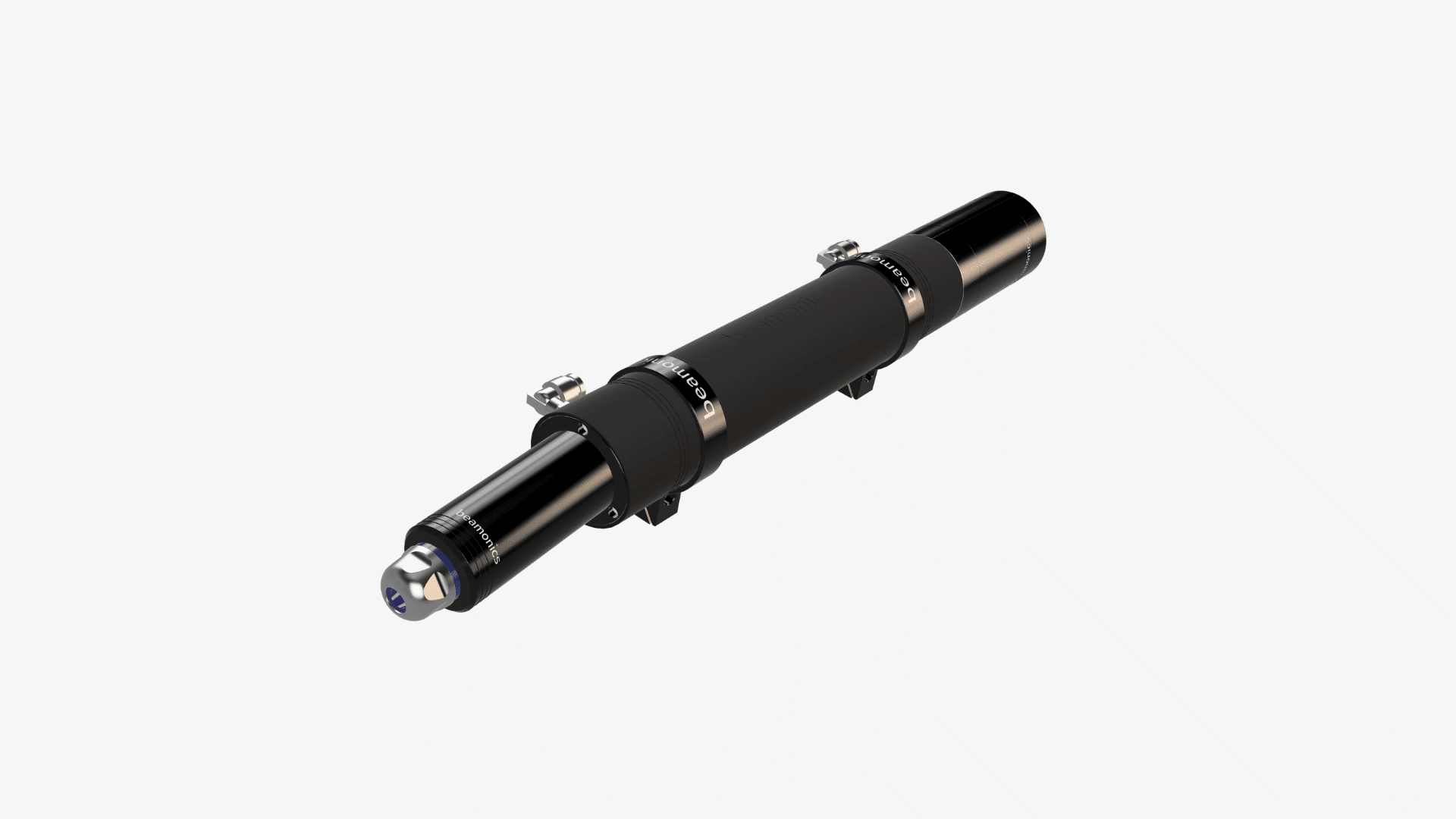
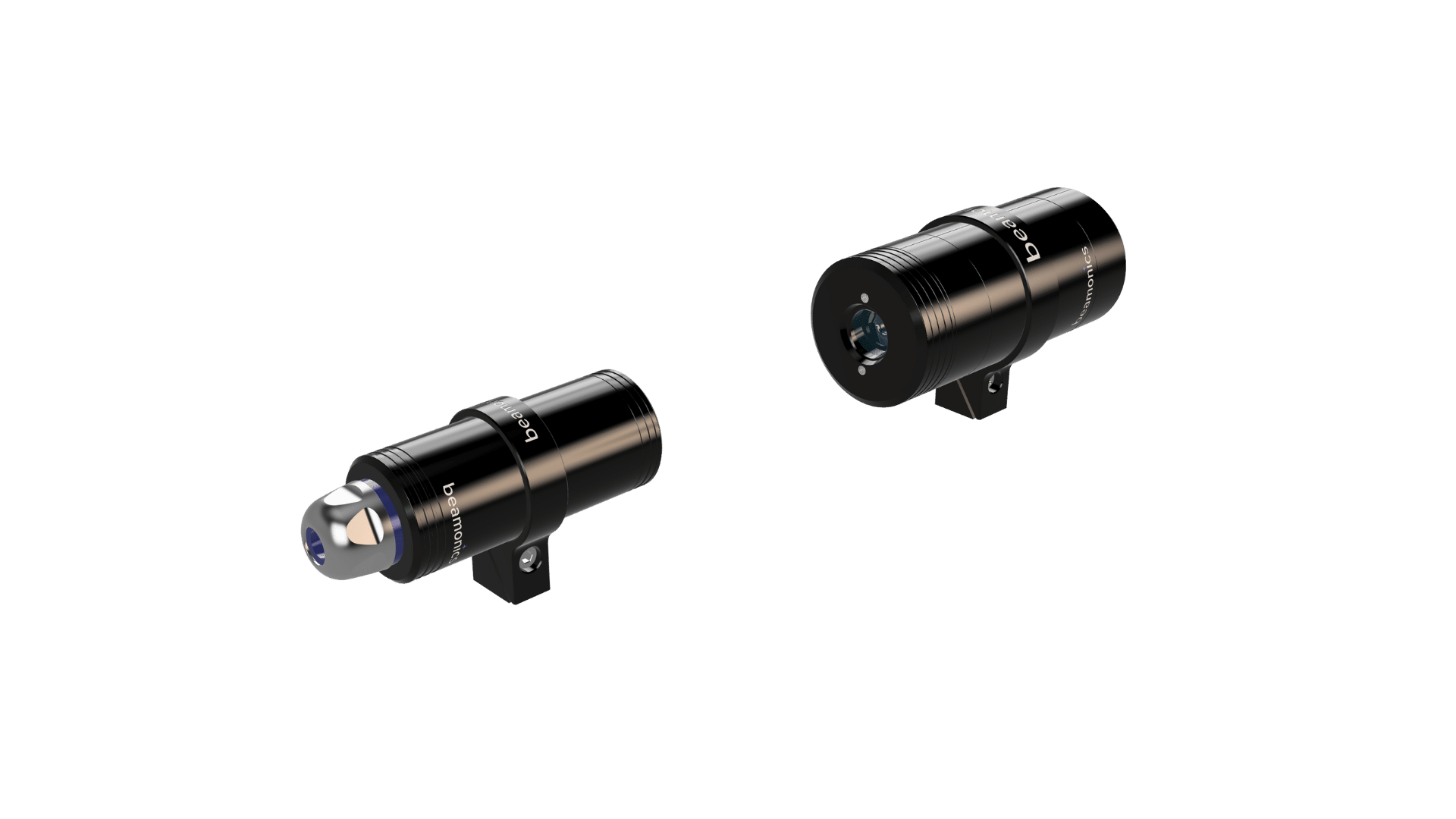
Cross-stack in-situ measurement. For continuous CO monitoring across a furnace stack, boiler exhaust duct, or kiln outlet, BeamStack mounts as a transmitter-receiver pair on opposite sides of the duct. The laser beam passes directly through the exhaust gas with no sample extraction, no transport tubing, and no conditioning system. The path-averaged CO concentration is reported in real time at the selected analysis rate. Under standard test conditions (L = 1 m, t = 1 s, P = 1 atm, T = 300 K), CO analysis precision is 0.2 ppm. The instrument is rated IP67, operates from −10 °C to 55 °C, consumes 5 W, and reaches measurement-ready state in approximately 5 seconds after power-up. PLC integration is supported through RS-485, 4–20 mA, and relay outputs.
This is the preferred configuration when the duct geometry allows line-of-sight mounting and when the fastest possible response is required, since there is zero transport delay between the gas and the measurement.
Extractive sampling. When the exhaust stream carries heavy particulate, entrained liquid, or condensable species that would foul in-situ optics, or when multiple measurement points must be served by a single analyzer, BeamCell provides CO measurement through a compact extractive flow cell. Gas is drawn through the acid-resistant chamber (0.185 m optical path) via G1/8 push-in connectors for 6 or 8 mm tubing. CO precision under standard conditions (L = 0.185 m, t = 1 s, P = 1 atm, T = 300 K) is 1 ppm. Multi-point valve sequencing allows cycling through several sample locations within seconds, which is useful for monitoring CO at multiple points along a combustion system, such as before and after a scrubber, or across several burner zones.
Remote stand-off monitoring. For screening flare stacks, open combustion sources, or areas where duct-mounted hardware is impractical, BeamSight provides stand-off CO detection at distances up to 30 m (100 m with a reflector). CO detection precision is 15 ppm·m under standard test conditions (Range = 8 m, t = 0.5 s, P = 1 atm, T = 300 K). The battery-powered portable version (1.0 kg, approximately 5 hours battery life) supports survey-style monitoring of multiple emission points without permanent installation.
CO monitoring as a process control input
The value of continuous CO data extends beyond safety alarms. When CO concentration is available in real time with sub-second resolution, it becomes a process control variable.
Air-fuel ratio optimization. CO and O₂ together define the combustion envelope. Excess air wastes energy by heating nitrogen that does not participate in combustion. Insufficient air produces CO and unburned hydrocarbons. The optimal operating point, where emissions and fuel consumption are both minimized, sits in a narrow band. Real-time CO feedback allows the control system to hold the process in that band, adjusting fan speeds or fuel valves in response to actual exhaust composition rather than relying on fixed air-to-fuel schedules that cannot account for changing fuel quality, ambient conditions, or equipment degradation.
Early fault detection. A step change in CO that correlates with a specific burner zone indicates a localized problem: a clogged nozzle, a failing igniter, or an air register that has shifted position. A gradual upward CO trend across all zones suggests systemic changes such as fuel quality deterioration or fan performance decline. Catching these patterns early, before they progress to a trip condition or equipment damage, converts a potential unplanned shutdown into a planned maintenance intervention.
Compliance documentation. Emission permits typically specify both average and short-term CO limits. Continuous monitoring at adequate time resolution provides the documentation needed to demonstrate compliance during both steady-state operation and transient events such as startup, shutdown, and load changes. This is particularly relevant for facilities subject to continuous emissions monitoring system (CEMS) requirements.
Practical considerations
CO concentration in combustion exhaust can range from sub-ppm during optimized operation to thousands of ppm during upset conditions. The TDLAS measurement handles this range without switching modes or saturating, because the relationship between absorption and concentration is governed by the Beer-Lambert law across the full range. The instrument does not have a fixed measurement span that must be configured for either low or high concentrations.
Beamonics instruments can handle transmission down to very low levels thanks to the proprietary platform, allowing processes to run uninterrupted without regular cleaning and re-calibration. In cross-stack installations on hot stacks, thermal expansion of the duct and structural movement can affect optical alignment. BeamStack’s optical design tolerates the alignment variations typical of industrial ductwork, but mounting should allow for thermal movement.
For extractive installations, CO is not a sticky gas in the way that NH₃ or HF are, so sample line losses are minimal with standard tubing materials. However, if the exhaust contains significant moisture, heated sample lines prevent condensation that could dissolve co-present acid gases and create corrosive condensate in the tubing.
The 0.2 ppm CO precision of BeamStack at 1 m path length is well below the concentration levels relevant for combustion control and compliance in most applications. At Beamonics, we are experts on picking the path length for your specific measurement case. Please get in touch below.
Closing Remark
CO monitoring in combustion processes is a measurement problem with two time constants: the fast transients that indicate developing faults and the slow trends that track equipment and fuel condition over weeks and months. Beamonics TDLAS resolves both. Real-time response captures the peaks that conventional sensors miss, while calibration-free stability ensures that the baseline reading six months from now is as reliable as the one measured today. For facilities where unplanned shutdowns carry significant cost and safety implications, continuous CO data is not supplementary instrumentation. It is the primary feedback signal for keeping the combustion process within its operating envelope.