In Brief
Combustion processes generate gas composition changes on timescales of milliseconds to seconds. Analyzers with response times measured in tens of seconds or minutes report averaged values that obscure transient events, including short emission spikes, burner instability, and rapid process excursions. Beamonics TDLAS analyzers with analysis rates up to 10 kHz capture these dynamics as they occur, providing data that is fast enough for real-time process control, compliance-relevant peak detection, and diagnostic troubleshooting in stacks, ducts, and open-air environments.
Background
Combustion exhaust composition is not steady. A gas turbine adjusting load, a flare stack responding to process upsets, a boiler cycling through fuel blends, or an engine operating under transient conditions all produce exhaust gas concentrations that fluctuate on sub-second timescales. CO spikes during incomplete combustion may last fractions of a second. O₂ fluctuations during air-fuel ratio adjustments occur within a few seconds. NH₃ slip from selective catalytic reduction systems can vary with catalyst temperature and reagent injection timing.
These transient events carry disproportionate significance. A brief CO exceedance may represent the majority of a facility’s non-compliant operating time. A momentary oxygen dip can indicate burner instability that precedes a flameout. An NH₃ spike downstream of a scrubber signals a dosing control problem that, if caught in real time, can be corrected before it affects downstream equipment or triggers an emission limit breach.
Conventional gas analyzers based on electrochemical cells, catalytic beads, or paramagnetic sensors have response times (T90) measured in tens of seconds to minutes. By the time these instruments register a change, the event may already be over. The reported value is a time-averaged approximation that smooths out the peaks and troughs that matter most for control and compliance. Extractive systems with long sample lines add further transport delay, compounding the problem.
TDLAS operates on a fundamentally different timescale. The laser is scanned across an absorption line thousands of times per second, and each scan yields an independent concentration measurement. The limiting factor is not the spectroscopy, which is inherently fast, but how the data is processed and reported. The Beamonics platform supports analysis rates from 1 Hz up to 10 kHz, giving the operator or control system access to concentration data at whatever time resolution the application requires.
Measurement principle at high speed
In a TDLAS analyzer, a narrowband laser is scanned across a narrow spectral region containing an absorption line of the target gas. Each scan takes microseconds. As the laser light passes through the gas, molecules of the target species absorb a fraction of the light at the characteristic wavelength. The instrument measures the transmitted intensity profile, fits the observed absorption feature to a physical model based on the Beer-Lambert law and known molecular parameters, and computes the gas concentration.
Because each wavelength scan covers both the absorption peak and adjacent non-absorbing regions, the measurement is self-referencing within every single cycle. The baseline is established and the absorption is quantified in the same operation, on the same timescale. This is what makes the measurement intrinsically fast: there is no integration period required to build up a signal, no chemical reaction that must reach equilibrium, and no diffusion process that limits how quickly the instrument can respond to a change in gas concentration.
At an analysis rate of 10 kHz, the instrument produces 10,000 independent concentration measurements per second. For most process control and compliance applications, this data is averaged down to 1 Hz or 10 Hz for reporting, but the raw high-speed data is available for diagnostic analysis, transient event characterization, and research applications where sub-millisecond resolution is valuable.
Beamonics BeamStack and BeamCell both support analysis rates from 1 Hz to 10 kHz on the same TDLAS platform. The choice between them depends on the measurement geometry, not on speed capability.
Measurement configurations for combustion and outdoor applications
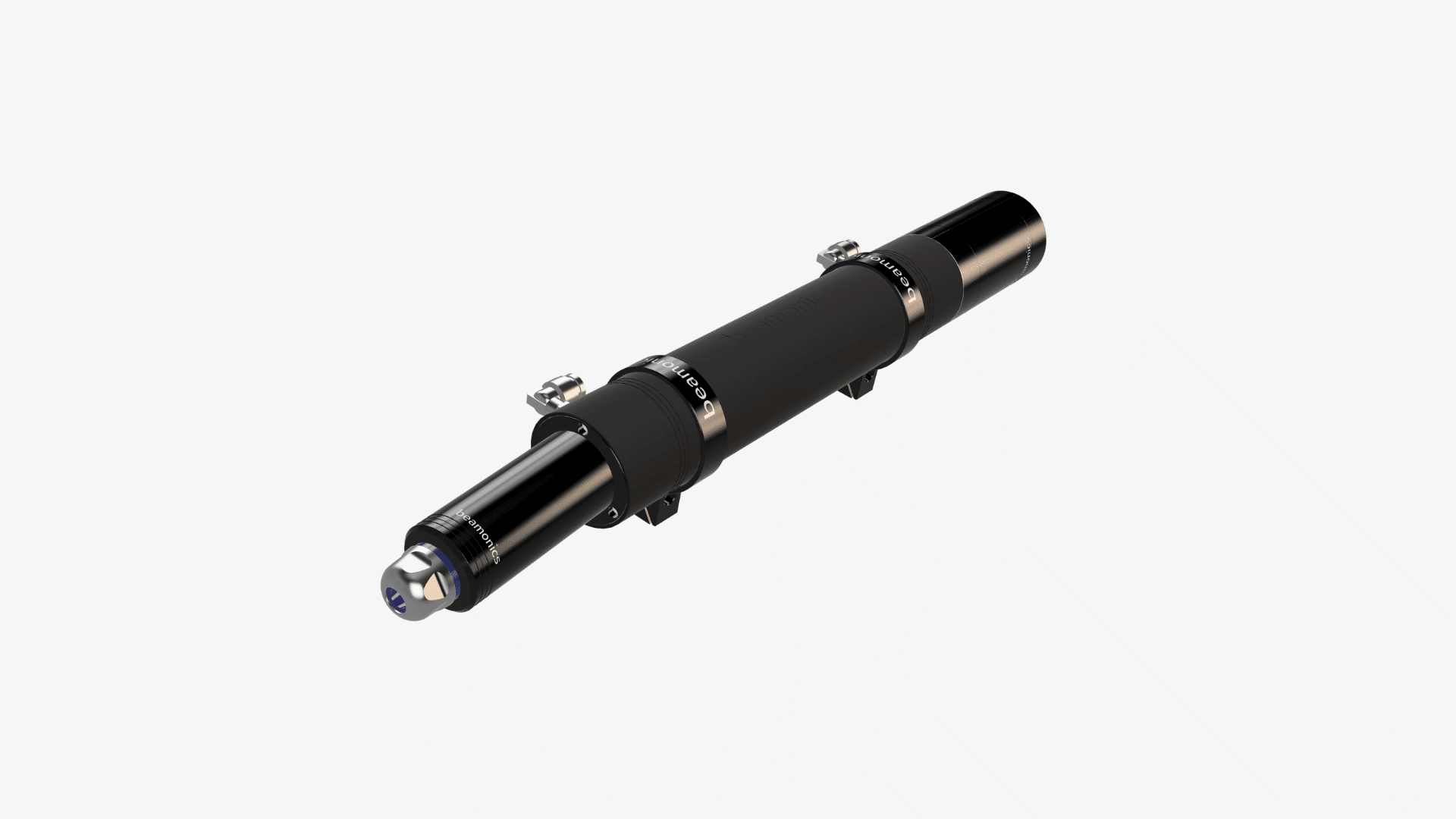
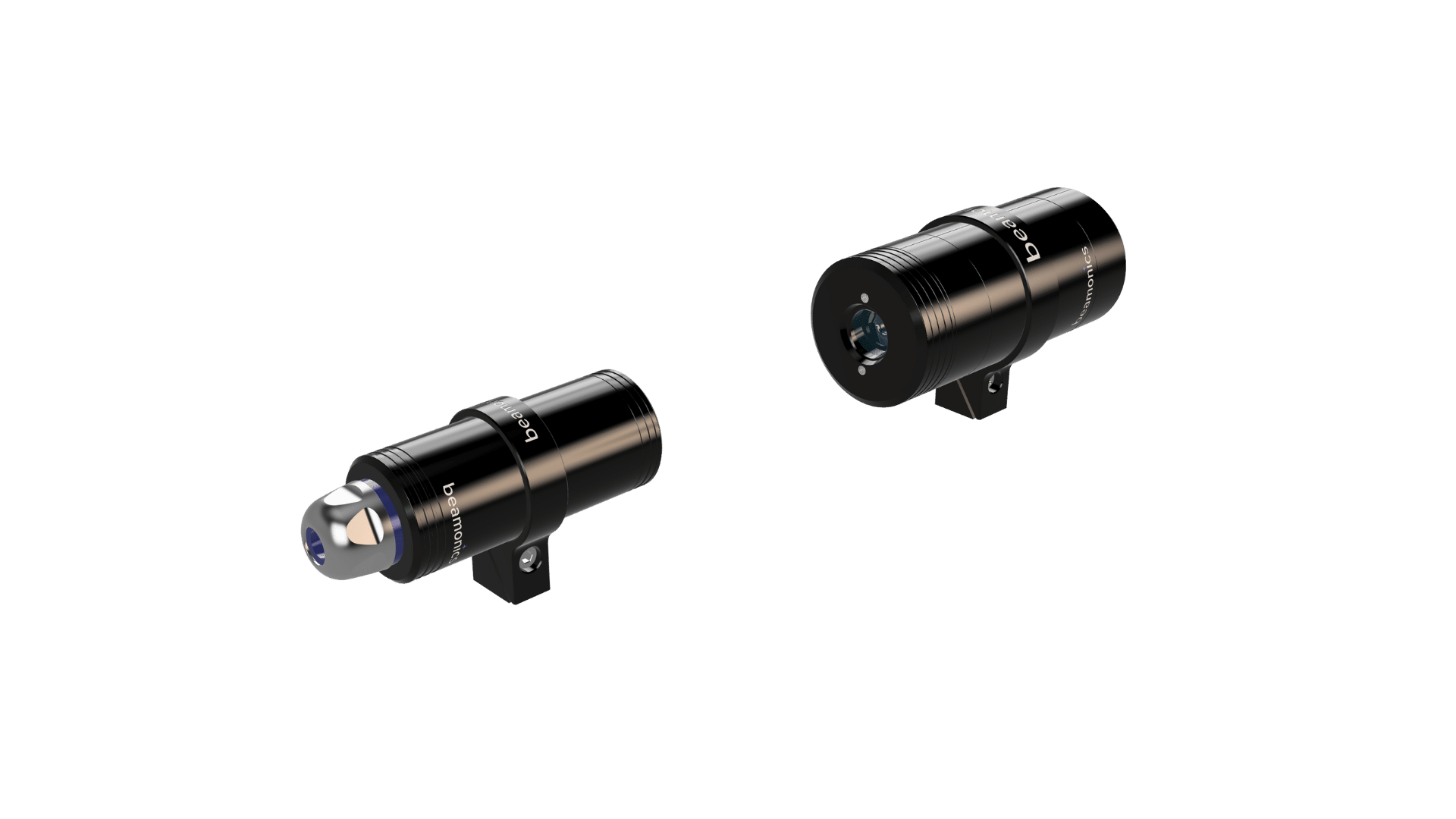
Cross-stack in-situ monitoring. For stacks and ducts where continuous compliance monitoring or combustion control is required, BeamStack mounts as a transmitter-receiver pair on opposite sides of the flow. The laser beam traverses the full duct cross-section, providing a path-averaged concentration that is spatially representative. There are no sample lines, no transport delay, and no sample conditioning. Response is limited only by the analysis rate. Under standard test conditions (L = 1 m, t = 1 s, P = 1 atm, T = 300 K), analysis precision reaches 0.2 ppm for CO, 0.5 ppm for CO₂, 6 ppm for O₂, 0.2 ppm for CH₄, 0.2 ppm for NH₃, and 0.01 ppm for HF. The instrument operates from −10 °C to 55 °C at IP67, with 5 W power consumption, 5-second startup, and standard PLC interfaces (RS-485, 4–20 mA, relay outputs).
Extractive sampling for conditioned measurement. When the exhaust stream carries heavy particulate, condensable tars, or entrained liquids that would foul in-situ optics, BeamCell provides the same TDLAS measurement in a controlled extractive configuration. Gas is drawn through the acid-resistant flow chamber (0.185 m optical path) via G1/8 connectors for 6 or 8 mm tubing. Precision under standard conditions (L = 0.185 m, t = 1 s, P = 1 atm, T = 300 K) reaches 1 ppm for CO, 2.5 ppm for CO₂, 30 ppm for O₂, 1 ppm for CH₄, 1 ppm for NH₃, and 0.05 ppm for HF. Multi-point valve sequencing allows a single analyzer to monitor several locations in a combustion system, cycling through sample points within seconds.
Remote stand-off screening. For initial assessment of emission sources, temporary monitoring during turnarounds, or surveillance of flare stacks and open combustion sources from a safe distance, BeamSight provides stand-off measurement at up to 30 m (100 m with reflector). Detection precision under standard conditions (Range = 8 m, t = 0.5 s, P = 1 atm, T = 300 K) reaches 15 ppm·m for CO, 40 ppm·m for CO₂, 15 ppm·m for CH₄, 15 ppm·m for NH₃, and 0.05 ppm·m for HF. The portable battery-powered version (1.0 kg, approximately 5 hours battery life) supports handheld or drone-mounted surveys of multiple emission points without permanent installation.
What high-speed data enables
The practical value of high analysis rates depends on what is done with the data. Raw 10 kHz output is relevant for research and diagnostics, but for most process applications, the benefit of fast spectroscopy is that it resolves events that slower instruments miss, even when the reported output is averaged to 1 or 10 Hz.
Compliance peak capture. Emission regulations increasingly require reporting of short-term peaks as well as time-averaged concentrations. A 15-minute average that falls below a CO limit may contain 30-second exceedances that a fast analyzer detects and logs. This data supports both compliance demonstration (showing that peaks were within limits) and root-cause analysis (identifying which operating conditions caused the spike).
Combustion optimization. Adjusting air-to-fuel ratio for minimum emissions requires feedback that reflects the current state of the flame, not the state from 30 seconds ago. Sub-second CO and O₂ readings allow tighter control of the combustion envelope, reducing CO and NOx formation without overshooting into fuel-rich conditions that waste energy. The economic return from improved combustion efficiency in large boilers and furnaces can be substantial.
Burner diagnostics. Cyclic patterns in CO or O₂ at specific frequencies can indicate mechanical problems: a sticking fuel valve, uneven air distribution, or flame instability. Detecting these patterns requires data at a rate that resolves the oscillation period. A 1 Hz output may reveal a slow drift, but catching a 2 Hz flame oscillation requires at least 4 Hz sampling. The 10 kHz capability of the Beamonics platform provides headroom for any industrially relevant diagnostic frequency.
Transient event characterization. Startup, shutdown, load changes, and fuel switching all produce transient gas composition profiles. Characterizing these profiles accurately, rather than seeing them as blurred averages, supports process model validation, operator training, and permit applications that must demonstrate emission behavior during non-steady-state operation.
Practical considerations
Beamonics instruments can handle transmission down to very low levels thanks to the proprietary platform, allowing processes to run uninterrupted without regular cleaning and re-calibration. Careful line selection is an inherent part of the Beamonics design process, and the analyzers as such offer little to no cross-interference, even in the complex gas matrices typical of combustion exhaust.
Fast data generates large data volumes. At 10 kHz, a single gas channel produces 864 million data points per day. Practical installations typically log at a reduced rate (1 to 100 Hz) for trending and alarm purposes, with burst-mode high-speed logging triggered by events or operator command. Interface bandwidth and storage capacity should be sized accordingly.
Analysis rate and detection precision trade off against each other. Averaging more scans improves signal-to-noise ratio and lowers the detection limit. At 1 s averaging, the Beamonics platform achieves its specified precision values. At 10 kHz output with no averaging, individual readings will have higher noise. The appropriate rate depends on whether the application prioritizes temporal resolution or detection sensitivity.
Cross-stack path length affects both sensitivity and spatial representativeness. Longer paths yield lower detection limits (more gas molecules interact with the beam) and better spatial averaging across the duct. Shorter paths may be necessary in very high-temperature environments where beam attenuation limits the usable distance. At Beamonics, we are experts on picking the path length for your specific measurement case. Please get in touch below.
Closing Remark
The speed of a TDLAS measurement is set by physics, not by the limitations of a chemical reaction or a diffusion process. For combustion exhaust and outdoor gas monitoring, this means concentration data at the timescale of the process itself, capturing the transient events that determine compliance status, combustion efficiency, and equipment health. The choice between cross-stack, extractive, and remote stand-off configurations adapts the same fast spectroscopic core to the specific access, conditioning, and coverage requirements of each installation.