In Brief
Combustion efficiency depends on maintaining the correct excess oxygen level in the flue gas. Too much O₂ wastes fuel by heating unnecessary air; too little produces carbon monoxide, unburned hydrocarbons, and soot. TDLAS provides fast, drift-free O₂ measurement that can replace or supplement zirconia probes and paramagnetic analyzers, particularly in applications where response speed, long-term stability, or harsh flue-gas conditions challenge conventional sensors.
Background
Combustion control in boilers, furnaces, kilns, and gas turbines is fundamentally a problem of managing the air-to-fuel ratio. The two primary feedback variables are O₂ and CO in the flue gas. O₂ indicates how much excess air is passing through the combustion zone. CO indicates whether the combustion is complete: rising CO signals that the air supply is insufficient for the fuel being burned, or that mixing and residence time are inadequate.
The target is a narrow operating window. Running lean (high excess O₂) ensures complete combustion but penalises thermal efficiency, because the additional nitrogen and oxygen in the flue gas absorb heat that would otherwise transfer to the process. Running rich (low O₂) improves thermal efficiency but risks incomplete combustion, producing CO, soot, and in some cases dangerous reducing atmospheres inside the furnace. The optimum typically lies between 1% and 4% O₂ in the flue gas, depending on the fuel, burner design, and process requirements.
Keeping the process within this window requires an O₂ measurement that is fast enough to track load changes, stable enough to avoid gradual bias, and robust enough to survive the temperature, particulate, and chemical environment of an industrial flue-gas path.
Conventional O₂ measurement technologies
Two technologies dominate installed-base combustion O₂ monitoring: zirconia probes and paramagnetic analyzers.
Zirconia (ZrO₂) probes are in-situ sensors that operate at high temperature, typically 600 to 800 °C. A ceramic element generates a voltage proportional to the difference in oxygen partial pressure between the flue gas and a reference (usually ambient air). Zirconia probes are widely used, relatively inexpensive, and respond in the range of a few seconds.
Their principal weakness is behaviour in reducing atmospheres. When the local flue-gas composition shifts to the fuel-rich side, combustible species at the probe tip react with available oxygen on the ceramic surface, consuming O₂ before it reaches the sensing element. The result is a false-low O₂ reading, which can cause the control system to reduce air supply further, pushing the process deeper into a reducing condition. This failure mode is well documented in boiler and furnace operation and is a significant safety and efficiency concern in processes with variable fuel quality or rapid load swings.
Zirconia probes also require periodic calibration, are sensitive to thermal shock during rapid temperature changes, and can suffer from reference air contamination. Probe replacement intervals vary but are typically measured in months to a few years depending on the severity of the environment.
Paramagnetic O₂ analyzers exploit the unusually strong paramagnetic susceptibility of the O₂ molecule. They are accurate and selective, but they are extractive instruments: the flue gas must be sampled, conditioned (cooled, filtered, dried), and transported to the analyzer. This sample-conditioning chain introduces transport delay, adds maintenance burden (filters, condensate drains, heated sample lines), and measures a point sample rather than a path-averaged value. Response times are typically in the range of 10 to 30 seconds once sample transport is accounted for.
For applications where response speed, in-situ measurement, and long-term stability without recalibration are priorities, both technologies have limitations that TDLAS can address.
How TDLAS measures O₂ in flue gas
Tunable diode laser absorption spectroscopy (TDLAS) measures oxygen by scanning a narrow-band laser across one of the molecular absorption lines in the O₂ A-band near 760 nm. The laser beam passes through the flue gas, either across a duct (cross-stack configuration) or through an extractive measurement cell, and the attenuation at the absorption wavelength is used to calculate concentration via the Beer-Lambert relation.
Because the measurement references a physical property of the oxygen molecule, it does not drift with time and does not depend on a consumable sensing element. Factory calibration against known gas-line parameters and reference standards sets the instrument, and routine field recalibration is not required. Verification can be performed using a reference gas or the instrument’s built-in self-diagnostics.
O₂ absorbs in the near-infrared at wavelengths that are well-separated from the absorption features of CO₂, H₂O, CO, and other common flue-gas species. This spectral selectivity means the O₂ reading is not affected by cross-interference from other gases present in the measurement path, a practical advantage in flue-gas environments where the background matrix changes with fuel type and combustion conditions.
The Beamonics platform completes a spectroscopic analysis cycle in as little as 100 microseconds, with configurable analysis rates up to 10 kHz. For combustion control, where boiler load changes and burner modulations produce O₂ fluctuations on timescales of seconds, this speed enables the control system to track real process dynamics rather than responding to delayed or time-averaged data.
Choosing a measurement configuration
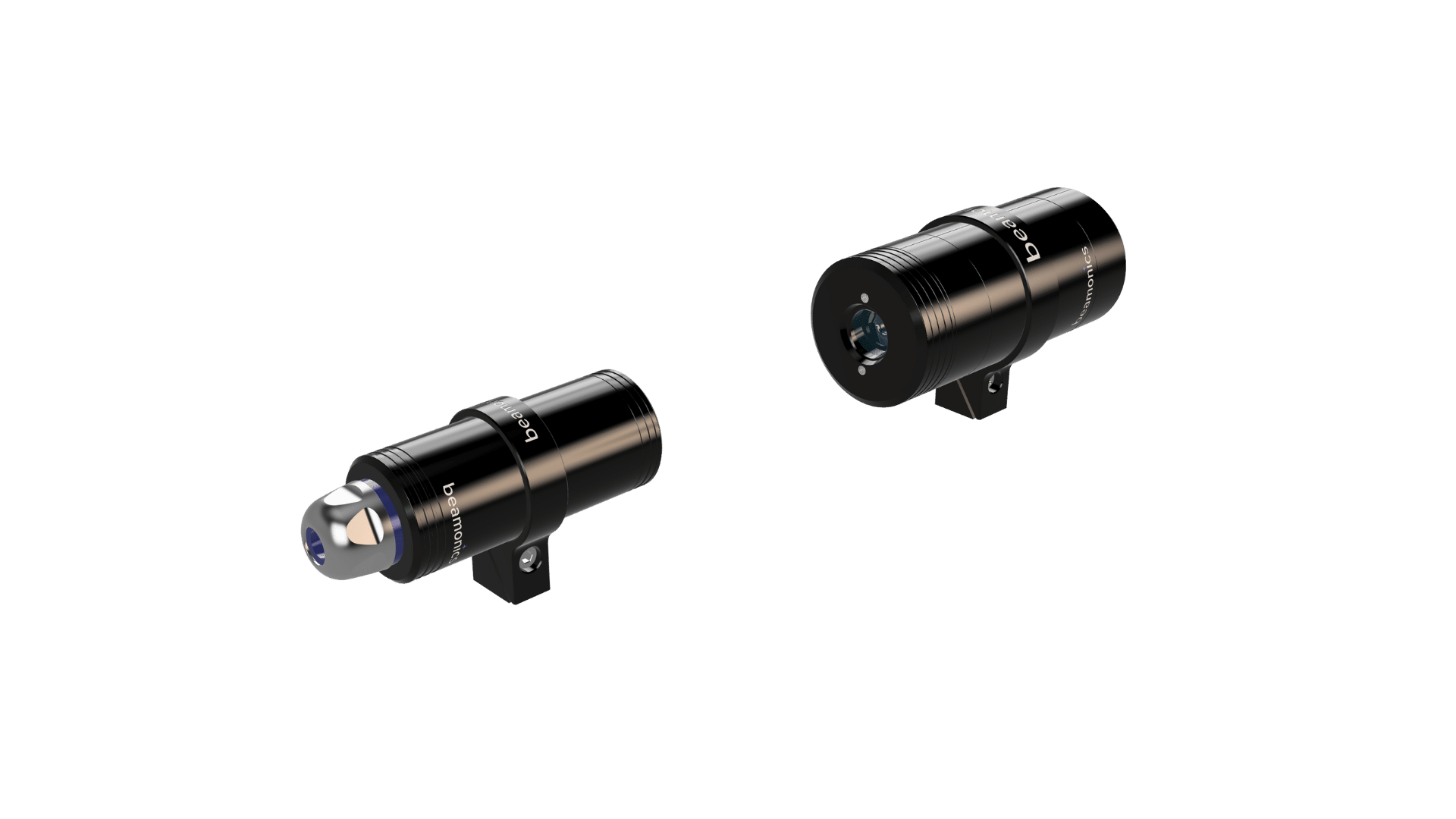
The BeamStack (BM-H-3) mounts a transmitter and receiver on opposite sides of the flue-gas duct, providing a path-averaged O₂ measurement across the full duct cross-section. This is the natural choice for in-situ combustion monitoring: the measurement reflects the actual gas composition in the duct without extracting a sample, conditioning it, or introducing a transport delay.
O₂ analysis precision is 6 ppm at a 1 m path length under standard test conditions (1 s averaging, 1 atm, 300 K), per the BM-H-3 datasheet (TDS R1.7.1). At the percent-level O₂ concentrations relevant to combustion control (typically 1% to 6%), this precision is far finer than the process requires, providing substantial measurement headroom.
For installations where cross-duct mounting is not feasible, the BeamCell (BM-H-3) provides an extractive alternative. Gas is drawn through a compact flow chamber with a 0.2 m optical path. O₂ precision is 30 ppm at 0.2 m under the same standard test conditions, per the BM-H-3-BC datasheet (TDS R1.6.1). The extractive approach adds sample transport time but allows the measurement point to be decoupled from the duct geometry, and the controlled cell environment is unaffected by duct particulate or thermal stratification.
Both instruments share IP67-rated enclosures, a supply voltage range of 15 to 32 VDC, typical power consumption of 5 W, and startup time of approximately 5 seconds. Data output options include RS-485/422, 4-20 mA, relay contacts, and an expansion connector carrying I²C, SPI, UART, and additional analog signals. Integration with existing PLC or DCS combustion control loops is direct.
Specification summary
| Parameter | BeamStack (BM-H-3) | BeamCell (BM-H-3) |
|---|---|---|
| Configuration | Cross-stack / open-path | Extractive flow-through |
| O₂ precision | 6 ppm (at 1 m) | 30 ppm (at 0.2 m) |
| CO precision | 0.2 ppm (at 1 m) | 1 ppm (at 0.2 m) |
| Analysis rate | Up to 10 kHz | Up to 10 kHz |
| Startup time | ~5 s | ~5 s |
| IP rating | IP67 | IP67 |
| Supply voltage | 15–32 VDC | 15–32 VDC |
| Power consumption | 5 W typical | 5 W typical |
| Operating temperature | -10 °C to 55 °C | -10 °C to 55 °C |
Standard test conditions: t = 1 s, P = 1 atm, T = 300 K. Precision is the largest of 1% relative and the specified value. Sources: BM-H-3 TDS R1.7.1, BM-H-3-BC TDS R1.6.1.
CO is included in the table because combustion control typically uses both O₂ and CO as feedback variables, and both can be measured on the same TDLAS platform with the appropriate laser modules.
Application contexts
In coal, biomass, and waste-fired boilers, fuel variability causes rapid changes in the air demand. A measurement that tracks O₂ fluctuations in real time allows the combustion control system to respond within the same load-change event, rather than correcting after the fact based on a delayed or averaged reading. The cross-stack configuration also captures the spatial average across the duct, reducing the influence of stratification that can bias a single-point probe.
In gas turbines and combined-cycle plants, precise O₂ control in the exhaust path feeds into emissions management for NOₓ. The relationship between excess air, flame temperature, and thermal NOₓ formation is well established: reducing excess air lowers the oxygen available for nitrogen oxidation but must be balanced against CO breakthrough. Fast, accurate O₂ data supports tighter control within this trade-off.
In cement kilns, the combustion zone operates at temperatures above 1400 °C with heavy dust loading and chemically aggressive gases including SO₂ and HCl. Zirconia probes in these environments have short service lives and are prone to the reducing-atmosphere failure mode described above. TDLAS avoids direct exposure of a sensing element to the process gas, though the optical windows in a cross-stack installation will require purge air to manage dust deposition.
In glass furnaces, the atmosphere is controlled to manage redox conditions that affect glass colour and quality. O₂ measurement stability over days and weeks, without drift that would require operator intervention, is a direct process-quality requirement rather than only an efficiency concern.
Practical considerations
Dust and particulate in the flue-gas path attenuate the TDLAS laser beam. In high-dust applications such as coal-fired boilers, cement kilns, or waste incinerators, purge air on the optical windows is standard practice. Heavy particulate loading reduces signal-to-noise and can degrade measurement precision if not managed. The instrument’s built-in diagnostics monitor received optical power and flag signal degradation as a fault, rather than reporting a false concentration value.
Thermal stratification in large ducts can cause the O₂ concentration to vary across the cross-section. A single cross-stack beam provides a path-averaged measurement along one line, which may not represent the full duct average in severely stratified flows. Multiple measurement paths or careful placement relative to mixing elements may be needed in large installations.
Zirconia probes remain appropriate for applications where cost constraints favour a simple, single-point sensor and where the process operates steadily in oxidising conditions without rapid excursions to the fuel-rich side. Paramagnetic analyzers remain the reference method for laboratory-grade O₂ accuracy in conditioned gas samples. The case for TDLAS is strongest where speed, long-term stability, freedom from field recalibration, and resilience to harsh flue-gas chemistry are operational priorities.
Closing remark
Combustion efficiency improvements of even a fraction of a percent translate to measurable fuel savings in large boilers and furnaces, and the tightening of emissions limits under the Industrial Emissions Directive and comparable frameworks makes accurate, fast O₂ measurement a compliance requirement rather than an operational luxury. The relevant question for most facilities is not whether precise O₂ monitoring is needed, but which measurement technology delivers the required accuracy and reliability at the lowest total cost over a multi-year operating cycle.
Related links
- BeamStack (BM-H-3) product page
- BeamCell (BM-H-3) product page
- TDLAS vs. paramagnetic oxygen analyzers
- TDLAS vs. electrochemical cells and catalytic bead sensors
- CO monitoring for combustion optimisation