In Brief
TDLAS and FTIR both measure gas concentrations using infrared absorption, but they approach the problem from opposite directions. TDLAS tunes a narrow laser to a single molecular absorption line, delivering high selectivity, sub-second response, and self-referenced stability for one or a few target gases. FTIR captures a broadband infrared spectrum and fits it against reference libraries to quantify dozens of species simultaneously, with a trade-off in response time, interference handling, and calibration burden. The choice depends on whether the application requires trace-level speed and selectivity for known target gases, or broad compositional coverage of a complex mixture.
Different answers to the same physical principle
Both technologies rely on the fact that gas molecules absorb infrared light at wavelengths corresponding to their rotational-vibrational energy transitions. The absorption pattern is species-specific, and the strength of absorption at a given wavelength is proportional to concentration (the Beer-Lambert relationship). Where the two methods diverge is in how they interrogate that absorption spectrum.
TDLAS uses a narrow-band approach: a single laser line probes a single molecular transition. FTIR uses a broadband approach: a wide infrared source and an interferometer capture the entire mid-infrared spectrum at once. That architectural difference drives nearly every practical trade-off between sensitivity and breadth, speed and coverage, maintenance simplicity and analytical flexibility.
How TDLAS works
A tunable diode laser is swept across a selected molecular absorption line in the infrared. As the laser wavelength scans through the transition, the gas sample attenuates the beam in proportion to its concentration. Modulation techniques (wavelength modulation spectroscopy, or WMS) extract the absorption signal from baseline noise, rejecting optical interference and drift.
Because the measurement references a physical spectral line whose position and shape are governed by molecular physics, the reading is inherently stable. There is no instrument zero that drifts over time, and routine field span calibrations are not required. Verification is handled through built-in self-referencing, zero checks, or periodic exposure to a known reference gas.
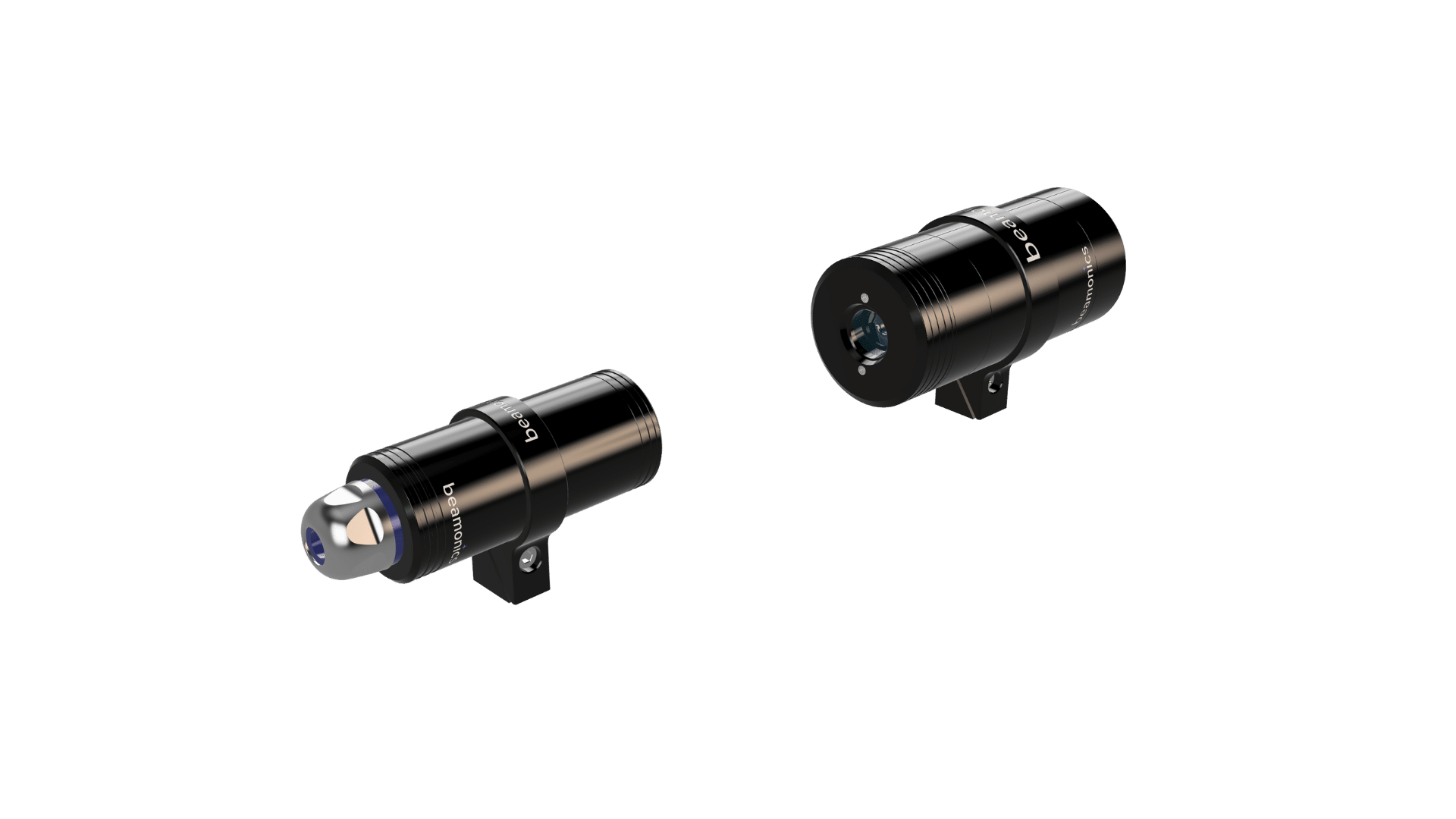
The laser targets one line or a narrow cluster of lines chosen specifically to avoid overlap with other species present in the gas matrix. This makes cross-interference negligible by design, provided the line selection is appropriate for the application. Response times are determined by the laser scan rate, not by diffusion or reaction kinetics. T90 values of one to two seconds are typical, with sub-second performance achievable depending on optics and sampling configuration. The Beamonics BM-H-3 platform supports analysis rates up to 10 kHz, with precision reaching 0.01 ppm for HF at a 1 m path length (BeamStack) or 1 ppm for CO at 0.2 m (BeamCell).
The limitation is species count. Each laser channel measures one gas. Measuring three or four species requires multiple channels or sequential multiplexing. For applications needing simultaneous quantification of ten or more gases, the hardware scales unfavorably compared to a single broadband instrument.
How FTIR works
Fourier-transform infrared spectroscopy passes a broadband infrared beam through the gas sample and into an interferometer, typically a Michelson design. The interferometer encodes the full spectrum into an interferogram, which is reconstructed into an absorbance spectrum by Fourier transform. Software then fits this spectrum against reference libraries to identify and quantify all IR-active species present.
The strength of this approach is breadth. A single FTIR measurement can quantify dozens of gas species simultaneously, provided they have distinct infrared absorption features and the spectral fitting model is properly configured. This makes FTIR valuable for complex mixture analysis, regulatory multi-pollutant reporting, and applications where the full gas composition matters more than the detection limit for any single species.
The trade-offs follow from the broadband architecture. Spectral resolution depends on the interferometer’s optical path difference, and higher resolution requires longer scan times. Typical T90 response times range from several seconds to tens of seconds, depending on the resolution setting, averaging, and the number of co-added scans needed for adequate signal-to-noise. Sensitivity is generally in the low ppm range across many species, adequate for most regulatory and process applications, but not competitive with TDLAS for trace-level or sub-ppm detection.
Cross-interference is a more significant concern than with TDLAS. Many gas species have overlapping absorption bands in the mid-infrared, particularly in the presence of water vapor, which has a dense and complex spectrum. Accurate quantification depends on the quality of the reference library, the interference modeling, and the spectral fitting algorithm. Maintaining these models requires periodic validation, especially when the gas matrix changes.
FTIR instruments are predominantly extractive. The gas sample is drawn through a heated cell, often with heated sample lines to prevent condensation and loss of reactive species. This adds complexity, cost, and potential sources of measurement error compared to in-situ configurations.
Specification comparison
| Parameter | TDLAS | FTIR |
|---|---|---|
| Measurement principle | Narrow laser scan across single absorption line | Broadband IR spectrum via interferometer and Fourier transform |
| Species per measurement | 1–3 typical per setup; multiplexable | Dozens of IR-active gases simultaneously |
| Sensitivity | Sub-ppm to ppb on selected lines | Low ppm range across many species |
| Response time (T90) | ~1–2 s typical; sub-second achievable | Seconds to tens of seconds |
| Selectivity | Very high; isolated line selection avoids overlap | Moderate; depends on library quality and interference modeling |
| Calibration | Factory-set, self-referencing; verification only | Periodic zero/span checks and spectral model validation |
| Cross-interference | Negligible by design | Requires careful spectral fitting, especially with water vapor |
| Deployment options | Cross-stack, open-path, extractive flow-cell, remote stand-off | Predominantly extractive with heated sample handling |
| Maintenance | Optical inspection and cleaning, 6–12 month intervals | Optics, IR source, windows, sample conditioning, model upkeep |
| Fault reporting | Continuous self-checks; explicit optical fault alarms | Varies; spectral quality metrics available but less direct |
Values are indicative and depend on gas species, path length, pressure, temperature, and matrix composition.
Where TDLAS is the stronger choice
TDLAS fits applications where speed, selectivity, and long-term stability for a defined set of target gases outweigh the need for broad compositional analysis.
Combustion control is a common example. Real-time CO and O₂ feedback at sub-second intervals enables tighter burner tuning than periodic multi-gas snapshots from an FTIR. Ammonia slip monitoring downstream of selective catalytic reduction (SCR) systems benefits from the combination of low detection limits and immunity to interference from the water vapor, SO₂, and NOₓ also present in the flue gas. HF monitoring in aluminum smelting requires sub-ppm precision in a chemically aggressive and particulate-laden environment where extractive sample conditioning would be impractical or unreliable. Leak detection for CH₄ or H₂S at pipeline infrastructure demands fast response and clear alarm logic, with no ambiguity from spectral fitting artifacts.
The common thread is a well-defined measurement problem: a small number of target species, low detection limits, fast dynamics, and the operational value of a self-referencing instrument that does not require routine recalibration.
Where FTIR is the stronger choice
FTIR fits applications where the measurement problem is compositional rather than species-specific.
Multi-pollutant emissions monitoring under regulatory frameworks that require simultaneous quantification of CO, CO₂, NOₓ, SO₂, HCl, NH₃, and other species from a single sampling point is a natural FTIR application. The cost of deploying separate TDLAS channels for each species would exceed the cost of a single FTIR system, and the regulatory requirement is for periodic or semi-continuous reporting rather than sub-second control. Process gas characterization in chemical manufacturing, where the mixture may contain a dozen or more species and the process engineer needs a complete composition profile, plays to FTIR’s strengths. Research and method development applications where the target species may not be known in advance benefit from the ability to capture and analyze the full spectrum retrospectively.
The common thread is breadth over depth: many species at ppm-level sensitivity, with response times measured in seconds rather than milliseconds, and an operational model that includes periodic calibration and model maintenance.
Practical considerations
Species coverage versus detection depth is the fundamental trade-off. FTIR covers more ground. TDLAS goes deeper on selected targets. For applications requiring both, some facilities deploy FTIR for broad survey monitoring alongside TDLAS for fast closed-loop control of the two or three gases that drive safety, efficiency, or compliance.
Interference handling differs structurally. TDLAS avoids most spectral overlaps by choosing isolated absorption lines. FTIR manages overlaps through mathematical deconvolution, which works well when the reference library is comprehensive and the matrix is stable, but can introduce errors when conditions change or unexpected species appear.
Calibration workload reflects the underlying measurement architecture. TDLAS references a physical spectral line and is inherently drift-resistant, requiring verification rather than routine recalibration. FTIR requires periodic zero and span checks, and the spectral fitting models must be validated against the actual gas matrix, particularly after process changes.
Sample handling complexity is often underestimated. TDLAS supports in-situ cross-stack, open-path, and extractive configurations, which can eliminate heated sample lines entirely in some installations. FTIR is typically extractive, requiring heated lines, filters, and sample conditioning to prevent condensation and preserve reactive species. The reliability and maintenance burden of the sample conditioning system can exceed that of the analyzer itself.
Complementary rather than competing
TDLAS and FTIR occupy different positions on the same measurement spectrum. TDLAS provides targeted precision: fast, selective, drift-resistant readings for a small number of critical gases. FTIR provides analytical breadth: comprehensive compositional data for complex mixtures at moderate sensitivity. Framing the selection as a binary choice between the two misses the practical reality that many facilities benefit from both, each deployed where its strengths align with the measurement requirement.
Related links:
- BeamStack (BM-H-3): Cross-stack and open-path TDLAS analyzer
- BeamCell (BM-H-3): Extractive flow-through TDLAS analyzer
- BeamSight (BM-V-2): Remote stand-off TDLAS analyzer
- TDLAS vs. electrochemical and catalytic bead gas detectors
- TDLAS and Raman spectroscopy: how two optical methods compare