In Brief
TDLAS and paramagnetic analyzers both measure oxygen concentration accurately, but they rely on unrelated physical principles and suit different installation contexts. Paramagnetic analyzers exploit the magnetic susceptibility of O₂ molecules, providing a mature, specifically oxygen-selective measurement that works well in clean, conditioned extractive systems. TDLAS measures O₂ through direct molecular absorption in the near-infrared, enabling in-situ cross-stack deployment, faster response, and immunity to the magnetic interference from NO and NO₂ that can bias paramagnetic instruments in combustion flue gas. For most industrial O₂ applications, the decision depends on whether in-situ measurement is needed, what else is in the gas matrix, and how much extractive sample conditioning infrastructure the installation can support.
Oxygen measurement across industrial contexts
Oxygen is one of the most widely measured gases in industrial process control. Combustion optimization in boilers, furnaces, and kilns relies on continuous O₂ feedback to maintain the correct air-fuel ratio. Inerting and purging verification in chemical processing and tank blanketing requires confirmation that O₂ levels are below safe thresholds. Product quality applications in food packaging, pharmaceutical manufacturing, and semiconductor fabrication demand measurement of trace O₂ to protect product integrity. Air separation plants monitor O₂ purity at percent levels. Confined space safety monitoring protects workers entering vessels, tanks, and enclosed areas.
The required measurement range varies from percent-level O₂ in combustion exhaust down to low-ppm traces in high-purity nitrogen or argon streams. No single technology is optimal across this entire span. Paramagnetic analyzers have been the standard for industrial oxygen measurement for decades and remain well suited to a defined set of applications. TDLAS has become a practical alternative where extractive sampling is impractical, response speed matters, or the gas matrix makes paramagnetic measurement unreliable.
The paramagnetic principle
Oxygen is unusual among common gases in having strong paramagnetic properties. Its two unpaired electrons give the O₂ molecule a significant magnetic susceptibility, causing it to be attracted into a magnetic field. Nearly all other gases encountered in industrial processes are diamagnetic, meaning they are weakly repelled by magnetic fields, or have negligible magnetic susceptibility.
Paramagnetic oxygen analyzers exploit this physical distinction. The sample gas is exposed to a non-uniform magnetic field inside the analyzer, and the instrument measures the resulting mechanical, thermal, or pressure effect caused by oxygen molecules being drawn into the high-field region. Several detection mechanisms exist. Older designs use a dumbbell suspended in the field and measure the deflection torque. Thermomagnetic designs measure the convective cooling effect as oxygen is drawn through a heated region. Magnetopneumatic designs detect the pressure differential created by the paramagnetic force on oxygen in a pulsed field.
The advantage of this approach is that selectivity for oxygen is built into the physics. The instrument responds to O₂ because O₂ is paramagnetic, and it largely ignores other gases because they are not. No spectral line selection, no reference library, and no chemical reaction is needed to achieve specificity.
The limitations also follow from the physics. Any other paramagnetic species in the sample will contribute to the signal. Nitric oxide (NO) has a paramagnetic susceptibility roughly half that of O₂, meaning that 100 ppm of NO in the sample produces a positive offset equivalent to approximately 50 ppm of O₂. Nitrogen dioxide (NO₂) is also paramagnetic, though less strongly. In combustion flue gas, where NO concentrations routinely reach several hundred ppm, this is not a trivial measurement error.
Paramagnetic analyzers also require a clean, dry, conditioned sample delivered at controlled temperature, pressure, and flow rate. The analyzer itself is typically a bench-mounted or panel-mounted instrument. Between the process tap point and the analyzer sits a sample conditioning system: particulate filters, moisture removal (condensation traps, permeation dryers, or refrigerated coolers), flow controllers, and often heated sample transport lines to prevent condensation in transit. The cost, complexity, and maintenance burden of this sample handling infrastructure can exceed that of the analyzer itself, particularly in demanding process environments.
How TDLAS measures oxygen
TDLAS measures O₂ by targeting absorption lines in the oxygen A-band near 760 nm in the near-infrared. A tunable diode laser is swept across these lines, and the instrument records the fraction of light absorbed as the beam passes through the gas. The depth and shape of the absorption features yield concentration, referenced directly to the known molecular parameters of oxygen.
The measurement is self-referencing: the calibration reference is the physics of the O₂ molecule, not an external standard. This is the same property that makes TDLAS stable over time for other gases. There is no drift mechanism in the measurement principle itself, and routine field span calibration is not required. Verification is handled through built-in self-diagnostics that monitor optical power and signal quality continuously, flagging degradation as an explicit instrument fault rather than producing a silently distorted reading.
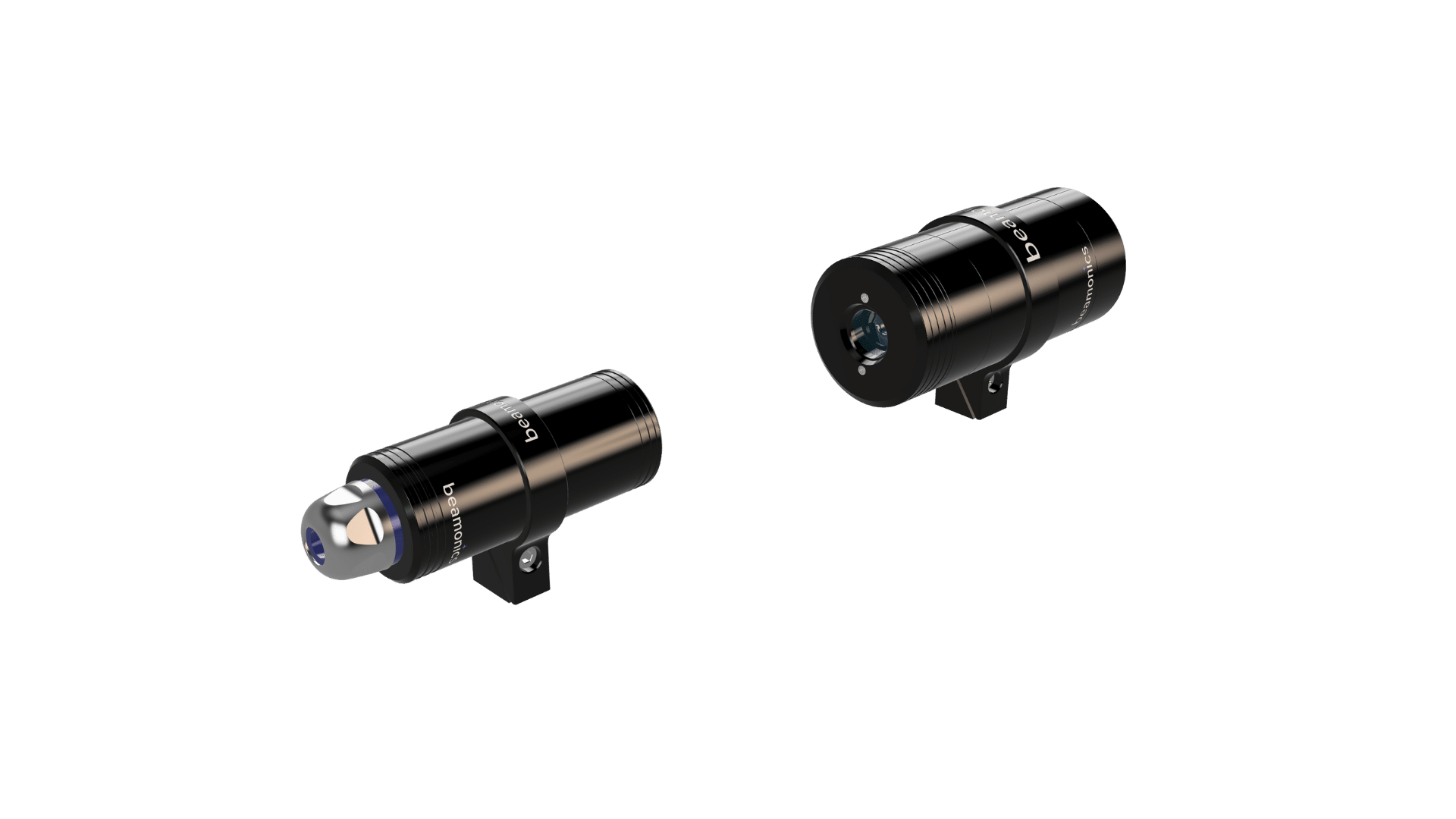
The Beamonics BeamStack achieves O₂ analysis precision of 6 ppm at a 1 m path length under standard conditions (1 s averaging, 1 atm, 300 K). The BeamCell extractive configuration achieves 30 ppm at a 0.2 m path length under the same conditions. Both figures represent the larger of 1% relative precision and the stated absolute precision.
Selectivity is spectroscopic rather than magnetic. The laser probes a narrow set of wavelengths where O₂ absorbs. Other gases produce interference only if they have absorption features at those same wavelengths. NO, NO₂, CO₂, H₂O, and the other species commonly found in combustion flue gas do not absorb at the O₂ measurement wavelength, so they do not affect the reading. Water vapor at very high concentrations can require firmware-level compensation in some configurations, but this is a well-understood correction.
In-situ measurement versus extractive sampling
The most significant practical difference between the two technologies is deployment geometry.
Paramagnetic analyzers are inherently extractive. The sample must be brought to the instrument. This requires a sample probe or tap at the process, transport tubing (often heated to prevent condensation), particulate filtration, moisture removal, pressure regulation, and flow control. The total system response time includes the transport delay through this sample train, which can range from tens of seconds to several minutes depending on the line length and volume. The analyzer itself may respond within a few seconds once the conditioned sample arrives, but the operator sees the total system response, not the analyzer response alone.
TDLAS in a cross-stack configuration requires no sample extraction at all. The transmitter and receiver mount on opposite sides of a duct or pipe, and the laser beam passes directly through the process gas. The measurement is the path-averaged O₂ concentration across the full beam path, updated continuously with T90 response times of one to two seconds. There is no sample transport delay, no conditioning system, and no opportunity for the sample to change composition between the process and the measurement point.
For combustion control, this difference is operationally significant. The speed at which O₂ data reaches the control system determines how tightly the air-fuel ratio can be regulated. A slow-responding measurement limits the controller’s ability to track changes in fuel composition, load demand, or combustion dynamics. Real-time O₂ feedback from a cross-stack TDLAS analyzer allows tighter control, which translates directly into fuel efficiency and emissions performance.
TDLAS is also available in extractive configuration (BeamCell) for applications where in-situ access is not feasible, and in remote stand-off configuration (BeamSight) for monitoring at a distance. The extractive configuration still benefits from the TDLAS measurement principle: fast spectroscopic response, no consumable sensing element, and no magnetic interference. The transport delay of the sample line applies, but the analyzer contributes no additional lag.
Interference from NO and NO₂ in combustion monitoring
This topic deserves specific attention because it is the most common source of undiagnosed measurement error in paramagnetic O₂ analyzers deployed on combustion flue gas.
NO is produced in all combustion processes. Concentrations depend on flame temperature, fuel type, and combustion conditions, but levels of 50 to 500 ppm are common in industrial boiler and furnace exhaust. At the upper end of that range, a paramagnetic O₂ analyzer will read approximately 0.025% O₂ high, roughly 250 ppm, solely due to NO interference. In a combustion control application targeting, for example, 2% O₂ in the stack, a 250 ppm positive offset represents a non-trivial bias that leads to a systematically leaner air-fuel setting than intended.
This error is not detectable from the O₂ reading alone. The instrument reports a valid-looking number, and the control system responds to it as though it were correct. The result is suboptimal combustion: either excess air (reducing efficiency) or, if the operator compensates by targeting a lower O₂ setpoint, a risk of running closer to the stoichiometric limit than intended.
TDLAS O₂ measurement is completely unaffected by NO or NO₂ concentration because the interference mechanism does not exist. The measurement is spectroscopic, not magnetic. NO absorbs at different wavelengths than O₂, and the laser does not probe those wavelengths. The reading reflects only the oxygen present.
Specification comparison
| Parameter | TDLAS | Paramagnetic oxygen analyzer |
|---|---|---|
| Physical principle | Near-infrared molecular absorption (O₂ A-band, ~760 nm) | Paramagnetic susceptibility of O₂ |
| O₂ precision (cross-stack, 1 m) | 6 ppm | N/A (extractive only) |
| O₂ precision (extractive, 0.2 m) | 30 ppm | ppm-level; application-dependent |
| Response time (total system) | 1–2 s in-situ; extractive adds transport delay | Seconds to minutes; dominated by sample transport |
| Deployment | In-situ cross-stack, extractive, or remote stand-off | Extractive only; requires conditioned sample |
| NO / NO₂ interference | None | Positive bias; NO has ~50% paramagnetic susceptibility of O₂ |
| Calibration | Factory-calibrated, self-referencing; verification only | Periodic zero/span with certified reference gases |
| Sample conditioning | Not required for in-situ configurations | Required: filtration, drying, flow control, often heated lines |
| Maintenance | 6–12 month optical inspection and cleaning | Low for sensing element; sample conditioning system requires regular servicing |
| Multi-gas capability | Same platform covers O₂, CO, CO₂, CH₄, NH₃, HF, H₂S, others | O₂ only |
| Operating temperature (analyzer) | -10 °C to 55 °C (BeamStack / BeamCell) | Typically requires climate-controlled environment |
Where paramagnetic analyzers remain well suited
Paramagnetic O₂ measurement is a proven technology with a decades-long track record in specific application categories. Air separation unit monitoring, where the gas matrix is clean and the measurement point is already part of a conditioned sampling system, is a natural fit. High-purity gas verification in nitrogen, argon, or helium production benefits from the inherent O₂ specificity and the very low cross-sensitivity to the carrier gas. Medical oxygen monitoring in hospital and clinical gas supply systems uses paramagnetic analyzers extensively. Laboratory and analytical applications where a conditioned sample is available as a matter of course present no disadvantage from the extractive requirement.
The common thread in these applications is a clean, well-defined gas matrix with low or negligible NO/NO₂ content, an existing extractive infrastructure, and process dynamics slow enough that sample transport delay does not limit the measurement’s usefulness.
Where TDLAS is the stronger choice
TDLAS extends O₂ measurement capability into applications where the paramagnetic approach encounters practical limitations.
Combustion control in boilers, furnaces, and kilns benefits most directly. The combination of in-situ measurement (no sample transport delay), real-time response (1–2 s T90), and immunity to NO interference gives a more accurate and faster O₂ reading than an extractive paramagnetic system can provide in the same service. Tighter O₂ control improves fuel efficiency and reduces CO and NOₓ emissions.
Stack and flue gas monitoring, where extracting a representative sample from a hot, wet, particulate-laden gas stream requires substantial sample conditioning, is simplified by cross-stack TDLAS. The analyzer measures through the stack directly, avoiding the cost and maintenance of heated lines, filters, dryers, and pumps.
Process environments containing elevated NO or NO₂, including SCR and SNCR systems where ammonia injection is used to reduce NOₓ, benefit from the absence of paramagnetic cross-interference. In these applications, O₂ measurement accuracy directly affects the ammonia dosing calculation, and a biased O₂ reading leads to over- or under-injection.
Installations where minimizing sample conditioning infrastructure is a design objective, whether for cost, space, reliability, or maintenance reasons, are better served by in-situ TDLAS than by any extractive technology.
Practical installation considerations
Cross-stack TDLAS requires flanged optical access ports on opposite sides of the duct or pipe. For new installations this is straightforward to specify during engineering. For retrofits into existing ductwork, it requires cutting and welding flanges, which may involve a process shutdown. The required port diameter is modest: the Beamonics BeamStack transmitter has a diameter of approximately 40 mm.
In very high-temperature gas streams (above the analyzer’s rated operating range of -10 °C to 55 °C), the mounting flanges can be extended or purged to keep the analyzer electronics within the operating envelope. Window purge air prevents particulate fouling of the optics. Beamonics analyzers continue measuring even at reduced optical transmission, reporting signal quality metrics so that maintenance can be scheduled before the measurement is compromised.
For high-purity O₂ measurement at very low concentrations (below a few ppm), both extractive TDLAS and paramagnetic analyzers are viable depending on the gas matrix. At these levels, sample cleanliness and leak integrity become the dominant sources of measurement uncertainty regardless of the analyzer technology.
Paramagnetic analyzers should be evaluated for NO/NO₂ interference before being specified for combustion flue gas service. If the expected NO concentration multiplied by 0.5 represents a significant fraction of the desired O₂ measurement accuracy, the paramagnetic approach may not meet the application requirement without additional correction or compensation.
Matching the measurement to the application
Paramagnetic oxygen analysis and TDLAS-based O₂ measurement address overlapping but not identical application spaces. Paramagnetic analyzers provide reliable, O₂-specific measurement in clean extractive systems where the gas matrix is well characterized and free of paramagnetic interferents. TDLAS provides faster, interference-resistant measurement with in-situ deployment options that eliminate extractive infrastructure. In combustion monitoring and flue gas applications particularly, the combination of real-time response and NO-immune selectivity makes TDLAS the more practical choice for installations where measurement speed and accuracy directly affect process efficiency and emissions performance.
Related links:
- BeamStack (BM-H-3): Cross-stack and open-path TDLAS analyzer
- BeamCell (BM-H-3): Extractive flow-through TDLAS analyzer
- BeamSight (BM-V-2): Remote stand-off TDLAS analyzer
- TDLAS vs. electrochemical and catalytic bead gas detectors
- TDLAS and FTIR: selecting the right infrared method
- TDLAS and NDIR: how two infrared absorption methods compare
- TDLAS and gas chromatography: continuous monitoring versus compositional analysis