In Brief
Fugitive emissions from valves, flanges, tanks, and buried infrastructure represent both a compliance liability and a direct product loss. TDLAS-based gas analyzers address the core measurement challenge in leak detection and repair (LDAR) programs: covering large areas quickly, quantifying what is found, and verifying that repairs hold. Stand-off, open-path, and extractive TDLAS configurations each serve a distinct role in this workflow, and together they bridge the gap between qualitative leak imaging and slow component-by-component screening.
Background
Fugitive emissions are unintended gas releases from equipment that is not designed to vent. Sources include valve packings, pipe flanges, pump seals, compressor casings, storage tank fittings, and soil above buried pipelines or landfill cells. In upstream oil and gas, CH₄ is the primary concern because of its short-term climate forcing and its direct link to lost production revenue. In chemical plants and refineries, H₂S, NH₃, and HCl pose acute toxicity and corrosion risks. Aluminum smelters and glass manufacturing produce HF, which is both acutely toxic and subject to tight regulatory limits.
The central difficulty with fugitive emissions is that they are spatially unpredictable and often intermittent. A valve that seals under steady-state conditions may leak during pressure swings or temperature cycling. A landfill cap may emit CH₄ only in certain soil moisture conditions. Conventional point sensors placed at fixed locations can miss leaks that occur between sensor heads, and portable sniffers (Method 21 style) require an operator to physically approach every component, which is slow and impractical for large sites. Optical gas imaging (OGI) cameras provide rapid visual scanning but are qualitative: they show that a leak exists, not how large it is, and their performance depends on wind, temperature contrast, and viewing angle.
Beamonics TDLAS fills a specific gap in this toolset. It provides quantitative, real-time concentration data with spectral selectivity that virtually eliminates false readings from non-target gases. It can operate in open-path, stand-off, or extractive configurations, allowing a single technology platform to serve roles from wide-area scanning to precise source quantification.
How TDLAS applies to leak detection
Tunable diode laser absorption spectroscopy works by scanning a narrowband laser across a molecular absorption line of the target gas and measuring the attenuation of light following the Beer-Lambert law. Each gas species absorbs at wavelengths determined by its molecular structure, so the measurement is inherently selective. There is no chemical reaction, no consumable sensor element, and no dependence on an external reference gas for routine operation. The instrument self-references against the known shape and position of the absorption feature, which eliminates the baseline drift that limits electrochemical and catalytic sensors over time.
For fugitive emissions work, three measurement geometries are relevant.
Stand-off detection points the laser at a distant surface, a wall, a pipe, or a retroreflector, and analyzes the return signal for absorption by gases in the intervening air column. Beamonics BeamSight operates in this mode with a native detection range of 30 m, extendable to 100 m with a reflective surface. The instrument reports path-integrated concentration in ppm·m, which represents the product of gas concentration and the distance the beam travels through the gas cloud. Under standard test conditions (Range = 8 m, t = 0.5 s, P = 1 atm, T = 300 K), BeamSight achieves detection precision of 15 ppm·m for CH₄, 15 ppm·m for NH₃, 40 ppm·m for CO₂, 15 ppm·m for CO, 25 ppm·m for H₂S, and 0.05 ppm·m for HF. At 0.7 kg (fixed installation) or 1.0 kg (battery-powered portable), it can be carried by hand, mounted on a drone, or attached to a ground rover for systematic area surveys. The battery-powered version provides approximately 5 hours of continuous operation.
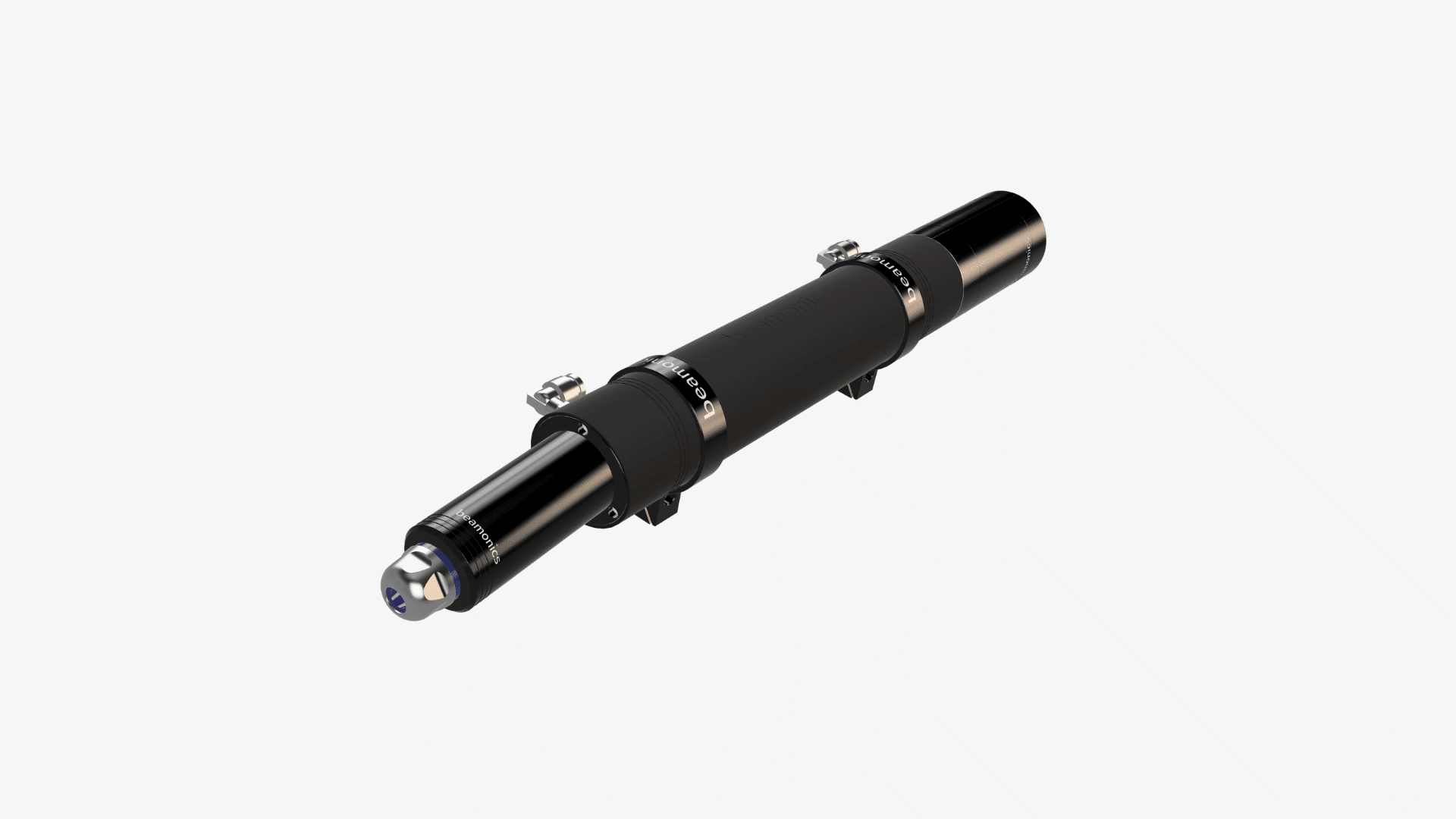
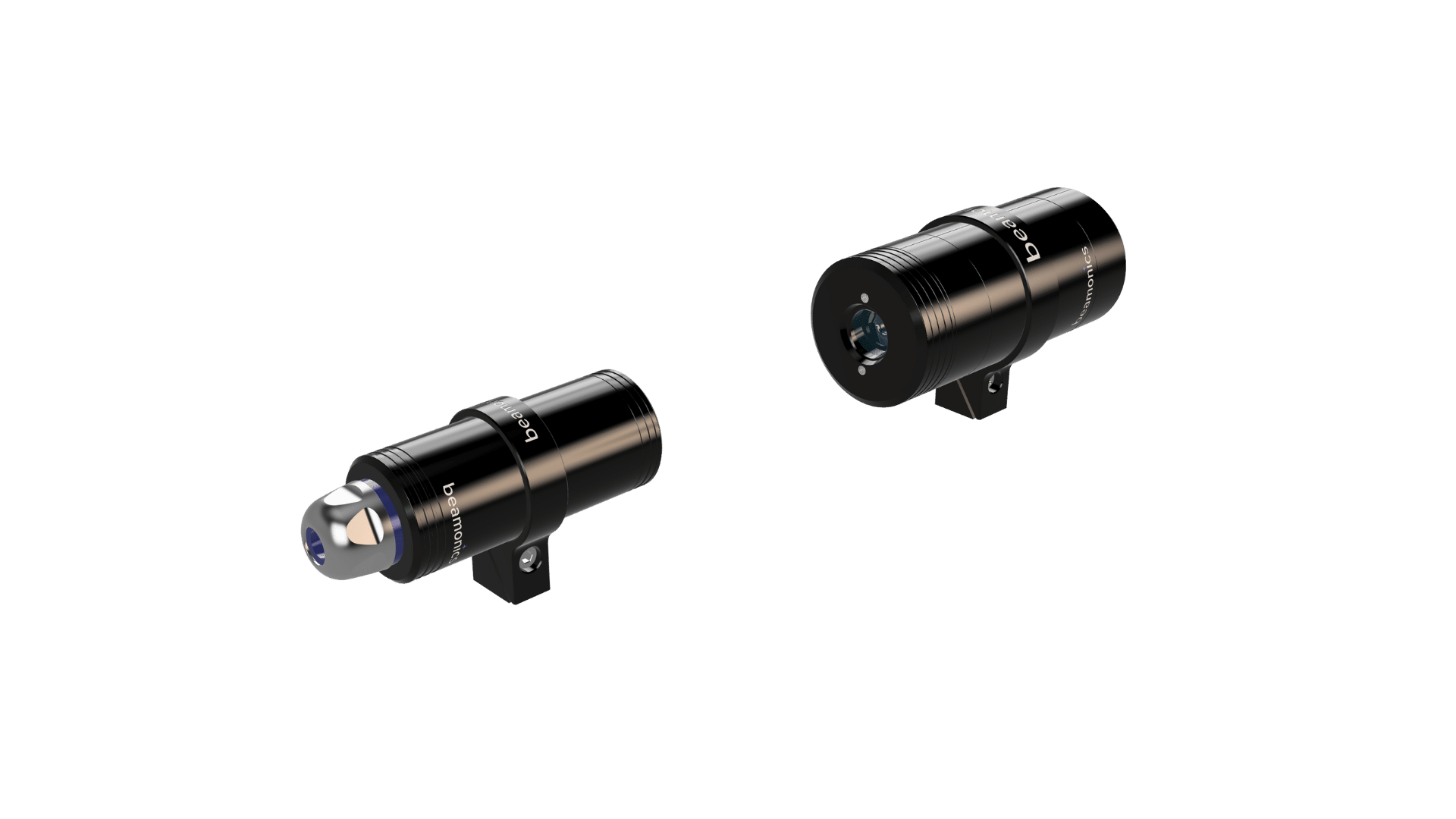
Open-path and cross-stack measurement places a transmitter on one side of a duct, corridor, or fence line and a receiver on the other. The laser beam traverses the gas continuously, providing a real-time path-averaged concentration without extracting a sample. BeamStack operates in this configuration with analysis precision of 0.2 ppm for CH₄, 0.2 ppm for CO, 0.5 ppm for CO₂, 0.3 ppm for H₂S, 0.2 ppm for NH₃, and 0.01 ppm for HF at a 1 m path length under standard test conditions (t = 1 s, P = 1 atm, T = 300 K). IP67 enclosures and an operating temperature range of −10 °C to 55 °C allow permanent installation on stacks, ducts, or fence-line posts. Analysis rates up to 10 kHz capture fast transient events that slower instruments would average out or miss entirely.
Extractive sampling draws gas through a flow cell for analysis at a controlled point. BeamCell uses a 0.185 m optical path in an acid-resistant flow chamber with G1/8 push-in connectors for 6 mm or 8 mm tubing. Precision under standard conditions (L = 0.185 m, t = 1 s, P = 1 atm, T = 300 K) reaches 1 ppm for CH₄, 1 ppm for CO, 2.5 ppm for CO₂, 1.5 ppm for H₂S, 1 ppm for NH₃, 0.05 ppm for HF, and 1 ppm for H₂O. The real-time measurement and multi-port sampling capability allow sequential measurement from several sample points within seconds, which is useful for tracing a leak through a piping header or verifying multiple repair sites in a single pass. The flow chamber materials withstand corrosive species including sulfuric acid, and the instrument is rated IP67 with an operating range of −10 °C to 55 °C.
Building an LDAR workflow around TDLAS
An effective leak detection and repair program moves through three phases: detection, quantification, and verification. Each phase has different measurement requirements, and a single Beamonics TDLAS platform can serve all three.
Detection and area screening. The objective is to find leaks quickly across a large site. A portable BeamSight unit, carried by an operator or mounted on a drone, sweeps well pads, tank farms, compressor stations, and fence lines. The instrument flags concentration anomalies in real time as the operator moves. Because the measurement is stand-off, there is no need to approach the source, which matters when the gas may be toxic or when the equipment is physically inaccessible. Drone-mounted operation extends coverage to elevated piping, flare headers, and remote wellheads without scaffolding or shutdown.
For continuous perimeter monitoring, two or more BeamStack open-path beams can form an upwind and downwind curtain around a facility boundary. The differential ppm·m between beams indicates when emissions are leaving the site. This architecture connects directly to a distributed control system (DCS) through RS-485, 4–20 mA, or relay outputs for automated alarming and work order generation.
Quantification and source identification. Once a plume is detected, the next step is to determine its magnitude and trace it to a specific component. Stand-off measurement from two or more angles can triangulate the source location. For precise concentration at the source, an extractive BeamCell sampling from a point near the suspect component provides absolute concentration in ppm. This number feeds directly into regulatory reporting, mass-balance calculations, and repair priority rankings.
The distinction between ppm·m (path-integrated) and ppm (point concentration) matters here. A reading of 150 ppm·m along a 10 m beam could represent 15 ppm distributed evenly, or a narrow jet at several hundred ppm crossing a small fraction of the beam. Open-path and stand-off readings are powerful for detection and trending, but source-level quantification benefits from shorter paths or extractive measurement.
Repair verification. After a valve is repacked, a flange is retorqued, or a seal is replaced, the repair needs confirmation. An extractive BeamCell with multi-port sampling can cycle through repaired components and log pass/fail results. Because Beamonics TDLAS reaches measurement-ready state in approximately 5 seconds after startup, verification can begin immediately. Self-referencing eliminates the pre-measurement calibration step that bump-tested electrochemical sensors require. Data is logged over RS-485 or 4–20 mA for audit trail purposes.
Selecting species and absorption lines
Careful line selection is an inherent part of the Beamonics design process, and the analyzers as such offer little to no cross-interference. The Beamonics platform covers the gas species most relevant to fugitive emissions work: CH₄, CO₂, CO, NH₃, HF, H₂S, HCl, H₂O, and O₂, depending on instrument configuration. For sites with multiple gas hazards, separate analyzers targeting different species can operate in parallel, each tuned to its optimal absorption line.
TDLAS targets specific molecules, not broad VOC classes. For screening unknown mixtures, pairing TDLAS with a photoionization detector or OGI camera for initial identification allows the regulated species to then be quantitatively monitored with Beamonics instruments.
Practical considerations
Open-path geometry averages along the beam. A narrow gas jet crossing a long beam will be diluted in the path-averaged reading. For small, concentrated leaks, shorter beam paths or extractive sampling provide better spatial resolution. A practical workflow uses open-path for broad detection and switches to extractive or close-range stand-off for pinpointing.
Beamonics instruments can handle transmission down to very low levels thanks to the proprietary platform, allowing processes to run uninterrupted without regular cleaning and re-calibration. During conditions where optical transmission is severely reduced, extractive sampling via BeamCell is unaffected since the measurement occurs inside a sealed flow cell.
Data volume requires sensible alarm configuration. High-speed TDLAS platforms generate continuous data streams. Configuring appropriate averaging windows, threshold levels, and alarm hold times prevents alert fatigue. In practice, spectral selectivity means false alarms from non-target gases are rare compared to broadband or electrochemical detectors, but process-related concentration fluctuations still require thoughtful alarm design.
Closing Remark
Fugitive emissions control depends on speed of detection, accuracy of quantification, and confidence in repair verification. Beamonics TDLAS serves all three functions within a single measurement technology, adapted to each role through stand-off, open-path, and extractive configurations. The combination of spectral selectivity, real-time response, and calibration stability allows LDAR programs to move from periodic surveys toward continuous, quantitative emissions management.