In Brief
TDLAS and NDIR both measure gas concentration through infrared absorption, but they differ in optical architecture, selectivity, response speed, and calibration requirements. TDLAS targets a single narrow absorption line with a tunable laser, achieving high selectivity, sub-second response, and inherent long-term stability without routine recalibration. NDIR uses a broadband infrared source with optical bandpass filters, offering a cost-effective and versatile platform for ppm-to-percent measurements of common gases such as CO₂, CO, and hydrocarbons. The choice between them depends on the required detection limit, the chemical environment, the acceptable calibration workload, and the speed at which the process demands a valid reading.
A shared principle, different implementations
Both TDLAS and NDIR exploit the same physical phenomenon: gas molecules absorb infrared radiation at wavelengths corresponding to their rotational-vibrational energy transitions. The absorption at a given wavelength is proportional to the gas concentration along the optical path, as described by the Beer-Lambert law. What separates the two technologies is how they select and measure those wavelengths.
TDLAS uses a monochromatic source, a tunable diode laser, to probe a single spectral line with very high precision. NDIR uses a polychromatic source, a broadband infrared emitter, and isolates a band of wavelengths using optical filters. That difference in spectral resolution drives the practical trade-offs between selectivity and versatility, speed and cost, maintenance simplicity and multi-gas capability.
How TDLAS works
A tunable diode laser emits infrared light at a precisely controlled wavelength. By modulating the laser’s injection current, the emission wavelength is swept rapidly across a selected molecular absorption line. The gas sample attenuates the beam as it passes through the optical path, and the depth and shape of the absorption feature yield the gas concentration.
Most modern TDLAS implementations use wavelength modulation spectroscopy (WMS), which applies a high-frequency modulation on top of the wavelength scan and detects the absorption signal at harmonics of the modulation frequency. This technique rejects broadband optical noise, baseline drift, and interference from species that do not have absorption features at the exact wavelength being probed.
The measurement reference is the molecular absorption line itself, a physical constant determined by quantum mechanics. This is what makes TDLAS inherently self-referencing: the instrument does not rely on an external calibration standard that can shift over time. Factory calibration is set during production, and field verification rather than routine span adjustment is the normal operating practice.
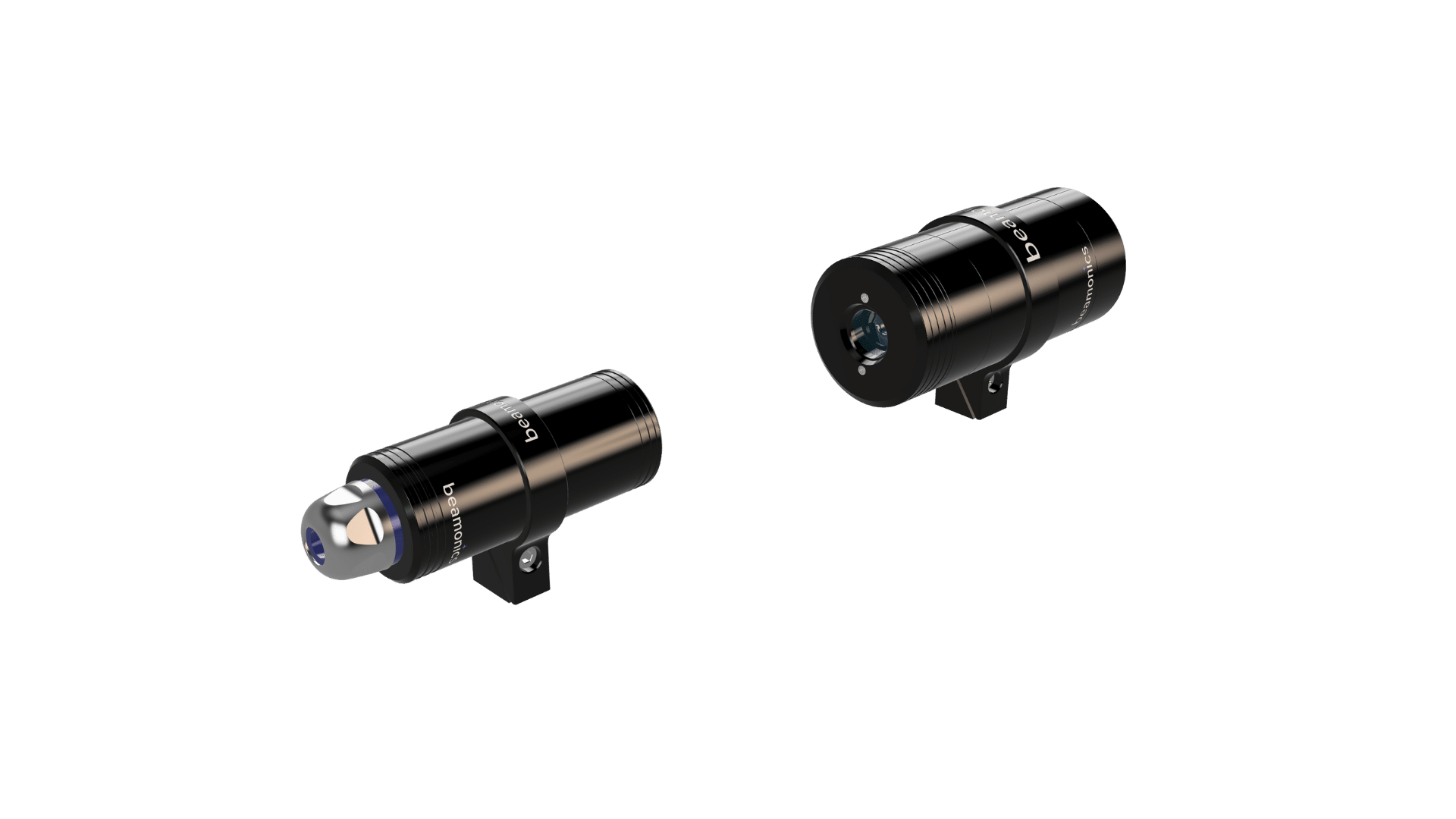
Response times are governed by the laser scan rate, not by diffusion or chemical kinetics. T90 values of one to two seconds are typical in industrial configurations, with sub-second performance achievable where the optics and sampling allow it. The Beamonics BM-H-3 platform supports analysis rates up to 10 kHz, with precision reaching 0.01 ppm for HF at a 1 m path length (BeamStack) or 1 ppm for CO at 0.2 m (BeamCell).
Continuous self-diagnostics monitor optical power, detector signal levels, and internal reference values. A loss of signal or alignment degradation is reported as an explicit instrument fault, distinct from a gas alarm, so operators know when a reading should not be trusted.
How NDIR works
A non-dispersive infrared analyzer uses a broadband infrared source, typically a heated filament or micro-emitter, to illuminate a gas cell. Optical bandpass filters mounted in front of one or more detectors select wavelength bands that correspond to absorption features of the target gases. A reference channel, filtered to a wavelength where no target gas absorbs, compensates for changes in source intensity and optical transmission over time.
Concentration is derived from the differential signal between the measurement and reference channels. The wider the spectral band passed by the filter, the more photons reach the detector (improving signal-to-noise), but the greater the risk that other gases with absorption features within the same band will interfere with the reading.
NDIR is well suited to gases with strong, broad, and well-separated infrared absorption bands. CO₂ absorbs strongly around 4.26 µm, CO around 4.65 µm, and many hydrocarbons in the 3.3–3.5 µm region. For these species at ppm-to-percent concentrations, NDIR provides reliable and economical measurements. Multi-gas packages that combine several filter channels in a single housing are common and cost-effective.
The trade-offs emerge at lower concentrations and in more complex gas matrices. Broadband filters cannot fully reject interference from species whose absorption bands overlap the target band. Water vapor is a particular challenge: its absorption spectrum is dense and spans much of the mid-infrared, creating interference risks for CO, CO₂, and hydrocarbon measurements that must be compensated algorithmically. The broadband infrared source ages over time, causing baseline drift that requires periodic zero and span calibration to correct. Response times depend on the gas cell volume, flow rate, and detector integration time, typically ranging from 2 to 30 seconds.
Specification comparison
| Parameter | TDLAS | NDIR |
|---|---|---|
| Detection principle | Tunable laser scans narrow absorption line | Broadband IR source with bandpass filters |
| Typical measurement range | ppb to low ppm (species-dependent); up to percent | ppm to percent for strong IR absorbers |
| Response time (T90) | ~1–2 s typical; sub-second achievable | 2–30 s typical |
| Selectivity | Very high; isolated line selection | Moderate; depends on filter bandwidth and gas matrix |
| Cross-interference | Negligible with proper line selection | Possible, especially from H₂O and overlapping bands |
| Calibration | Factory-set, self-referencing; verification only | Periodic zero/span to track source aging and baseline drift |
| Multi-gas capability | One species per laser channel; multiplexable | Multiple filter channels in a single housing |
| Deployment options | Cross-stack, open-path, extractive flow-cell, remote stand-off | Predominantly extractive |
| Maintenance | Optical cleaning, 6–12 month intervals, minimal consumables | IR source replacement, filter inspection, dust management, sample conditioning |
| Instrument cost | Higher per channel | Lower per channel |
| Lifecycle cost | Lower for critical points (less calibration, fewer service calls) | Higher cumulative cost from consumables, span gas, and calibration labor |
Values are indicative and depend on gas species, path length, pressure, temperature, and matrix composition.
Where TDLAS is the stronger choice
TDLAS fits applications where selectivity, speed, or stability justify a higher per-channel instrument cost.
Reactive and corrosive gases present the clearest case. NH₃ slip monitoring downstream of selective catalytic reduction systems, HF and HCl in cement kiln or waste incineration flue gas, and H₂S in sour gas processing all involve species that are difficult to measure accurately with broadband methods. TDLAS achieves the necessary sub-ppm sensitivity without cross-interference from the water vapor, SO₂, or hydrocarbons also present in these gas streams.
Fast control loops are another natural fit. Combustion optimization through real-time CO and O₂ feedback requires sub-second readings to close the control loop tightly enough to improve efficiency. An NDIR instrument with a 10–30 second response cannot track the transient excursions that matter for burner tuning or trip logic.
Processes that cannot tolerate calibration-driven downtime benefit from the self-referencing architecture. Sites with limited instrument technician availability, remote installations, or continuous processes where taking an analyzer offline for span calibration creates operational risk are well served by TDLAS.
In-situ and open-path measurement geometries eliminate the sample conditioning system entirely in some applications. A cross-stack TDLAS installation measures directly across a duct or stack, avoiding the heated sample lines, filters, pumps, and condensate management that an extractive NDIR setup requires.
Where NDIR is the stronger choice
NDIR fits applications where cost-effective multi-gas coverage at moderate concentrations outweighs the need for trace sensitivity or sub-second speed.
Building ventilation and indoor air quality monitoring commonly use NDIR for CO₂ at percent or high-ppm levels, where the measurement is straightforward and the gas matrix is clean ambient air. Engine exhaust analysis packages combine CO₂, CO, and hydrocarbon channels in a single NDIR unit at a price point that TDLAS cannot match for the same species count. Boiler and furnace monitoring at ppm-to-percent levels for CO₂ and CO, where response times of several seconds are acceptable and the sample is conditioned before reaching the analyzer, is well served by NDIR.
The common thread is a measurement problem with relatively high target concentrations, clean or well-conditioned sample gas, limited interference risk, and an operational model that already budgets for periodic calibration and source replacement.
Gas-by-gas guidance
CO₂ and CO are the gases where NDIR is most established and most competitive. For ppm-to-percent measurements in clean sample streams, NDIR is mature, economical, and well understood. TDLAS becomes preferable when water vapor interference must be eliminated rather than compensated, when sub-second response is needed for control, or when the measurement environment is too harsh for reliable extractive sampling.
NH₃, HF, and HCl are strong cases for TDLAS. These species are reactive, prone to sample line losses in extractive systems, and occur in gas matrices where broadband interference from water vapor and other species makes NDIR impractical at the required detection limits.
CH₄ can be measured by either method. NDIR is suitable for fixed-point monitoring at higher concentrations in benign environments. TDLAS is preferred for leak detection and localization, open-path area monitoring, or low-ppm sensitivity in complex gas matrices. The Beamonics BeamSight (BM-V-2) provides remote CH₄ detection at distances up to 30 m (100 m with reflector) with a detection precision of 15 ppm·m.
H₂O measurement for moisture control and dry-down verification in gas processing benefits from TDLAS. The speed of the measurement and the ability to resolve fast moisture transients are difficult to replicate with broadband methods.
Practical considerations
Water vapor handling is the single most common source of NDIR measurement error in industrial applications. Algorithmic compensation helps, but cannot fully eliminate interference when the water content is high or variable. TDLAS sidesteps this problem by selecting an absorption line that does not overlap with water vapor features.
Sampling architecture has a direct impact on reliability and lifecycle cost. TDLAS supports in-situ cross-stack and open-path configurations that eliminate sample conditioning entirely. NDIR is almost always extractive, which means heated lines, particulate filters, condensate management, and flow control must all be maintained. The reliability of the sample system often determines the reliability of the overall measurement.
Calibration workload compounds over the life of an installation. A TDLAS analyzer that requires only periodic verification consumes less span gas, less technician time, and creates fewer windows of measurement uncertainty than an NDIR analyzer on a quarterly zero/span schedule. Over a ten-year installation, this difference is significant.
Purchase price alone is a poor basis for technology selection. The total cost of ownership includes calibration labor, span gas consumption, sample conditioning maintenance, unplanned service calls, and the operational cost of measurement gaps during calibration or sensor replacement. For critical measurement points, TDLAS often has a lower lifecycle cost despite a higher initial instrument price.
Paired rather than exclusive
TDLAS and NDIR serve different segments of the same measurement landscape. NDIR is a practical, cost-effective choice for routine multi-gas monitoring at moderate concentrations in clean gas streams. TDLAS is the stronger option where selectivity, speed, stability, or harsh conditions make conventional broadband methods unreliable or impractical. Many facilities deploy both: NDIR for general-purpose coverage and TDLAS at the specific measurement points where accuracy, speed, or uptime carry the highest operational value.