In Brief
TDLAS and Raman spectroscopy both use laser light to measure gases, but they operate on fundamentally different physical principles and are suited to different measurement problems. TDLAS excels at high-sensitivity, high-speed detection of specific gas species, with precision reaching ppb levels and response times in the low seconds. Raman spectroscopy can identify multiple gas species simultaneously from a single measurement, but at lower sensitivity and slower response. The choice between them depends on whether the application demands trace-level precision for a known target gas or broad compositional analysis of a gas mixture.
Two optical principles, different trade-offs
Both TDLAS and Raman spectroscopy are laser-based, non-destructive techniques for gas analysis. Beyond that shared starting point, they diverge in almost every practical respect: sensitivity, speed, selectivity, hardware complexity, and the types of measurement problems they solve well.
Understanding the physical basis of each method clarifies why those differences exist and where each technique fits in an industrial or research context.
How TDLAS measures gas concentration
Tunable diode laser absorption spectroscopy (TDLAS) works by scanning a narrow-band laser diode across a specific molecular absorption line in the infrared spectrum. As the laser light passes through a gas sample, molecules of the target species absorb photons at wavelengths that correspond to their rotational-vibrational energy transitions. The relationship between absorption and concentration follows the Beer-Lambert law: stronger absorption means higher concentration.
Because each gas species has a unique set of absorption lines governed by molecular physics, TDLAS achieves high selectivity by design. The laser targets one line or a narrow cluster of lines, and gases with different spectral signatures do not interfere with the measurement. The signal is absolute and self-referencing, tied to the physical properties of the molecule rather than to an external calibration standard. This is what makes long-term stability possible without routine field recalibration.
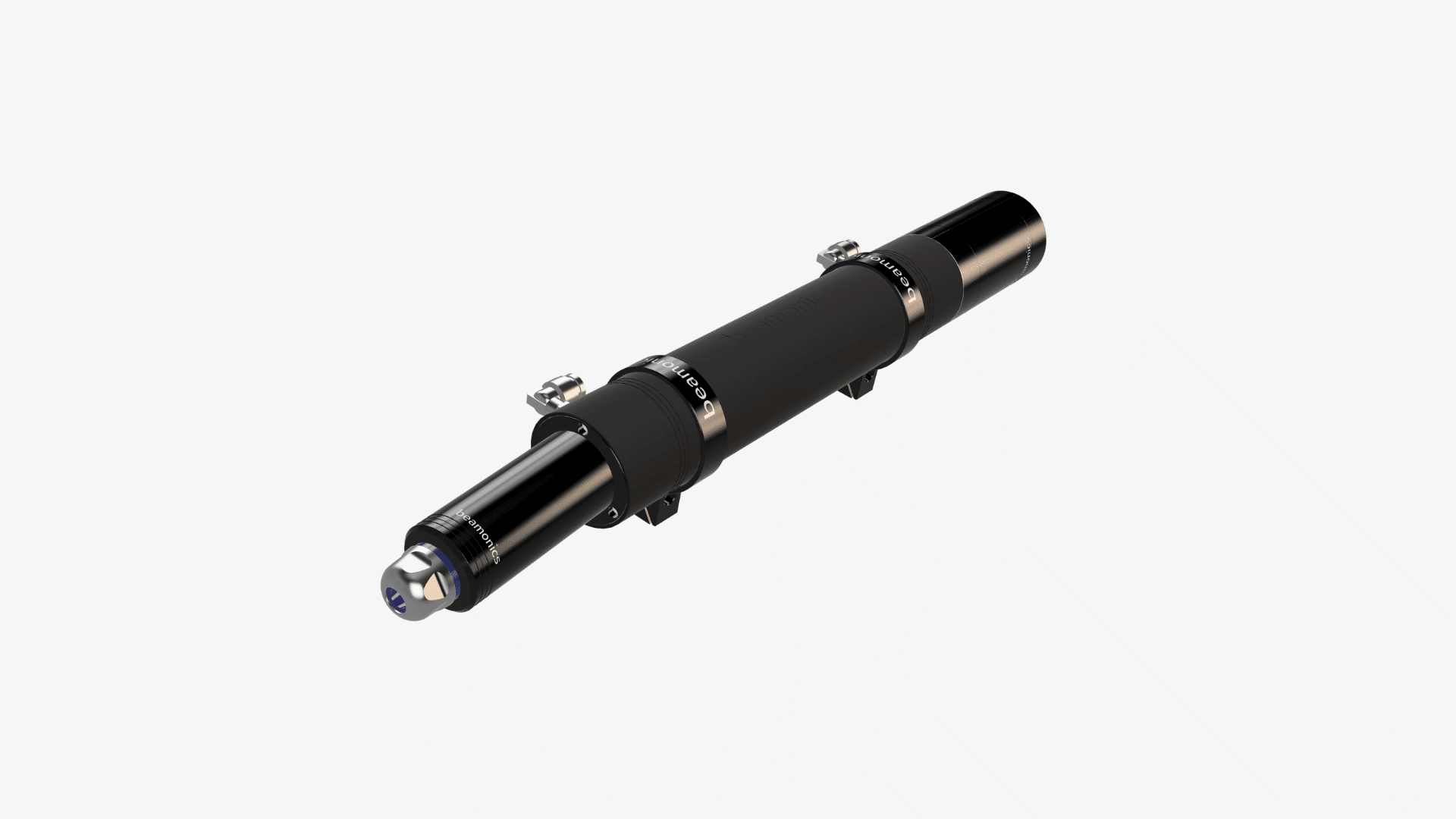
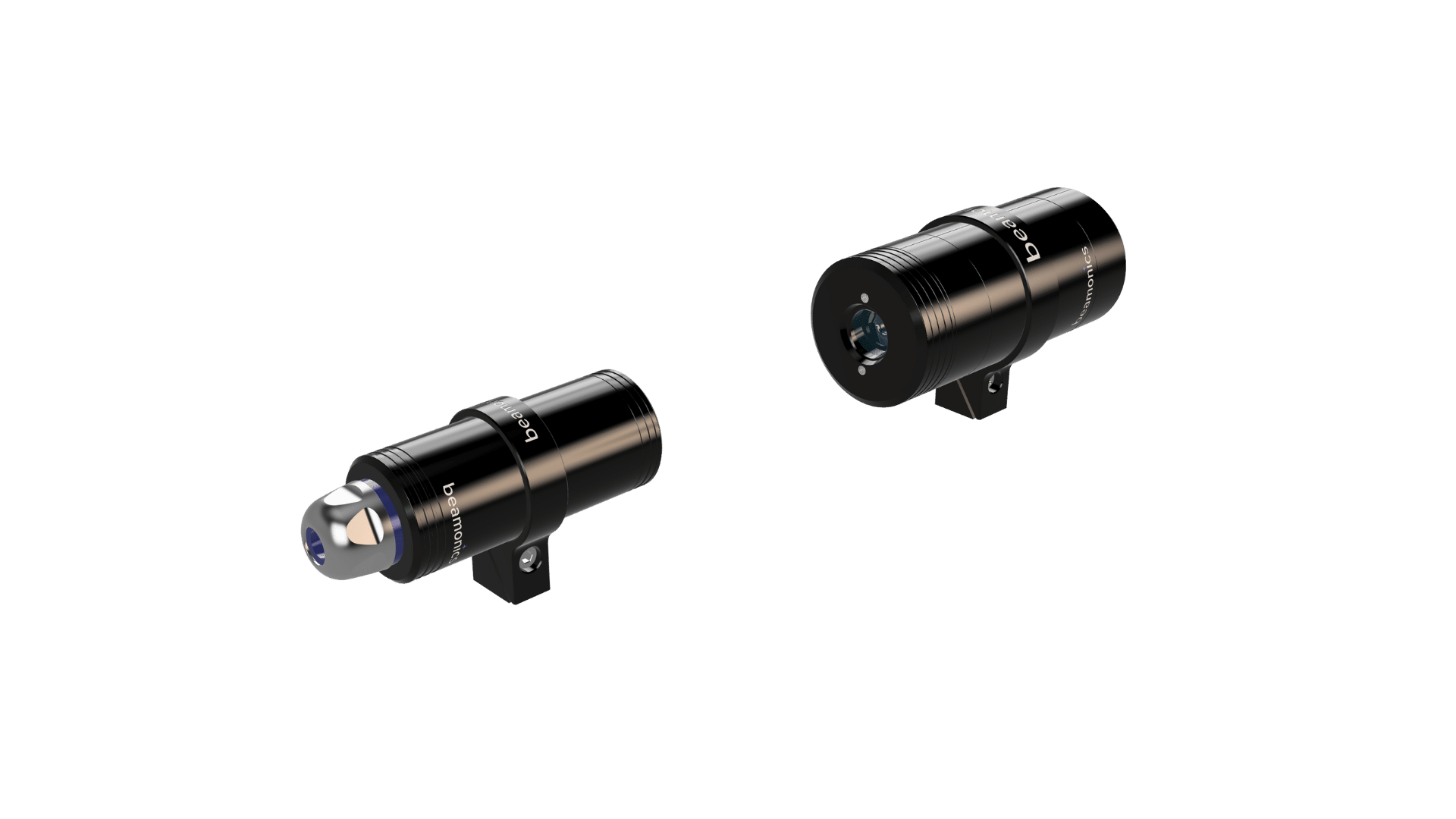
Response times are determined by the laser scan rate, not by chemical reaction kinetics or diffusion. T90 values of one to two seconds are typical, with sub-second performance achievable in optimized configurations. The Beamonics BM-H-3 platform, for example, supports analysis rates up to 10 kHz and achieves precision down to 0.01 ppm for HF at a 1 m path length (BeamStack configuration) or 0.05 ppm at 0.2 m (BeamCell extractive configuration).
The limitation is that TDLAS measures one gas species per laser channel. Measuring multiple gases requires multiple laser channels or sequential switching, which adds cost and complexity. TDLAS is a specialist: it measures what it is configured to measure, and it measures it very well.
How Raman spectroscopy measures gas composition
Raman spectroscopy is based on inelastic scattering of light. When a laser beam (typically in the visible or near-UV range) interacts with gas molecules, a small fraction of photons scatter at a shifted wavelength. The magnitude of this wavelength shift, called the Raman shift, depends on the vibrational and rotational energy levels of the molecule. Each gas species produces a characteristic pattern of shifted wavelengths, forming a spectral fingerprint.
The key advantage of this principle is that a single laser excitation can produce Raman-shifted signals from every molecular species present in the sample simultaneously. A broadband spectrometer captures all the shifted wavelengths at once, enabling identification and quantification of multiple gases from one measurement.
The key disadvantage is that Raman scattering is an inherently weak effect. Only roughly one in every 10⁷ to 10⁸ photons undergoes Raman scattering. This makes the technique far less sensitive than absorption-based methods. Typical detection limits for Raman gas analysis fall in the low ppm range under favorable conditions, compared to ppb-level sensitivity for TDLAS. Achieving even ppm-level performance usually requires high laser power (hundreds of milliwatts to several watts), long integration times, or multi-pass optical cells to increase signal strength.
Response times are correspondingly slower. Where TDLAS delivers continuous readings at sub-second to low-second intervals, Raman systems often require integration times of several seconds to tens of seconds, depending on the target concentration and required signal-to-noise ratio.
Practical comparison
| Parameter | TDLAS | Raman spectroscopy |
|---|---|---|
| Physical principle | Molecular absorption (Beer-Lambert law) | Inelastic light scattering (Raman effect) |
| Sensitivity | ppb-level (e.g., 0.01 ppm HF at 1 m path) | Low ppm range typical |
| Selectivity | Very high; targets single molecular absorption line | Broad; identifies multiple species simultaneously |
| Response time | ~1–2 s typical; sub-second achievable | Seconds to tens of seconds |
| Multi-gas capability | One species per laser channel | Multiple species per measurement |
| Calibration | Factory-calibrated, self-referencing | Requires periodic calibration against reference mixtures |
| Laser requirements | Low-power diode laser (mW range), infrared | High-power laser (hundreds of mW to W), typically visible/UV |
| Cross-interference | Negligible by design | Possible from fluorescence or overlapping Raman bands |
| Typical deployment | Industrial process control, safety monitoring, emissions compliance | Laboratory gas analysis, multi-component process streams, research |
Where TDLAS is the stronger choice
TDLAS is better suited to applications that require trace-level sensitivity for a specific gas, fast response for real-time process control or safety alarms, and long-term unattended operation with minimal maintenance.
Typical examples include HF monitoring in aluminum smelting, where concentrations must be tracked at sub-ppm levels in chemically aggressive flue gas. Leak detection for CH₄ or H₂S at pipeline infrastructure, where response speed determines whether a release is caught. Combustion optimization through real-time CO and O₂ measurement in furnace exhaust. Semiconductor fabrication, where trace HF or NH₃ contamination at ppb levels can compromise wafer quality.
In these cases, the measurement problem is well-defined: one or two target species at low concentrations, measured continuously, with reliability over months or years of unattended operation. TDLAS addresses this directly.
Where Raman spectroscopy is the stronger choice
Raman spectroscopy is better suited to applications that require compositional analysis of gas mixtures where multiple species must be identified and quantified from a single sample.
Typical examples include natural gas quality analysis, where the relative proportions of CH₄, C₂H₆, C₃H₈, CO₂, N₂, and other components determine calorific value. Biogas composition monitoring, where CH₄ and CO₂ ratios vary with feedstock and digester conditions. Research applications involving complex or unknown gas mixtures where the target species may not be predetermined. Pharmaceutical process monitoring where multiple gaseous species must be tracked simultaneously.
In these cases, the measurement problem is broad rather than deep: knowing the full composition matters more than achieving the lowest possible detection limit for any single component. Raman spectroscopy’s ability to capture a complete spectral fingerprint in one measurement is a structural advantage that TDLAS, with its single-species-per-channel architecture, cannot match without significant hardware expansion.
Considerations and limitations
TDLAS requires a separate laser channel for each target gas. For applications needing five or more species simultaneously, the cost and complexity of a multi-channel TDLAS system may become impractical compared to a single Raman analyzer. TDLAS also measures along a defined optical path, which means the measurement geometry must be compatible with the installation: in-situ cross-stack, extractive cell, or remote stand-off, depending on the instrument configuration.
Raman spectroscopy’s low scattering efficiency limits its usefulness for trace gas detection. Applications requiring ppb-level sensitivity or fast alarm response are outside its practical operating envelope. High-power lasers generate heat and may pose safety considerations in explosive or flammable atmospheres. Fluorescence from particulates, aerosols, or certain molecular species can interfere with Raman signals, complicating measurements in dirty or complex process environments. Calibration against reference gas mixtures is required periodically, as the technique does not have the inherent self-referencing property of absorption spectroscopy.
Complementary rather than competing
TDLAS and Raman spectroscopy answer different questions about a gas stream. TDLAS answers “how much of this specific gas is present, right now, at trace levels?” Raman spectroscopy answers “what gases are in this mixture, and in what proportions?” Framing the selection as a competition between the two technologies misses the point. The measurement requirement determines which physical principle is appropriate, and in some facilities both methods may be deployed in different parts of the same process.
Related links:
- BeamStack (BM-H-3): Cross-stack and open-path TDLAS analyzer
- BeamCell (BM-H-3): Extractive flow-through TDLAS analyzer
- BeamSight (BM-V-2): Remote stand-off TDLAS analyzer
- TDLAS vs. electrochemical and catalytic bead gas detectors